
Your cart
Choose your Location
-
Bintel Glebe
Usually ready for pickup in 24 hours
Bintel 84 Wentworth park road, Glebe, 2073, NSW
Phone:(02) 9518 7255
Hours:
Monday9:30 am–5:30 pm
Tuesday9:30 am–5:30 pm
Wednesday9:30 am–5:30 pm
Thursday9:30 am–5:30 pm
Friday9:30 am–5:30 pm
Saturday9:30 am–4 pm
SundayClosed
Professional Observatory Telescopes
Observatory-grade and professional telescopes for advanced astronomers, researchers and educational institutions. This range covers large-aperture optical tubes built for permanent observatories and high-resolution work, where tracking accuracy and optical quality matter most.
Ritchey-Chretien, CDK and astrograph telescopes
Most scopes here are imaging-first designs. Ritchey-Chretien (RC) and CDK astrographs deliver flat, well-corrected fields for deep-sky astrophotography, while large-aperture reflectors suit high-resolution planetary and research imaging. If you are building a serious astrograph setup in Australia, this is the place to start.
Looking for Professional Observatory Telescopes? We stock a range online and ship from Sydney to anywhere in Australia or New Zealand, with Australian warranty and expert advice from astronomers who use this gear themselves.
After something more general? Browse our full range of telescopes, or start with beginner telescopes if you are new to the hobby.
30 products
30 products
Sort by:
- Featured
- Most relevant
- Best selling
- Alphabetically, A-Z
- Alphabetically, Z-A
- Price, low to high
- Price, high to low
- Date, old to new
- Date, new to old


$68,999.00
CDK20’s Key Features
Large Aperture and Moderate Focal Ratio
The CDK20 f/6.8 features a significant 508 mm aperture and an f/6.8 focal ratio. This combination provides excellent light-gathering capabilities and a wide field of view, enhancing its ability to capture detailed images of deep-sky objects for astrophotography and research purposes.
Advanced Optical Design
Equipped with a state-of-the-art Corrected Dall-Kirkham optical system, the CDK20 offers unmatched image clarity. It eliminates off-axis coma and astigmatism and provides a perfectly flat field, ensuring images are crisp and detailed across the entire field of view, requiring minimal post-processing.
Robust Mechanical Structure
Built with a carbon fiber optical tube, the CDK20 is both durable and lightweight. Its design minimizes thermal expansion, ensuring minimal focus shift with temperature changes, which is ideal for extended observing sessions under diverse environmental conditions.
High-Performance Mirrors and Coatings
Utilizing fused silica mirrors, the CDK20 maintains precise optical alignment and exceptional surface accuracy, even during temperature fluctuations. The high-quality coatings improve light transmission and reduce stray light, optimizing the telescope's performance for specialized observational tasks.
Thermal Management
The CDK20 has cooling fans and a Delta-T ready system to achieve thermal equilibrium swiftly. These features help reduce air turbulence within the tube, thus minimizing image distortion and maintaining consistent imaging quality.
Integrated Dew Control
The telescope includes advanced dew prevention technology with heater pads controlled by PlaneWave’s software. This ensures optical surfaces remain free from condensation in humid conditions, thus maintaining clear and consistent imaging performance.
Application-Specific Benefits
Astrophotography
With its large image circle and exceptional field flatness, the CDK20 allows astrophotographers to capture expansive and breathtaking views of the cosmos with incredible detail and clarity.
Astronomy Research
The stable and precise imaging capabilities of the CDK20 make it an invaluable asset for academic institutions and observatories engaged in sophisticated astronomical research, including deep-sky surveys and detailed photometric studies.
Visual Observations
The CDK20 excels in visual observation, providing bright and clear views ideal for star parties and serious visual astronomy. Its large aperture and superior optical quality deliver stunning views of planetary, lunar, and deep-sky objects, making every viewing session a memorable experience. Here's the updated article adapted for the CDK17 based on the features and specifications from the provided product page:
Space Situational Awareness (SSA) and Space Domain Awareness (SDA)
The CDK20 also lends itself to Space Situational Awareness and Space Domain Awareness applications. Its capability to provide detailed observations can be essential for tracking and monitoring satellites and other space debris, contributing valuable data for space traffic management and safety initiatives.
Optical Systems
| Aperture | 508mm (20") |
| Focal Length | 3454mm (136") |
| Focal Ratio | f/6.8 |
| Central Obstruction | 39% of the Primary Mirror Diameter |
| Back Focus From Mounting Surface | 224 mm (8.81") |
| Weight | 140 lbs (63.5 kg) |
| OTA Length | 1194 mm (47") |
| Optical Design Performance | 1.5-micron RMS on-axis, 3.8-micron RMS at 12 mm off-axis, 6.0-micron at 21 mm off-axis |
| Upper Cage | Carbon fiber truss |
| Lower Cage | Carbon fiber truss and light shroud |
| Image Circle Size | 52mm |
Secondary Mirror
| Diameter | 191 mm (7.5") |
| Material | Fused silica (quartz) |
| Shape | Spherical |
| Coating | Enhanced Aluminum - 96% |
Lens Group
| Diameter | 90mm (3.54") |
| Coating | Broadband AR Coatings (less than .5% reflected from 400 to 700 nm) |
Primary Mirror
| Optical Diameter | 508 mm (20") |
| Outer Diameter | 521 mm (20.5") |
| Shape | Prolate Ellipsoid |
| Material | Fused Silica (quartz) |
| Coating | Enhanced Aluminum - 96% |
| Included Items | Heating Elements for Dew Prevention - The heating pads on the primary and secondary mirror require the 600195 Delta-T controller sold separately |
| Flashdrive - Contains software and instructions for collimation and spacing the primary to secondary mirror |


$31,049.00
PlaneWave L350 Direct Drive Mount
The L-Series combines versatility, simplicity and affordability by combining all the technology of our Observatory class telescopes into a compact stand-alone mount. In its Alt/Az configuration it is considerably more compact than its equatorial counterpart, allowing a larger telescope to fit in a smaller enclosure. Unlike German Equatorial mounts, there are no meridian flips to deal with, and no large protruding counterweights to create a dangerous hazard in a public observatory. Alt/Az is more intuitive to use and no polar alignment is needed. Besides, it is the way the pros do it!
L-Series Mounts Features:
- Direct-drive motors on each axis for smooth, fast, and virtually silent movement of the telescope
- Slew speeds up to 50 degrees per second
- High resolution encoders on each axis for precise positioning
- Zero backlash
- Zero periodic error
- PointXP mount modeling software
- Enclosed electronics
- Through the mount cabling
FEATURES:
| Direct drive motors and encoders | Direct Drive motors and on-axis encoders eliminate the need for gears, thereby eliminating backlash and periodic error. With high-resolution encoders providing the feedback for the direct drive motors, not only will the telescope track without periodic error and backlash, the mount will also counter wind gusts with precise servo feedback. | |
| Incredible Slew Speed | The direct drive motors can move the telescope at speeds up to 50 degrees per second for tracking satellites or just to minimize target acquisition time. | |
| Dual mounting bracket | PlaneWave style mounting bracket to hold CDK17/20 onto inside of fork arm with additional option of mounting a scope on the outside of the fork arm. Optional dovetail clamp required. | |
| Azimuth balance system | For precise center of gravity balance whether in Alt-Az or Equatorial configuration | |
| Through the mount cabling | Access panels in the fork arm and azimuth axis allow for camera equipment cabling through the inside of the mount. | |
| Proven CDK700/PW1000 Technology | The L-Series uses the same proven technology as the CDK700 and 1-Meter PW1000 which are being used in Universities round the world. |
MOUNT SYSTEM
| Type | Alt-Azimuth / Equatorial Direct Drive Mount |
| Weight | 110 lbs (50 kg) |
| Max. Load Capacity | 100 lbs (45 kg) |
| Latitude Range | 0 to 90 degrees, Northern and Southern hemispheres |
| Cable Management | Equipment cables can be wired through mount |
CONTROL SYSTEM
| Control Electronics | PlaneWave Interface dual axis telescope control |
| User Interface | PlaneWave Interface 4 (PWI4) Control Software with integrated PointXP mount modeling software |
| Homing Sensors | Home position sensors are included allowing the mount can find its home position on power up. |
| Slew Rate | 20 degrees per second (standard); 50 degrees per second (maximum), both axes |
| Power Requirement | Accepts 120 VAC. Supplied with 12VDC 15A Regulated Power Adapter |
MOTION CONTROL
| Motor Control | Industrial grade brushless motor control system and built in electronics |
| Motor - Azimuth and Altitude | Direct Drive 3 Phase Axial-Flux Torque Motors |
| Encoder - Azimuth and Altitude | 152mm disk built into the azimuth and altitude axes with stainless steel encoder on the circumference with reader yields 18,880,000 counts per revolution of the telescope. This translates to about 0.069 arcsecond resolution |
| Motor Torque | Approximately 20 ft-lbs continuous; 50 ft-lbs peak |
| Drive Electronics | Industrial grade, off-the-shelf brushless motor drives for each axis with custom designed interface card |
| Telescope Control Software | PlaneWave Interface (PWI4). Incorporates PointXP mount modeling software by Dave Rowe All ASCOM compatible. |
SYSTEM PERFORMANCE
| Pointing Accuracy | <10 arcsecond RMS with PointXP Model |
| Pointing Precision | 2 arcsecond |
| Tracking Accuracy | < .3 arcsecond error over 5 minute period |
| System Natural Frequency | 10 Hz or greater |
Price is ex Store
Check the PlaneWave website for Instructions and Schematics.


From $22,860.00
Introducing the new Paramount MX Series 6 transportable observatory.
The Paramount MX Series 6 represents the latest in gear-driven GEM performance.
Its new features include a 25% instrument capacity increase, an option for absolute digital encoders, and multiple connectivity options.
The MX German equatorial mount has always been a popular Paramount model and the new Paramount MX Series 6 offers several important improvements.
On-axis Absolute Encoders vs. Motor-based Encoders.
Paramount's equipped with on-axis absolute encoders know where they are at all times. Paramount's with incremental encoders (or motor-based encoders) know only how far they have moved since they were initialized using a nightly process called homing.
The crucial additional difference is that the on-axis absolute encoders are fitted directly to the mount axes themselves, bypassing the worm drives. Paramount's with incremental encoders are fitted to the worms instead, which means that with incremental encoders alone, periodic errors in the worm drive show up in the tracking. These mounts must be calibrated and corrected using a process called periodic error correction (PEC), which measures and records the repeatable gear train errors and removes them. (TheSky features advanced, multi-harmonic PE detection and PEC calibration that minimizes periodic error in mounts with incremental encoders.)
For mounts with incremental encoders, homing re-zeros the encoders when precise sensors on each of the axes are reached. From then on, the incremental encoders are in effect delivering absolute readings.
However, the crucial additional difference remains, namely that the incremental encoder system is behind the worm drive, and periodic error correction is still required to get the best out of the RA tracking.
High-resolution on-axis absolute encoder technology is significantly more expensive than incremental encoders.
Are on-axis absolute encoders right for me ?
The short answer is, “it depends.”
Gear-driven Paramounts equipped with on-axis absolute encoders do not have periodic error, require no mechanical initialization (or homing), and the number of TPoint pointing samples needed for precision calibration is reduced.
These advantages expedite nightly setup, negate one-time periodic error training, and shorten the calibration process require to achieve spectacular pointing and tracking performance. However, the Paramount worm gear's uncorrected periodic error is low (below 7 arc seconds peak to peak), and, after a one-time PE training, periodic error correction (PEC) generally make it negligible. The Paramount without on-axis absolute encoders requires a nightly Find Home process that usually takes a minute or less to complete.
So, at least with Paramounts, periodic error is effectively in the noise, and homing straightforward.
What about pointing and tracking?
Without on-axis absolute encoders, Paramounts routinely produce 5-to-10-minute unguided exposures; many have reported 20 minutes. Also without on-axis absolute encoders, Paramount’s produce all-sky pointing accuracies at or below 30 arcseconds RMS (usually less than 15 arcseconds on fixed mirror telescopes).
Paramount’s exceptional software makes the above performance possible. TheSky Professional edition, in conjunction with TPoint™ and ProTrack™ the mount’s position is continually updated in both axes to correct system-wide pointing and tracking errors caused by tube flexure, atmospheric refraction, polar misalignment, harmonic errors from mis-centered encoders and/or worm gears, and more.
On-axis absolute encoders alone cannot correct these errors which exist with all telescopes. A properly applied telescope model is necessary to achieve superior pointing and tracking.
So are on-axis absolute encoders right for you? Perhaps if you want to enjoy the conveniences mentioned above. And for many, that’s enough. With that said, the optional on-axis 26-bit Renishaw absolute encoders with 0.02 arc second precision are the finest available and they operate in temperatures between +80°C and –40°C.
Hardware Specifications
- 56 kg instrument capacity; 113 kg maximum payload capacity (instruments + counterweights)
- All sky pointing accuracies at or below 30 arcseconds RMS (see Software Specifications below for details)
- Unibody mount design weighs 24 kg without counterweights or counterweight shaft
- Maximum seven (7) arcseconds peak-to-peak periodic error before correction
- After a one-time training, periodic error is 1 arcsecond, peak-to-peak or less
- Optional 26-bit Renishaw encoders eliminate periodic error and the need for homing; operates in temps as low as –40° C
- If you skip encoders now and later decide you want them, they can be retrofitted on the Paramount MX Series 6
- As there’s some confusion about what encoders can and cannot do, there’s an FAQ below that elaborates on that and whether they’re right for you
- Its encoder cables are located inside the mount to help prevent snags.
- All electronics and through-the-mount cables are housed inside the mount with ample room for additional cables
- Its state-of-the-art MKS 6000 telescope control system (TCS) lets you connect via USB C, Ethernet, and Wi-Fi
- Two-port USB 2.0 hub located on the instrument panel
- Redesigned Versa-Plate™ (included) accepts most telescopes and makes mounting them a breeze
- 48V DC power supply and PC-to-mount USB and Ethernet cables included
- Two 9 kg counterweights are included which can balance 18-22 kg. You may need more for heavier payloads.
- Belt-driven gears with spring loaded worm gears produce virtually zero backlash
- Durable and fade-resistant red powder coating and black anodized finish; components are aluminum
- Clutch-free design helps maintain its TPoint™ assisted pointing accuracy
- AutoHome™ homing capability ensures the mount always knows its orientation (after performing an initializing process called “homing” that typically takes less than a minute)
- Calibrated azimuth and elevation polar alignment adjustments speed polar alignment
Software Specifications
- Paramount’s unequaled pointing and tracking wouldn’t be possible without its TPoint™ and ProTrack™ software.
- By employing TPoint’s calibration and telescope modeling tools, you’ll enjoy all sky pointing accuracies at or below 30 arcseconds RMS.
- Operating in conjunction with TPoint ™, ProTrack™ continuously updates the mount’s position across both axes to correct system-wide tracking errors including tube flexures, atmospheric refraction, polar misalignment, harmonic errors from mis-centered encoders, and more.
- On-axis absolute encoders alone cannot correct these errors which exist with all telescopes. A properly applied telescope model is necessary to achieve superior tracking.
- Without encoders, Paramounts can deliver uncommonly long unguided exposures (one customer reported 20 minutes).
- For more information about what encoders can and cannot do, please see the FAQ below.
- All the included software is integrated into a single, easy-to-use, application consisting of TheSky™ Professional, TPoint™, Cameras+, Domes, Multi-OS+, and Weather modules.
- You can control all your astrophotography-related cameras and devices with this one app.
- It runs on macOS™, Windows™, Ubuntu™, and Linux (x86_64 and ARM64 architectures).
- Regardless of the operating system you run it on, it appears and operates identically. You can even switch between operating systems and its license allows up to six computers. Why paint yourself or your institution into a corner?
- Absent ProTrack™ which is unique to Paramounts, the included software is sold separately as TheSky™ Universal Bundle and represents a US$1,095 value.
SKU: SB-10613
Optional Black Anodised available on request

From $16,370.00
The Paramount MYT Series 6 delivers exceptional performance made possible through its artful integration of precision mechanics, advanced control system electronics, and the uniquely capable Paramount Software Suite (included).
Skillfully carrying up to 32 kg of telescopes, cameras, and accessories, the Paramount MYT can help you create your next astrophoto masterpiece, at home, or on the go.
New features include:
- All new MKS 6000 offers built-in Ethernet, USB-C and Wi-Fi communication options and more.
- Optional Power On and Observe™ on-axis absolute encoder technology. No homing required and no periodic error.
- High-amperage XT60 connectors can supply continuous 12V DC power up to 60A.
- Improved Versa-Plate dovetail features drop-in telescope installation.
- Increased capacity: up to 32 kg of instrumentation, 64 kg with counterweights.
- Streamlined Instrument Panel provides pass through Ethernet connection and 3 XT60 power ports.
- Red components are powder coated aluminium for fade-resistant durability, black components anodized aluminium.
Introducing the new Paramount MYT Series 6 portable observatory.
Its new features include a 40% instrument capacity increase, an option for absolute digital encoders, and multiple connectivity options.
Being the lightest of all the Paramounts, the Paramount MYT Series 6 is the ultimate grab-and-go observatory.
On-axis Absolute Encoders vs. Motor-based Encoders.
Paramount's equipped with on-axis absolute encoders know where they are at all times. Paramount's with incremental encoders (or motor-based encoders) know only how far they have moved since they were initialized using a nightly process called homing.
The crucial additional difference is that the on-axis absolute encoders are fitted directly to the mount axes themselves, bypassing the worm drives. Paramount's with incremental encoders are fitted to the worms instead, which means that with incremental encoders alone, periodic errors in the worm drive show up in the tracking. These mounts must be calibrated and corrected using a process called periodic error correction (PEC), which measures and records the repeatable gear train errors and removes them. (TheSky features advanced, multi-harmonic PE detection and PEC calibration that minimizes periodic error in mounts with incremental encoders.)
For mounts with incremental encoders, homing re-zeros the encoders when precise sensors on each of the axes are reached. From then on, the incremental encoders are in effect delivering absolute readings.
However, the crucial additional difference remains, namely that the incremental encoder system is behind the worm drive, and periodic error correction is still required to get the best out of the RA tracking.
High-resolution on-axis absolute encoder technology is significantly more expensive than incremental encoders.
Are on-axis absolute encoders right for me ?
The short answer is, “it depends.”
Gear-driven Paramounts equipped with on-axis absolute encoders do not have periodic error, require no mechanical initialization (or homing), and the number of TPoint pointing samples needed for precision calibration is reduced.
These advantages expedite nightly setup, negate one-time periodic error training, and shorten the calibration process require to achieve spectacular pointing and tracking performance. However, the Paramount worm gear's uncorrected periodic error is low (below 7 arc seconds peak to peak), and, after a one-time PE training, periodic error correction (PEC) generally make it negligible. The Paramount without on-axis absolute encoders requires a nightly Find Home process that usually takes a minute or less to complete.
So, at least with Paramounts, periodic error is effectively in the noise, and homing straightforward.
What about pointing and tracking?
Without on-axis absolute encoders, Paramounts routinely produce 5-to-10-minute unguided exposures; many have reported 20 minutes. Also without on-axis absolute encoders, Paramount’s produce all-sky pointing accuracies at or below 30 arcseconds RMS (usually less than 15 arcseconds on fixed mirror telescopes).
Paramount’s exceptional software makes the above performance possible. TheSky Professional edition, in conjunction with TPoint™ and ProTrack™ the mount’s position is continually updated in both axes to correct system-wide pointing and tracking errors caused by tube flexure, atmospheric refraction, polar misalignment, harmonic errors from mis-centered encoders and/or worm gears, and more.
On-axis absolute encoders alone cannot correct these errors which exist with all telescopes. A properly applied telescope model is necessary to achieve superior pointing and tracking.
So are on-axis absolute encoders right for you? Perhaps if you want to enjoy the conveniences mentioned above. And for many, that’s enough. With that said, the optional on-axis 26-bit Renishaw absolute encoders with 0.02 arc second precision are the finest available and they operate in temperatures between +80°C and –40°C.
Hardware Specifications
- 32 kg instrument capacity; 64 kg maximum payload capacity (instruments + counterweights)
- All sky pointing accuracies at or below 30 arcseconds RMS (see Software Specifications below for details)
- Unibody mount design weighs 16 kg without counterweights or counterweight shaft
- Maximum seven (7) arcseconds peak-to-peak periodic error before correction
- After a one-time training, periodic error is 1 arcsecond, peak-to-peak or less
- Optional 26-bit Renishaw encoders eliminate periodic error and the need for homing; operates in temps as low as –40° C
- If you skip encoders now and later decide you want them, they can be retrofitted on Series 6 Paramounts
- As there’s some confusion about what encoders can and cannot do, there’s an FAQ below that elaborates on that and whether they’re right for you
- Its encoder cables are located inside the mount to help prevent snags.
- All electronics and through-the-mount cables are housed inside the mount with ample room for additional cables
- Its state-of-the-art MKS 6000 telescope control system (TCS) lets you connect via USB C, Ethernet, and Wi-Fi
- Two-port USB 2.0 hub located on the instrument panel
- Redesigned Versa-Plate™ (included) accepts most telescopes and makes mounting them a breeze
- 48V DC power supply and PC-to-mount USB and Ethernet cables included
- 9 kg counterweight included and can balance 9 kg. You may need to purchase more for heavier payloads.
- Belt-driven gears with spring-loaded worm gears produce virtually zero backlash
- Durable and fade-resistant red powder coating and black anodized finish; components are aluminium
- Clutch-free design helps maintain its TPoint™ assisted pointing accuracy
- AutoHome™ homing capability ensures the mount always knows its orientation (after performing an initializing process called “homing” that typically takes less a minute or less)
- Calibrated azimuth and elevation polar alignment adjustments speed polar alignment
Software Specifications
- Paramount’s unequaled pointing and tracking wouldn’t be possible without its TPoint™ and ProTrack™ software.
- By employing TPoint’s calibration and telescope modeling tools, you’ll enjoy all-sky pointing accuracies at or below 30 arcseconds RMS. Nothing outperforms that.
- Operating in conjunction with TPoint ™, ProTrack™ continuously updates the mount’s position across both axes to correct system-wide tracking errors including tube flexures, atmospheric refraction, polar misalignment, harmonic errors from mis-centered encoders, and more.
- On-axis absolute encoders alone cannot correct these errors which exist with all telescopes. A properly applied telescope model is necessary to achieve superior tracking.
- Without encoders, Paramounts can deliver uncommonly long unguided exposures (one customer reported 20 minutes).
- For more information about what encoders can and cannot do, please see the FAQ below.
- All the included software is integrated into a single, easy-to-use, application consisting of TheSky™ Professional, TPoint™, Cameras+, Domes, Multi-OS+, and Weather modules.
- You can control all your astrophotography-related cameras and devices with this one app.
- It runs on macOS™, Windows™, Ubuntu™, and Linux (x86_64 and ARM64 architectures.
- Regardless of the operating system you run it on, it appears and operates identically. You can even switch between operating systems and its license allows up to six computers. Why paint yourself or your institution into a corner?
- Absent ProTrack™ which is unique to Paramount, the included software is sold separately as TheSky™ Universal Bundle and represents a $1,095 value.
SKU: SB-10610
Optional Black Annodised mount available on request

$61,199.00
The CDK350 Observatory System from PlaneWave Instruments is a premium setup designed for the astrophotography aficionado and the dedicated astronomy researcher. This system marries the high-performing CDK14 optical tube assembly with the robust L-350 direct-drive mount, creating an unmatched observational platform that excels across a spectrum of applications, from deep celestial studies to sophisticated astrophotography
Key Features of the CDK350 Observatory System
CDK14 Optical Tube Assembly
- Aperture and Focal Length: Boasts a 14-inch aperture and a 2563 mm focal length at an f/7.2 focal ratio, ideal for capturing wide-field views of the cosmos with incredible depth and clarity.
- Advanced Optical Design: Features a Corrected Dall-Kirkham optical design, providing a field free of off-axis coma and astigmatism while achieving a perfectly flat field across a 70 mm image circle, ensuring critically sharp images throughout the entire field.
- High-Quality Construction: Constructed from lightweight yet durable carbon fiber, minimizing thermal expansion and allowing for rapid thermal equilibration, which helps maintain optical precision in fluctuating temperatures.
- Superior Mirrors and Coatings: Fitted with rock-solid fused silica mirrors known for their minimal thermal expansion, paired with premium coatings that enhance light throughput while minimizing stray light for optimal image quality.
- Thermal Management: Integrates an advanced cooling system with multiple fans that promote rapid thermal stabilization, essential for maintaining consistent high-quality imaging during lengthy exposures and minimizing focus shifts caused by temperature variations.
L-350 Direct Drive Mount
- Direct Drive Motors: Features sophisticated direct-drive motors on each axis, ensuring smooth, swift, and near-silent movement of the telescope with zero backlash and zero periodic error, perfect for both tracking celestial objects and quick repositioning.
- High-Resolution Encoders: Comes equipped with high-resolution optical encoders on both axes, delivering precise positioning and movement, which is critical for high-quality astrophotography and detailed celestial research.
- Azimuth Dovetail Balance System: Includes a finely adjustable balance system that enhances the stability and performance of the setup in both alt-azimuth and equatorial configurations, critical for sustained accurate tracking and easing the strain on the mount during prolonged observations.
- Rapid Target Acquisition: Boasts direct-drive motors capable of impressive slew speeds up to 50 degrees per second, allowing for quick and efficient targeting of celestial objects and satellites, vital for dynamic observations and responsive astrophotography.
Application-Specific Advantages
Astrophotography
The CDK350 is a powerhouse for astrophotographers, offering exceptional tracking accuracy and image stability which facilitate capturing breathtaking celestial images with intricate details and vibrant colors.
Astronomy Research
Researchers will find the CDK350 invaluable for its consistent performance and precise data collection capabilities. It serves as a reliable platform for photometry, spectroscopy, and minor planet tracking, providing a robust foundation for scientific exploration and discovery.
Visual Observations
For enthusiasts of visual astronomy, the CDK350 delivers vibrant and detailed views of the universe. Its substantial aperture and high-quality optical components ensure superb viewing of planetary, lunar, and deep-sky objects, enhancing every observational session.
Space Situational Awareness (SSA) and Space Domain Awareness (SDA)
With its swift and precise repositioning capabilities, the L-350 mount in the CDK350 system is capable of tracking satellites and space debris. However, it's important to note that while the L-series mounts are highly effective for astrophotography and research applications, they might not meet the optimal performance standards required for dedicated SSA/SDA operations. For those needs, we recommend exploring our T-600 Direct-Drive Gimbal, specifically engineered to exceed the demanding requirements for SSA/SDA applications, ensuring superior tracking and responsiveness in monitoring and cataloging space objects.
Mount System
| Mount Weight | 50kg (110 lbs) |
| Max. Load Capacity | 45 kg (100 lbs) |
| Latitude Range | 0 to 90 degrees, Northern and Southern hemispheres |
| Cable Management | Equipment cables can be wired through mount |
Control system
| Control Electronics | PlaneWave Interface dual axis telescope control |
| User Interface | PlaneWave Interface 4 (PWI4) Control Software with integrated PointXP mount modeling software |
| Homing Sensors | Home position sensors are included allowing the mount to find its home position on power up. |
| Slew Rate | 20 degrees per second (standard); 50 degrees per second (maximum), both axes |
| Power Requirement | Accepts 120 to 240 VAC. Supplied with 120 VAC 15A IEC Type B Regulated Power Adapter |
Optical Systems
| Aperture | 356mm (14") |
| Focal Length | 2563 mm (101") |
| Focal Ratio | f/7.2 |
| Central Obstruction | 23.5% by surface area; 48.5% of the Primary Mirror Diameter |
| Back Focus | 282 mm (11.09") |
| Weight | 22 kg (48 lbs) |
| Optimal Field of View | 52 mm Image Circle |
Mechanical Structure
| Fork Assembly | L-350 Mount |
| Fork Base | Welded stainless steel torsion box |
| Optical Tube | Carbon fiber truss and light shroud |
| Instrument Payload | 45 kg (100 lbs) |
Motion control
| Motor – Azimuth and Altitude | Direct Drive 3 Phase Axial-Flux Torque Motors |
| Encoder – Azimuth and Altitude | 152mm stainless steel encoder ring with reader built into the azimuth and altitude axes. 18,880,000 counts per revolution (0.069 arcsecond resolution). |
| Motor Torque | Approximately 20 ft-lbs continuous; 50 ft-lbs peak |
| Drive Electronics | Industrial grade, off-the-shelf brushless motor drives for each axis with custom designed interface card |
| Telescope Control Software | PlaneWave Interface (PWI4). Incorporates PointXP mount modeling software by Dave Rowe. Provides HTTP and ASCOM control interfaces. MaxIm DL is required for camera control when building a pointing model within our PWI4 software. |
Included items
| Heating elements for dew prevention - The heating pads on the primary and secondary mirror require the 600195 Delta-T controller sold separately |
| OTA Cover - To protect the primary mirror and inside of the optical tube |
| Flash drive -Contains PWI4 software for mount control , instructions for installation, software, and instructions for collimation and spacing the primary to secondary mirror |
| Hardware - Six 3/8-16 x 1/4″ socket head cap screws to bolt the mount to the pier, or wedge; Six 3/8-16 x 1/4″ washers; One extended length shoulder bolt for RA axis to EQ wedge alignment |
| One 16′ USB cable - To connect the mount to the observatory control computer |
| One 120VAC power cable - To provide power to the mount |
| Standard Allen Key set - For tightening bolts used on the mount |
| Gamepad - Used for control of the mount tracking speeds for visual observing |
| Keller EZ-Saddle (600182) - The Keller EZ saddle comes standard with the L-350 mount |

$53,499.00
The CDK300 Observatory System from PlaneWave Instruments, an elite configuration designed specifically for the astrophotography enthusiast and serious astronomy researcher. This system combines the precision-engineered CDK12.5 optical tube assembly with the robust L-350 direct-drive mount, offering an unparalleled observational experience that excels in a wide array of applications from detailed celestial studies to advanced astrophotography.
Key Features of the CDK300 Observatory System
CDK12.5 Optical Tube Assembly
- Aperture and Focal Length: Features a 12.5-inch aperture and a 2541 mm focal length at an f/8 focal ratio, perfect for capturing deep-sky objects with exceptional depth of field and clarity.
- Advanced Optical Design: Utilizes a Corrected Dall-Kirkham optical design, eliminating off-axis coma and astigmatism while achieving a perfectly flat field across a 52 mm image circle, ensuring sharp and detailed images across the entire field.
- High-Quality Construction: The optical tube is constructed from lightweight and sturdy carbon fiber, reducing thermal expansion and allowing rapid cooling, which maintains optical alignment in varying temperatures.
- Superior Mirrors and Coatings: Equipped with rock-solid fused silica mirrors known for their low thermal expansion, along with high-quality coatings that maximize light transmission and minimize stray light.
- Thermal Management: Incorporates a sophisticated cooling system featuring three rear cooling fans and four boundary layer fans. This setup rapidly achieves thermal equilibrium, essential for maintaining consistent imaging quality during long exposure astrophotography and reducing thermal-induced focus shifts.
L-350 Direct Drive Mount
- Direct Drive Motors: Employs state-of-the-art direct-drive motors on each axis, providing smooth, fast, and ultra-quiet movement of the telescope with zero backlash and zero periodic error.
- High-Resolution Encoders: Integrated high-resolution encoders offer precise positioning, essential for capturing high-quality astrophotography and conducting detailed astronomical research.
- Azimuth Dovetail Balance System: Provides precise center of gravity adjustments, enhancing the stability and performance of the system in both alt-azimuth and equatorial configurations, crucial for maintaining accurate tracking and reducing strain on the mount during extended observations.
- Azimuth Dovetail Balance System: Provides precise center of gravity adjustments, enhancing the stability and performance of the system in both alt-azimuth and equatorial configurations, crucial for maintaining accurate tracking and reducing strain on the mount during extended observations.
- Rapid Target Acquisition: Equipped with direct-drive motors capable of slew speeds up to 50 degrees per second, enabling quick and efficient targeting of celestial objects and satellites, crucial for dynamic observations and time-sensitive astrophotography.
Application-Specific Advantages
Astrophotography
The CDK300 system is a powerhouse for astrophotographers, providing exceptional tracking accuracy and image stability which allow for capturing breathtaking celestial images with intricate details and vibrant colors.
Astronomy Research
Researchers will find the CDK300 invaluable for its consistent performance and precise data collection capabilities. Ideal for photometry, spectroscopy, and minor planet tracking, it serves as a reliable platform for scientific exploration and discovery.
Visual Observations
For those who enjoy visual astronomy, the CDK300 offers vibrant and detailed views of the cosmos. Its large aperture and high-quality optical components make it perfect for viewing planetary, lunar, and deep-sky objects, enriching every observational session.
Space Situational Awareness (SSA) and Space Domain Awareness (SDA)
With its swift and precise repositioning capabilities, the L-350 mount in the CDK300 system is capable of tracking satellites and space debris. However, it's important to note that while the L-series mounts are highly effective for astrophotography and research applications, they might not meet the optimal performance standards required for dedicated SSA/SDA operations. For those needs, we recommend exploring our T-600 Direct-Drive Gimbal, specifically engineered to exceed the demanding requirements for SSA/SDA applications, ensuring superior tracking and responsiveness in monitoring and cataloging space objects.
Mount System
| Mount Weight | 50kg (110 lbs) |
| Max. Load Capacity | 45 kg (100 lbs) |
| Latitude Range | 0 to 90 degrees, Northern and Southern hemispheres |
| Cable Management | Equipment cables can be wired through mount |
Control System
| Control Electronics | PlaneWave Interface dual axis telescope control |
| User Interface | PlaneWave Interface 4 (PWI4) Control Software with integrated PointXP mount modeling software |
| Homing Sensors | Home position sensors are included allowing the mount to find its home position on power up. |
| Slew Rate | 20 degrees per second (standard); 50 degrees per second (maximum), both axes |
| Power Requirement | Accepts 120 to 240 VAC. Supplied with 120 VAC 15A IEC Type B Regulated Power Adapter |
Optical Systems
| Aperture | 318 mm (12.5 inch) |
| Focal Length | 100.04 inch (2541 mm) |
| Focal Ratio | f/8 |
| Central Obstruction | 42% of the primary mirror diameter |
| Backfocus from Mounting Surface | 265 mm (10.445 inch) |
| Backfocus from Racked in Focuser | 183 mm (7.2 inch) |
| Weight | 19 kg (42 lbs) |
| Optimal Field of View | 52 mm image circle |
Mechanical Structure
| Fork Assembly | L-350 Mount |
| Fork Base | Welded stainless steel torsion box |
| Optical Tube | Carbon fiber |
| Instrument Payload | 45 kg (101 lbs) |
Motion Control
| Motor – Azimuth and Altitude | Direct Drive 3 Phase Axial-Flux Torque Motors |
| Encoder – Azimuth and Altitude | 152mm stainless steel encoder ring with reader built into the azimuth and altitude axes. 18,880,000 counts per revolution (0.069 arcsecond resolution). |
| Motor Torque | Approximately 20 ft-lbs continuous; 50 ft-lbs peak |
| Drive Electronics | Industrial grade, off-the-shelf brushless motor drives for each axis with custom-designed interface card |
| Telescope Control Software | PlaneWave Interface (PWI4). Incorporates PointXP mount modeling software by Dave Rowe. Provides HTTP and ASCOM control interfaces. MaxIm DL is required for camera control when building a pointing model within our PWI4 software. |
Included Items
| Heating elements for dew prevention - The heating pads on the primary and secondary mirror require the 600195 Delta-T controller sold separately |
| OTA Cover - To protect the primary mirror and inside of the optical tube |
| Flash drive - Contains PWI4 software for mount control, instructions for installation, software, and instructions for collimation and spacing the primary to secondary mirror |
| Hardware - Six 3/8-16 x 1/4″ socket head cap screws to bolt the mount to the pier, or wedge; Six 3/8-16 x 1/4″ washers; One extended length shoulder bolt for RA axis to EQ wedge alignment |
| One 16′ USB cable - To connect the mount to the observatory control computer |
| One 120VAC power cable - To provide power to the mount |
| Standard Allen Key set - For tightening bolts used on the mount |
| Gamepad - Used for control of the mount tracking speeds for visual observing |
| Keller EZ-Saddle (600182) - The Keller EZ saddle comes standard with the L-350 mount |
| One 16′ USB cable - To connect the mount to the observatory control computer |

$117,999.00
After successfully introducing the DeltaRho 350, the DeltaRho 500 is now available for transcending the challenges of-ultra wide field imaging. With a primary mirror that is fixed in place, collimation is quickly achieved with a simple adjustment to the tip and tilt of the secondary mirror. With more than twice the light-gathering power of the DeltaRho 350, maximizing the performance of your astrograph has never been easier due to PlaneWave’s pursuit of the perfect telescope!
- Corrected Cassegrain focus optical design
- Aperture – 508 mm (20″)
- Focal length – 1537 mm
- Focal Ratio – f/3.03
- 70mm Image Circle > 2.6 degrees
- Fixed Primary Mirror
- Collimation performed via 3 tip/tilt screws at the secondary mirror
- 9.166” (232.8 mm) from mounting surface (without focuser and rotator).
- Backfocus of 5.81″ (147.6mm) with Series-5XL focuser and Series-5 Rotator installed (with focuser at midpoint of travel range).
- Built-in primary and secondary dew heaters with temperature sensors
- Compatible with L-500 or 600 series direct drive mounts.
Our team at PlaneWave is passionate about designing exceptional telescopes so that users around the world are able to capture the most awe-inspiring astro images possible. From design to manufacture, our goal with the DeltaRho 500 was centered around creating a revolutionary wide-field telescope. The DeltaRho 500 is a Cassegrain Optical Design with the imaging train at the back of the telescope to prevent obstruction of the instrument. This offers a real advantage against prime focus designs, which can severely limit users’ ability to operate with filter wheels or large cameras. Witness the incredible breakthrough in telescope technology as the DeltaRho 500 operates at f/3 and 1537 mm focal length, which is sure to revolutionize your astrophotography.
Last, but not least, the DeltaRho 500 provides a flat field, which ensures stunning clarity from corner-to-corner images without field curvature degradation. The DeltaRho 500 offers the simplicity of single-mirror collimation, stray light control of advanced 3D printed baffles, and structural performance created through finite element analysis (FEA). DeltaRho 500 users can experience pinpoint stars edge-to-edge and a 2-degree field of view when using large 16803/4040 (52mm) size camera sensors. This field of view is over twice as large as our CDK 20! This kind of equipment allows users to experience a whole new level of wide-field imaging that can bring them closer than ever to deep space. The DeltaRho 500 allows nothing to stand in between the user and amazing astro images.
Carbon Fiber Tube Design
Minimizes thermal expansion which causes focus shift as temperature changes during an imaging session. Carbon fiber also reaches ambient temperatures quickly and is extremely lightweight and rigid to help ensure that excellent imaging data is produced.
Collimation software
Along with the included collimation mask, PlaneWave Collimation software allows for quick and easy collimation necessary to maximize the performance of a fast f-ratio optical system.
3D Printed Baffles
PlaneWave's digital 3D printing technology adds successive layers of material to our baffle systems for lightweight, precision-positioned internal stray light control to minimize vignetting and maximize image contrast.
Cooling Fans
Three fans are strategically placed on the backplate of the optical tube to ventilate through the telescope and by the primary mirror. Four additional fans on the side of the optical tube provide airflow across the primary, bringing thermal equilibrium efficiently to prevent distorted images due to temperature variations.
The fans are controlled via the PWI 4 software with the PlaneWave Series 5 Controller sold separately.
Dew Control Ready
For added dew prevention, the DR500 is internally wired with polyimide film heater pads and a temperature sensor, which is ready to be controlled with the Series 5 Controller via PWI 4 software.
Optical system
| Optical Design | Corrected Cassegrain |
| Aperture | 508 mm (20 inch) |
| Focal Length | 1537 mm (60.5 inch) |
| Focal ratio | f/3 |
| Central Obstruction | 59 % by diameter |
| Back Focus from Mounting Surface (No focuser/rotator installed) | 9.166 in (232.8 mm) from mounting surface; 7.271 inch (184.7 mm) from lens cell |
| Weight | 165 lbs (75 kg) |
| OTA Length | 35.1 inch (892 mm) |
| Optical Design Performance (Spot Diameter) | 3.86 micron RMS on-axis, 4.04 micron RMS at 22 mm off-axis, and 6.04 micron RMS at 35 mm off-axis (Spot Diameters) |
| Telescope Cage | Carbon fiber truss poles with carbon fiber shroud |
| Optimal Field of View | 70mm image circle |
Primary Mirror
| Optical Diameter | 20 inch (508 mm) |
| Outer Diameter | 20.8 inch (528 mm) |
| Shape | Prolate ellipsoid |
| Material | Fused silica (quartz) |
| Coating | Enhanced aluminum – 96% |
Secondary Mirror
| Diameter | 286 mm (11.26 inch) |
| Material | Fused silica (quartz) |
| Shape | Spherical |
| Coating | Enhanced aluminum – 96% |
Lens Group
| Diameter | 160 mm (6.3 inch) Largest Lens |
| Number of lenses | Three |
| Coating | Broadband AR Coatings (on avg. less than .5% reflected from 400 to 700 nm) |
Included items
| Heating elements for dew prevention | The heating pads on the primary and secondary mirror require the Series 5 Controller (sold separately). |
| OTA Cover | Which protects the primary mirror and the inside of the optical tube. |
| Flashdrive | Contains software and instructions for collimation and spacing the primary to the secondary mirror. |
| Wrench Set (5812A35) | Standard hex wrenches (European orders only) |
Configurations
For the DeltaRho 500 and Series-5XL Focuser:
To achieve proper mechanical clearance, a 0.5″ spacer (#6003165) is required.
If the user plans on using our Focuser and Rotator, the 0.5″ spacer is placed in between the Focuser and Rotator, then the Tip-Tilt Adapter.
If the user plans on using only the focuser, the 0.5″ spacer, assembles as follows: OTA, Focuser, Spacer, then Tip-Tilt Adapter.
The Tip Tilt Adapter is compatible with the Series- 5XL Focuser, as both the focuser and the tip-tilt accessory use the 7.125″ flange interface.
Recommended Accessories
Mount Accessories
- L-500 Direct Drive Mount (600550)
Imaging Accessories
- Tip-Tilt Adapter for Series-5 Focuser or Rotator to SecureFit (6061006)
OTA Accessories
- 0.5″ Extension Spacer for 7.125″ Flange Interface (6003165)
- Piggyback Dovetail Bar (201990)
- Series-5XL Focuser (6071001)
- Series-5 Rotator (6021001)
- Series-5 Controller (600199)


$38,000.00
Through years of dreaming of the perfect telescope for wide-field imaging, our pursuit of innovation has finally been honored with PlaneWave’s revolutionary DeltaRho 350 f/3 telescope. The DeltaRho 350 is designed for unsurpassed wide-field imaging and ease of use in the field. Since the primary mirror is fixed in place, collimation is quickly achieved by adjusting the tip and tilt of the secondary mirror. With the Delta Rho 350, your astrophotography experience will be second to none!
- Corrected Cassegrain focus optical design
- Aperture – 350 mm
- Focal length – 1050 mm
- Focal Ratio – f/3
- 60mm Image Circle > 3 degrees
- Fixed Primary Mirror
- Collimation performed via 3 tip/tilt screws at the secondary mirror
- Backfocus of 5.651” (143.535 mm) from mounting surface (without focuser and rotator). This distance includes refraction from filters.
- Backfocus of 2.525″ (64.135 mm) with Series-5 focuser and Series-5 Rotator installed (with focuser at midpoint of travel range).
- Built-in primary and secondary dew heaters with temperature sensors
- *L-350 mount seen in product photo is sold separately
Capturing the most stunning astrophotographs possible is something our team is passionate about. From design to manufacture, our goal with the DeltaRho 350 was centered around creating a game-changing wide-field telescope. The DeltaRho 350 is a Cassegrain optical design which means the imaging train is secured at the back of the telescope and does not block the light path compared to prime focus designs, which severely limit users’ ability to operate with filterwheels or large cameras.
The DeltaRho 350 is an incredible breakthrough in telescope technology and ease of use. Operating at f/3 and 1050 mm focal length, the DeltaRho is a wide-field telescope that is sure to revolutionize your astrophotography!
Additionally, the DeltaRho 350 provides a perfectly flat field so your astrophotographs will have stunning clarity from corner to corner of the image without field curvature degrading the photos. Offering the simplicity of single-mirror collimation, the stray light control of advanced baffles, structural performance created through finite element analysis (FEA), and decades of telescope design experience, the DeltaRho 350 is an exceptional telescope. DeltaRho 350 users can experience pinpoint stars edge-to-edge and a 170 x 170 arcminute field of view when using large 16803/4040 size camera sensors. This field of view is nearly 3 times as large as our CDK14! When equipment fades into the background and simply performs, the astrophotography experience becomes even more fun and rewarding!
Optical System
| Optical Design | Corrected Dall-Kirkham (CDK) |
| Aperture | 350 mm |
| Focal Length | 1050 mm (41.34 in.) |
| Focal ratio | f/3 |
Secondary Mirror
| Diameter | 7.48 in. (190 mm) |
| Material | Fused silica (quartz) |
| Shape | Spherical |
| Coating | Enhanced aluminum – 96% |
Primary Mirror
| Optical Diameter | 13.78 inches (350mm) |
| Outer Diameter | 14.5 inches (468.3mm) |
| Shape | Prolate Ellipsoid |
| Material | Fused Silica (quartz) |
Lens Group
| Diameter | 110 mm (4.33 inch) |
| Number of lenses | Three |
| Coating | Broadband AR Coatings (less than .5% reflected from 400 to 700nm) |
Standard Features
| Corrected Cassegrain | The corrected design yields a flat field free from off-axis astigmatism, coma, and field curvature. |
| Carbon Fiber Truss Design | Minimizes thermal expansion which causes focus shift with changes in temperature. |
| Dovetail Expansion Joint | Allows for the difference in thermal expansion between carbon fiber and aluminum. The expansion joint allows the aluminum dovetail expand and contract without stressing the carbon fiber lower truss |
| Cooling Fans | Three cooling fans blow air inside the back of the telescope. This helps the telescope to reach thermal equilibrium quickly. The fans are controlled by a computer if the optional Electronic Focus Accessory (EFA Kit) is purchased. |
| Delta-T Ready | For added dew prevention, the DR350 is internally wired with polyimide film heater pads and temperature sensor, ready to be controlled with the optional Delta-T controller. |
Shipping
| Crated Shipping Weight | 225 lbs | 102 KG |
| Crate Width | 31 inches | 787.4 mm |
| Crate Height | 26 inches | 660.4 mm |
| Crate Length | 53 inches | 1346.2 mm |
Included Items
| Heating elements for dew prevention | The heating pads on the primary and secondary mirror require the 5-Series Controller sold separately |
| OTA Cover | To protect the primary mirror and inside of the optical tube |
| Flashdrive | Contains software and instructions for collimation and spacing the primary to secondary mirror |
| Wrench Set (5812A35) | Standard hex wrenches (European orders only) |
Recommended Accessories
OTA Accessories
- Series-5 Focuser (6011001)
- Series-5 Rotator (6021001)
- Series-5 Controller (600199)
Mount Accessories
- L-350 Direct Drive Mount (600549)
- DeltaRho 350 Piggyback Dovetail (140990)
Imaging Accessories
- Tip-Tilt Adapter for Series-5 Focuser or Rotator to SecureFit (6061006)


$72,599.00
The PlaneWave L600 Direct Drive Mount is ideal for the CDK24 and capable of holding up to 136kgs (300 lbs). Slewing at up to 50 degrees per second with pointing accuracy <10 arc seconds with Point XP and tracking accuracy of <.3 arc seconds over 5 minutes. This precision mount is a work of art.
The L-Series combines versatility, simplicity and affordability by combining all the technology of our Observatory class telescopes into a compact stand-alone mount. In its Alt/Az configuration it is considerably more compact than its equatorial counterpart, allowing a larger telescope to fit in a smaller enclosure. Unlike German Equatorial mounts, there are no meridian flips to deal with, and no large protruding counterweights to create a dangerous hazard in a public observatory. Alt/Az is more intuitive to use and no polar alignment is needed. Besides, it is the way the pros do it!
PlaneWave L600 Direct Drive Mount Features:
- Direct-drive motors on each axis for smooth, fast, and virtually silent movement of the telescope
- Slew speeds up to 50 degrees per second<
- High resolution encoders on each axis for precise positioning
- Zero backlash
- Zero periodic error
- Payload Capacity up to 136kg
- PointXP mount modeling software
- Enclosed electronics
- Weight is 153kg.
FEATURES:
MOUNT SYSTEM
| Type | Alt-Azimuth / Equatorial Direct Drive Mount |
| Weight | 338 lbs (153 kg) |
| Max. Load Capacity | 300 lbs (136 kg) |
| Latitude Range | 0 to 90 degrees, Northern and Southern hemispheres |
| Cable Management | Equipment cables can be wired through mount |
CONTROL SYSTEM
| Control Electronics | PlaneWave Interface dual axis telescope control |
| User Interface | PlaneWave Interface 4 (PWI4) Control Software with integrated PointXP mount modeling software |
| Homing Sensors | Home position sensors are included allowing the mount can find its home position on power up. |
| Slew Rate | 20 degrees per second (standard); 50 degrees per second (maximum), both axes |
| Power Requirement | Accepts 120 VAC. Supplied with 12VDC 15A Regulated Power Adapter |
MOTION CONTROL
| Motor Control | Industrial grade brushless motor control system and built in electronics |
| Motor - Azimuth and Altitude | Direct Drive 3 Phase Axial-Flux Torque Motors |
| Encoder - Azimuth and Altitude | 152mm disk built into the azimuth and altitude axes with stainless steel encoder on the circumference with reader yields 18,880,000 counts per revolution of the telescope. This translates to about 0.069 arcsecond resolution |
| Motor Torque | Approximately 20 ft-lbs continuous; 50 ft-lbs peak |
| Drive Electronics | Industrial grade, off-the-shelf brushless motor drives for each axis with custom designed interface card |
| Telescope Control Software | PlaneWave Interface (PWI4). Incorporates PointXP mount modeling software by Dave Rowe All ASCOM compatible. |
SYSTEM PERFORMANCE
| Pointing Accuracy | <10 arcsecond RMS with PointXP Model |
| Pointing Precision | 2 arcsecond |
| Tracking Accuracy | < .3 arcsecond error over 5 minute period |
| System Natural Frequency | 10 Hz or greater |
PlaneWave L600 Direct Drive Schematics
NOTE: This product has a lengthy leadtime for more information email: education@bintel.com.au

From $36,350.00
Introducing the new Paramount ME Series 6 observatory workhorse.
The Paramount ME Series 6 represents the latest in gear-driven GEM performance.
Its new features include a state-of-the-art MKS 6000 telescope control system that lets you connect via USB C, Ethernet, and Wi-Fi. Its two-port USB 2.0 hub is conveniently located on the instrument panel
The Paramount ME Series 6 remains an observatory favorite among professional and advanced-amateur astronomers.
On-axis Absolute Encoders vs. Motor-based Encoders.
Paramount's equipped with on-axis absolute encoders know where they are at all times. Paramount's with incremental encoders (or motor-based encoders) know only how far they have moved since they were initialized using a nightly process called homing.
The crucial additional difference is that the on-axis absolute encoders are fitted directly to the mount axes themselves, bypassing the worm drives. Paramount's with incremental encoders are fitted to the worms instead, which means that with incremental encoders alone, periodic errors in the worm drive show up in the tracking. These mounts must be calibrated and corrected using a process called periodic error correction (PEC), which measures and records the repeatable gear train errors and removes them. (TheSky features advanced, multi-harmonic PE detection and PEC calibration that minimizes periodic error in mounts with incremental encoders.)
For mounts with incremental encoders, homing re-zeros the encoders when precise sensors on each of the axes are reached. From then on, the incremental encoders are in effect delivering absolute readings.
However, the crucial additional difference remains, namely that the incremental encoder system is behind the worm drive, and periodic error correction is still required to get the best out of the RA tracking.
High-resolution on-axis absolute encoder technology is significantly more expensive than incremental encoders.
Are on-axis absolute encoders right for me ?
The short answer is, “it depends.”
Gear-driven Paramounts equipped with on-axis absolute encoders do not have periodic error, require no mechanical initialization (or homing), and the number of TPoint pointing samples needed for precision calibration is reduced.
These advantages expedite nightly setup, negate one-time periodic error training, and shorten the calibration process require to achieve spectacular pointing and tracking performance. However, the Paramount worm gear's uncorrected periodic error is low (below 7 arc seconds peak to peak), and, after a one-time PE training, periodic error correction (PEC) generally make it negligible. The Paramount without on-axis absolute encoders requires a nightly Find Home process that usually takes a minute or less to complete.
So, at least with Paramounts, periodic error is effectively in the noise, and homing straightforward.
What about pointing and tracking?
Without on-axis absolute encoders, Paramounts routinely produce 5-to-10-minute unguided exposures; many have reported 20 minutes. Also without on-axis absolute encoders, Paramount’s produce all-sky pointing accuracies at or below 30 arcseconds RMS (usually less than 15 arcseconds on fixed mirror telescopes).
Paramount’s exceptional software makes the above performance possible. TheSky Professional edition, in conjunction with TPoint™ and ProTrack™ the mount’s position is continually updated in both axes to correct system-wide pointing and tracking errors caused by tube flexure, atmospheric refraction, polar misalignment, harmonic errors from mis-centered encoders and/or worm gears, and more.
On-axis absolute encoders alone cannot correct these errors which exist with all telescopes. A properly applied telescope model is necessary to achieve superior pointing and tracking.
So are on-axis absolute encoders right for you? Perhaps if you want to enjoy the conveniences mentioned above. And for many, that’s enough. With that said, the optional on-axis 26-bit Renishaw absolute encoders with 0.02 arc second precision are the finest available and they operate in temperatures between +80°C and –40°C.
Hardware Specifications
- 109 kg instrument capacity; 218 kg maximum payload capacity (instruments + counterweights)
- All sky pointing accuracies at or below 30 arcseconds RMS
- Unibody mount design weighs 38 kg without counterweights or counterweight shaft
- Maximum seven (7) arcseconds peak-to-peak periodic error before correction
- After a one-time training, periodic error is 1 arcsecond, peak-to-peak or less
- Optional 26-bit Renishaw encoders eliminate periodic error and the need for homing; operates in temps as low as –40° C
- If you skip encoders now and later decide you want them, they can be retrofitted on the Paramounts ME Series 6
- As there’s some confusion about what encoders can and cannot do, there’s an FAQ below that elaborates on that and whether they’re right for you
- Its encoder cables are located inside the mount to help prevent snags.
- All electronics and through-the-mount cables are housed inside the mount with ample room for additional cables
- Its state-of-the-art MKS 6000 telescope control system (TCS) lets you connect via USB C, Ethernet, and Wi-Fi
- Two-port USB 2.0 hub located on instrument panel
- Included Versa-Plate™ conveniently accepts most telescopes
- 48V DC power supply and PC-to-mount USB and Ethernet cables included
- Two 14 kg counterweights included. You may need more if your imaging system weighs more than 28 kg.
- Belt-driven gears with spring loaded worm gears produce virtually zero backlash
- Durable and fade-resistant red powder coating and black anodized finish; components are aluminum
- Clutch-free design helps maintain its TPoint™ assisted pointing accuracy
- AutoHome™ homing capability ensures the mount always knows its orientation (after performing an initializing process called “homing” that typically takes less than a minute)
- Calibrated azimuth and elevation polar alignment adjustments speed polar alignment
Software Specifications
- Paramount’s unequaled pointing and tracking wouldn’t be possible without its TPoint™ and ProTrack™ software.
- By employing TPoint’s calibration and telescope modeling tools, you’ll enjoy all sky pointing accuracies at or below 30 arcseconds RMS. Nothing outperforms that
- Operating in conjunction with TPoint ™, ProTrack™ continuously updates the mount’s position across both axes to correct system-wide tracking errors including tube flexures, atmospheric refraction, polar misalignment, harmonic errors from mis-centered encoders, and more.
- On-axis absolute encoders alone cannot correct these errors which exist with all telescopes. A properly applied telescope model is necessary to achieve superior tracking.
- Without encoders, the Paramount ME Series 6 can deliver uncommonly long unguided exposures (one customer reported 20 minutes).
- For more information about what encoders can and cannot do, please see the FAQ below.
- All the included software is integrated into a single, easy-to-use, application consisting of TheSky™ Professional, TPoint™, Cameras+, Domes, Multi-OS+, and Weather modules.
- You can control all your astrophotography-related cameras and devices with this one app.
- It runs on macOS™, Windows™, Ubuntu™, and Linux (x86_64 and ARM64 architectures).
- Regardless of the operating system you run it on, it appears and operates identically. You can even switch between operating systems and its license allows up to six computers. Why paint yourself or your institution into a corner?
- Absent ProTrack™ which is unique to Paramount, the included software is sold separately as TheSky™ Universal Bundle and represents a US$1,095 value.
SKU: SB10616
Optional Black Anodised mounts available on request

$31,599.00
Our largest portable refractor, the APO180FL F/7 allows the observer to delve deep into the beauty of space.
- The APO180FL F/7 features an oil-spaced apochromatic-triplet objective with a Fluorite (CaF2) middle element, resulting in color correction that is optimized for visual use and imaging. This oil-spaced triplet design in combination with multi-layer coatings on all surfaces of the objective ensure maximal light transmission.
- The objective is housed in an aluminum cell, providing for excellent thermoregulation properties while remaining lightweight and strong.
- The optical assembly sits in a lightweight aluminum tube that utilizes anti-reflective coating and sharp-edged baffles throughout the interior and forget about collimation – after the scope leaves TEC, no adjustment is required.
- Further, the crisp all white assembly projects the elegant, handcrafted quality that TEC is known for. Expect deep contrast and rich, natural color out of this compact and timeless design.
-
Each APO180FL F/7 comes equipped with a Starlight Instruments FTF#3545 Feather Touch Focuser that was designed in collaboration with TEC. This is Starlight Instruments’ largest rotating focuser with coarse and fine focusing 9:1 Planetary Reduction Assembly.
- The APO180FL F/7 can be fitted with to other focuser models by request. Please contact TEC to confirm whether the desired focuser will fit with the desired TEC model
- The 2” locking metal collet is insensitive to temperature fluctuations and holds loads with high precision and concentricity.
- It also comes equipped with a Focuser wheel for easy mount installation and direction.
- Available for purchase as a Binocular Telescope. This requires the purchase of 2 APO180FL F/7.
- Able to accommodate a wide variety of eyepieces and mounts.
In classic refractor fashion, the TEC APO180FL F/7 is a no compromise, no frills design that lets the wonders of nature speak for themselves. Please know that ALL PRICES AND AVAILABILITY ARE SUBJECT TO CHANGE.
Recommended Accessories;
- 12” Dovetail Plate and Carry Handle facilitate easy transportation and fit seamlessly with most mounts. The larger size fits effortlessly with our larger models.
- Precision adjustable Tube Rings.
- Focal Reducer Corrector converts the F/7 Ratio to F/6.2 with a 115mm back focus.
- 180mm Field Flattener prevents vignetting and ensures high quality imaging.
- 10×60 Baader Vario Finderscope with a TEC Finder Bracket and Base for Telescope mounting.
- 7×50 Vixen Finderscope with a TEC Finder Bracket and Base for Telescope mounting.
- Gutekunst Compact Atmospheric Dispersion Corrector (ADC).
Testing and Quality Assurance
TEC Telescopes go through rigorous testing to ensure top quality performance. Newtonian Rings are used throughout the glass production process and we then use an interferometer to correct any remaining imperfections. Every telescope is then tested vigorously to reach the most optimum Strehl ratio possible. Rest assured that your telescope has been optimized to be as optically perfect as possible. If the objective does not reach Yuri’s expectations, the telescope will not be shipped. As a strict policy, TEC will not release telescope test reports.
While the objectives are fine-tuned under interferometrical control to meet the highest optical standards, cosmetic imperfections may exist in the objective and the tube assembly. Please rest assured that any imperfection in the telescope has been determined not to affect the optical performance.
| Clear Aperture | 180 mm |
| Focal Length | 1260 mm |
| Focal Ratio | 7.0 |
| Resolution (Theoretical) | 0.66 arcsec |
| Dew Shield Diameter | 9.11″ / 231.5 mm |
| Tube Diameter | 7.56″ / 192 mm |
| Tube Length (Retracted) | 44.5″ / 1130 mm |
| Tube Length (Extended) | 53″ / 1346 mm |
| Focuser Tube Fully Extended | +3.5″ / 114 mm |
| Length in Working Position with the Focuser in Middle of Focusing Range | 56.1″ / 1425 mm |
| Dist. From Focuser End to Focal Plane (Back Focus) | 8.27″ / 210 mm +-1 |
| Center of Gravity from the Middle of the Wheel and 2.5 lbs / 1 kg load | 19.7″ / 500 mm |
| Center of Gravity from the Middle of the Wheel (Telescope Retracted) | 21.3″ / 540 mm |
| Tube weight | 36.5 lb / 16.5 kg |
| OTA Weight with Rings, Plate, Handle | 40 lbs / 18.2 kg |

$24,990.00
An extension of the highly popular APO140FL, the APO160FL F/7 allows the observer to delve deeper into the beauty of space.
- The TEC APO160FL F/7 features an oil-spaced apochromatic-triplet objective with a Fluorite (CaF2) middle element, resulting in color correction that is optimized for visual use and imaging. This oil-spaced triplet design in combination with multi-layer coatings on all surfaces of the objective ensure maximal light transmission.
- The objective is housed in an aluminum cell, providing for excellent thermoregulation properties while remaining lightweight and strong.
- The optical assembly sits in a lightweight aluminum tube that utilizes anti-reflective coating and sharp-edged baffles throughout the interior and forget about collimation – after the scope leaves TEC, no adjustment is required.
- Further, the crisp all white assembly projects the elegant, handcrafted quality that TEC is known for. Expect deep contrast and rich, natural color out of this compact and timeless design.
-
Each APO160FL F/7 comes equipped with a Starlight Instruments FTF#3545 Feather Touch Focuser that was designed in collaboration with TEC. This is Starlight Instruments’ largest rotating focuser with coarse and fine focusing 9:1 Planetary Reduction Assembly.
- The APO160FL F/7 can be fitted with to other focuser models by request. Please contact TEC to confirm whether the desired focuser will fit with the desired TEC model.
- The 2” locking metal collet is insensitive to temperature fluctuations and holds loads with high precision and concentricity.
- It also comes equipped with a Focuser wheel for easy mount installation and direction.
- Available for purchase as a Binocular Telescope. This requires the purchase of 2 APO160FL F/7.
- Able to accommodate a wide variety of eyepieces and mounts.
In classic refractor fashion, the TEC APO160FL F/7 is a no compromise, no frills design that lets the wonders of nature speak for themselves.
Please know that ALL PRICES AND AVAILABILITY ARE SUBJECT TO CHANGE WITHOUT NOTICE
Recommended Accessories;
- Precision adjustable Tube Rings
- 12” Dovetail Plate and Carry Handle facilitate easy transportation and fit seamlessly with most mounts. The larger size fits effortlessly with our larger models.
- Focal Reducer Corrector converts the F/7 Ratio to F/6.2 with a 115mm back focus.
- 160mm Field Flattener with an 85mm back focus.
- 7×50 Vixen Finderscope with a TEC Finder Bracket and Base for Telescope mounting.
Testing and Quality Assurance
TEC Telescopes go through rigorous testing to ensure top quality performance. Newtonian Rings are used throughout the glass production process and TEC then use an interferometer to correct any remaining imperfections. Every telescope is then tested vigorously to reach the most optimum Strehl ratio possible. Rest assured that your telescope has been optimized to be as optically perfect as possible. If the objective does not reach TEC's expectations, the telescope will not be shipped. As a strict policy, TEC will not release telescope test reports.
While the objectives are fine-tuned under interferometrical control to meet the highest optical standards, cosmetic imperfections may exist in the objective and the tube assembly. Please rest assured that any imperfection in the telescope has been determined not to affect the optical performance.
| Clear Aperture | 160 mm |
| Focal Length | 1120 mm |
| Focal Ratio | 7.0 |
| Resolution (Theoretical) | 0.75 arc sec |
| Dew Shield Diameter | 7.91″ / 201 mm |
| Tube Diameter | 6.38″ / 162 mm |
| Tube Length (Retracted) | 39″ / 991 mm |
| Tube Length (Dew Shield Extended) | 47″ 1194 mm |
| Length Incl. Focuser Fully Extended | +3.5″ / 114 mm |
| Length in Working Position with the Focuser in Middle of Focusing Range | 50.7″ / 1288 mm |
| Dist. From Focuser End to Focal Plane (Back Focus) | 7.48″ / 190 mm +-1 |
| Center of Gravity from the Middle of the Wheel and 2.5 lbs / 1 kg load | 15.6″ / 396 mm |
| Center of Gravity from the Middle of the Wheel (Telescope Retracted) | 16.4″ / 417 mm |
| Telescope Weight | 27 lb / 12.3 kg |
| Weight Incl. Rings, Plate, Handle | 31 lbs / 14 kg |

$126,999.00
Our largest refractor, the APO250VT F/8.8 allows the observer to immerse themselves in the beauty of space. This observatory class instrument provides the best visual experience that TEC has to offer.
- The APO250VT F/8.8 features an air-spaced apochromatic-triplet objective with a Fluorite (CaF2) middle element, resulting in color correction that is optimized for visual use and imaging. This air-spaced triplet design in combination with multi-layer coatings on all surfaces of the objective ensure maximal light transmission.
- The objective is housed in an titanium cell, providing for excellent thermoregulation properties while remaining lightweight and strong.
- The optical assembly sits in a lightweight aluminum tube that utilizes anti-reflective coating and sharp-edged baffles throughout the interior and forget about collimation – after the scope leaves TEC, no adjustment is required.
- Further, the crisp all white assembly projects the elegant, handcrafted quality that TEC is known for. Expect deep contrast and rich, natural color out of this compact and timeless design.
- Each APO250VT F/8.8 comes equipped with a Starlight Instruments FTF#3545 Feather Touch Focuser that was designed in collaboration with TEC. This is Starlight Instruments’ largest rotating focuser with coarse and fine focusing 9:1 Planetary Reduction Assembly.
- The 2” locking metal collet is insensitive to temperature fluctuations and holds loads with high precision and concentricity.
- Includes precision adjustable Tube Rings.
- Able to accommodate a wide variety of eyepieces.
- Recommended to be paired with a high capacity load mount and a stationary observation station.
In classic refractor fashion, the TEC APO250VT F/8.8 is a no compromise, no frills design that lets the wonders of nature speak for themselves. Please know that ALL PRICES AND AVAILABILITY ARE SUBJECT TO CHANGE WITHOUT NOTICE
Recommended Accessories
- Adjustable Dovetail Plate and Semirings.
- 10×60 Baader Vario Finderscope with a TEC Finder Bracket and Base for Telescope mounting.
- 7×50 Vixen Finderscope with a TEC Finder Bracket and Base for Telescope mounting.
- Gutekunst Compact Atmospheric Dispersion Corrector (ADC)
Testing and Quality Assurance
TEC Telescopes go through rigorous testing to ensure top quality performance. Newtonian Rings are used throughout the glass production process and we then use an interferometer to correct any remaining imperfections. Every telescope is then tested vigorously to reach the most optimum Strehl ratio possible. Rest assured that your telescope has been optimized to be as optically perfect as possible. If the objective does not reach Yuri’s expectations, the telescope will not be shipped. As a strict policy, TEC will not release telescope test reports.
While the objectives are fine-tuned under interferomerical control to meet the highest optical standards, cosmetic imperfections may exist in the objective and the tube assembly. Please rest assured that any imperfection in the telescope has been determined not to affect the optical performance.
| Clear aperture | 250mm (10″) |
| Focal length | 2200mm |
| Focal ratio | 8.8 |
| Resolution (theoretical) | 0.5″ |
| Tube diam. | 254mm |
| Tube length (retracted) | 2000mm |
| Tube length (extended) | 2500mm |
| Tube weight | 50 kg |


$31,499.00
The Rowe-Ackermann Schmidt Astrograph (Celestron RASA 36), is a cost-effective optical system for space surveillance, Space Situational Awareness (SSA), other scientific applications, and advanced wide field astroimaging. It offers unprecedented value in aperture, speed, field of view, and optical performance. The RASA design has a convenient external prime-focus image capture location with a flat focal plane, providing small spot sizes to the edge of a wide field. The result is images free of optical defects like field curvature, off-axis coma, and astigmatism.
The 36 cm aperture version is the largest RASA Celestron manufactures; it is the biggest and fastest (f/2.2) optical instrument of its kind available off-the-shelf. Unlike most telescopes, which only focus visible light (400-700 nm), the RASA 36 cm focuses an extended spectral range (400-900 nm), allowing a brighter signal to be detected by a camera sensor. The RASA 36 cm also features a redesigned focus system, which ensures easy and stable focusing.
RASA 36 c sample back-focus distance (77.5 mm) accommodates a wide variety of imaging sensors. A custom camera adapter can be added for a field of view up to 4.4 degrees.
Important freight requirement RASA 36 is a professional-caliber, high-precision instrument. It is manufactured and aligned to an exacting standard to provide exceptional optical performance. The telescope has been packaged to ensure it retains alignment and resulting performance during transport. However, due to the weight, size, and known stresses of shipping via parcel service, Celestron has determined that the ideal transport is a palletized delivery via LTL truck freight. For all Australian deliveries, Celestron will ship via this method. Please contact us for further freight costs
| OPTICAL TUBE INFO: | |
|---|---|
| Optical Design | Rowe-Ackermann Schmidt Astrograph |
| Aperture | 355.6mm (14") |
| Focal Length | 790mm (31.1") |
| Focal Ratio | f/2.2 |
| Central obstruction diameter | 158mm (6.22")(44% of aperture diameter) |
| Light Gathering Power (Compared to human eye) | 2581X |
| Resolution (Rayleigh) | 0.39 arc seconds |
| Resolution (Dawes) | 0.36 arc seconds |
| Image circle | 60.1mm (2.36") Ø, 4.4° |
| Useable field | 70mm (2.75") Ø, 5.1°, only minimal performance loss at edge of FOV |
| Wavelength range | 400 – 900 nm |
| Spot size | < 6.3 μm RMS across FOV |
| Optical coatings | Enhanced aluminum, XLT multi-coatings used throughout |
| Off-axis Illumination | 83% at 30mm (1.18") off-axis |
| Optical window | 104mm (4.09") Ø |
| Back focus with included camera adapter | 55mm (2.16") |
| Back focus from top of threaded collar | 77.5mm (3.05") |
| Optical Tube | Aluminum |
| Optical Tube Length | 1079.5mm (42.5") |
| Optical Tube Diameter | 406.4mm (16") |
| Focuser | New focuser design, minimizes focus shift |
| Finderscope | Not included |
| Optical Tube Weight | 75 lbs (34.02 kg) |
| Other features | Ventilation fan, dual dovetail mounting bars |
| Included items | 48mm (1.89") camera adapter, fan battery pack |

$62,999.00
State-of-the-Art Direct-Drive Motors
Equipped with PlaneWave's proprietary direct-drive motors on each axis, the L-550 ensures the telescopes' smooth, fast, and whisper-quiet movement. This capability is crucial for swiftly tracking celestial objects and satellites across the sky with minimal vibration and maximum accuracy.
High-Resolution Encoders
With high-resolution encoders on each axis, the L-550 delivers exact positioning, essential for capturing crisp, detailed night sky images. These encoders are vital for scientific applications demanding precise data collection.
Zero Backlash and Periodic Error
The L-550's design eliminates backlash and periodic error, facilitating steady tracking vital for top-notch astrophotography and dependable, long-term observational research.
Flexible Installation Options
The L-550 is available in both Alt/Az and equatorial configurations to meet a variety of observational needs. This versatility makes it suitable for fixed installations in educational observatories and adaptable setups for amateur astronomers.
Through-the-Mount Cabling
The innovative through-the-mount cabling system enhances setup cleanliness and safety, preventing cable snagging and reducing setup time.
Azimuth Dovetail Balance System
Provides precise center of gravity adjustments, enhancing the stability and performance of the system in both alt-azimuth and equatorial configurations, crucial for maintaining accurate tracking and reducing strain on the mount during extended observations.
Optional Dual Mounting Bracket
Allows for the attachment of additional telescopes or accessories on the mount, enhancing versatility and enabling simultaneous multi-instrument use, ideal for complex observational setups or educational demonstrations.
Rapid Target Acquisition
Equipped with direct-drive motors capable of slew speeds up to 50 degrees per second, enabling quick and efficient targeting of celestial objects and satellites, crucial for dynamic observations and time-sensitive astrophotography.
PointXP Mount Modeling Software
Included with the mount, PointXP software precisely models the mount's tracking behavior, enhancing its accuracy for critical applications. This software is invaluable for projects that require exact positioning and consistent tracking over extended periods.
Application-Specific Advantages
Astrophotography
The L-550's rapid slew speeds and silent operation allow astrophotographers to reposition swiftly and quietly between shots, capturing stunning celestial images without disrupting the observational setting.
Research
Researchers benefit from the L-550's robust construction and precise tracking to conduct detailed celestial observations and night-long monitoring with minimal interruption and consistent data quality.
Space Situational Awareness (SSA) and Space Domain Awareness (SDA)
With its ability to swiftly and accurately reposition, the L-550 has ben been used for tracking satellites and space debris. However, our L-series mounts work best for astrophotography and research applications. To exceed the ideal performance requirements for SSA/SDA applications, we created the T-600 Direct-Drive Gimbal.
Mount Systems
| Type | Alt-Azimuth / Equatorial Direct Drive Mount |
| Weight | 153kg (338 lbs) |
| Max Load Capacity | 136kg (300 lbs) |
| Latitude Range | 0 to 90 degrees, Northern and Southern hemispheres |
| Cable Management | Equipment cables can be wired through mount |
| Swing-Through Length (From Altitude Axis) | 650.748 mm (25.62") |
Control Systems
| Control Electronics | PlaneWave Interface dual axis telescope control |
| Homing Sensors | Home position sensors are included allowing the mount can find its home position on power up. |
| Slew Rate | 20 degrees per second (standard); 50 degrees per second (maximum), both axes |
| Power Requirement | Accepts 120 to 240 VAC. Supplied with 120 VAC 15A IEC Type B Regulated Power Adapter. |
Motion control
| Motor Control | Industrial grade brushless motor control system and built in electronics |
| Motor – Azimuth and Altitude | Direct Drive 3 Phase Axial-Flux Torque Motors |
| Encoder – Azimuth and Altitude | 152mm stainless steel encoder ring with reader built into the azimuth and altitude axes. 18,880,000 counts per revolution (0.069 arcsecond resolution). |
| Motor Torque | Approximately 20 ft-lbs continuous; 50 ft-lbs peak |
| Drive Electronics | Industrial grade, off-the-shelf brushless motor drives for each axis with custom designed interface card |
| Telescope Control Software | Uses PWI4. Incorporates PointXP mount modeling software by Dave Rowe. All ASCOM compatible. |
System Performance
| Pointing Accuracy | <10 arcsecond RMS with PointXP Model |
| Pointing Precision | 2 arcseconds at sidereal velocity |
| Tracking Accuracy | 0.3 arcseconds over a 5-minute period at sidereal velocity |
| System Natural Frequency | 10 Hz or greater |
| Included Items | Dovetail Saddle (200919) - The PW wide saddle comes standard with the L-550 mount |
| Hardware - Six 1/2-13 x 1 1/4″ socket head cap screws to bolt the mount to the pier or wedge; Six 1/2-13 washers; One extended length shoulder bolt for RA axis to EQ wedge alignment | |
| One 16' USB Cable - To connect the mount to the observatory control computer | |
| One 120VAC power cable- To provide power to the mount | |
| Standard Allen Key Set- For tightening bolts used on the mount | |
| Flash drive- Contains PWI4 software for mount control and instructions for installation | |
| 3/8 Socket - Used for operating the RA balance leadscrew on the mount | |
| Gamepad - Used for control of the mount tracking speeds for visual observing | |
| Standard Allen Key Set- For tightening bolts used on the mount |

$111,570.00
The CDK500 Observatory System from PlaneWave Instruments is a sophisticated solution designed for the serious astrophotographer and dedicated astronomy researcher. This high-end system combines the powerful CDK20 optical tube with the precise L-500 direct-drive mount, creating an exceptional observational platform that excels in a variety of scientific and imaging applications.
Key Features of the CDK500 Observatory System
CDK20 Optical Tube Assembly
- Advanced Optical Design: Employs a Corrected Dall-Kirkham optical design, achieving a field free of off-axis coma and astigmatism and a perfectly flat field across a 52 mm image circle, resulting in critically sharp images over the entire viewing area.
- High-Quality Construction: Constructed with robust carbon fiber, reducing thermal expansion and enabling quick thermal equilibration, which helps maintain precise optical alignment under fluctuating temperatures.
- Superior Mirrors and Coatings: Equipped with high-stability fused silica mirrors known for minimal thermal expansion, paired with high-performance coatings that maximize light throughput while minimizing stray light for optimal imaging quality.
- Thermal Management: Incorporates an advanced cooling system with strategically placed fans that ensure rapid thermal stabilization, essential for maintaining consistent, high-quality imaging and minimizing focus shifts caused by temperature changes.
CDK20 f/6.8 OTA
- Aperture and Focal Length: Features a 20-inch aperture, a shorter 3454 mm focal length at a faster f/6.8 focal ratio, and a shorter back focus of 223 mm.
CDK20 f/7.7 OTA
- Aperture and Focal Length: Features a 20-inch aperture, a longer 3947mm focal length at an f/7.7 focal ratio, and a longer 269.24 mm back focus.
L-500 Direct Drive Mount
- Direct Drive Motors: Features state-of-the-art direct-drive motors on each axis, providing smooth, fast, and virtually silent movement of the telescope with zero backlash and zero periodic error, perfect for precise tracking and rapid repositioning of celestial objects.
- High-Resolution Encoders: Outfitted with high-resolution optical encoders on both axes, offering precise positioning and movement, which is crucial for elite astrophotography and detailed astronomical studies.
- Azimuth Dovetail Balance System: Includes a finely adjustable balance system that enhances the stability and performance of the setup in both alt-azimuth and equatorial configurations, essential for prolonged accurate tracking and reducing stress on the mount during extended observations.
- Rapid Target Acquisition: Capable of impressive slew speeds up to 50 degrees per second, allowing for quick and efficient targeting of celestial bodies and satellites, vital for dynamic observations and responsive astrophotography.
Application-Specific Advantages
Astrophotography
The CDK500 is a formidable system for astrophotographers, offering unmatched tracking accuracy and image stability, which facilitate capturing spectacular celestial images with detailed resolution and vibrant colors.
Astronomy Research
Researchers will find the CDK500 invaluable for its consistent performance and precise data collection capabilities. It serves as a robust platform for sophisticated photometry, spectroscopy, and minor planet tracking, offering a solid foundation for scientific discovery and exploration.
Visual Observations
For enthusiasts of visual astronomy, the CDK500 provides vibrant and detailed views of the universe. Its significant aperture and high-quality optical components ensure exceptional viewing of planetary, lunar, and deep-sky objects, enriching every observational experience.
Space Situational Awareness (SSA) and Space Domain Awareness (SDA)
With its swift and precise repositioning capabilities, the L-500 mount in the CDK500 system is capable of tracking satellites and space debris. However, it's important to note that while the L-series mounts are highly effective for astrophotography and research applications, they might not meet the optimal performance standards required for dedicated SSA/SDA operations. For those needs, we recommend exploring our T-600 Direct-Drive Gimbal, specifically engineered to exceed the demanding requirements for SSA/SDA applications, ensuring superior tracking and responsiveness in monitoring and cataloging space objects.
Mount systems
| Mount Weight | 257 lbs (100 kg) |
| Max. Load Capacity | 200 lbs (91 kg) |
| Latitude Range | 0 to 90 degrees, Northern and Southern hemispheres |
| Cable Management | Equipment cables can be wired through mount |
Control systems
| Control Electronics | PlaneWave Interface dual axis telescope control |
| User Interface | PlaneWave Interface 4 (PWI4) Control Software with integrated PointXP mount modeling software |
| Homing Sensors | Home position sensors are included allowing the mount can find its home position on power up. |
| Slew Rate | 20 degrees per second (standard); 50 degrees per second (maximum), both axes |
| Power Requirement | Accepts 120 VAC. Supplied with 12VDC 15A Regulated Power Adapter |
Optical systems
| Aperture | 508 mm (20") |
| Focal Length | 3454 mm (135.98") or 3947 mm (155.4") |
| Focal Ratio | f/6.8 or f/7.77 |
| Central Obstruction | 39% of the Primary Mirror Diameter |
| Back Focus | f/6.8 - 223 mm (8.81 in), f/7.77 - 269.24 mm (10.6") |
Mechanical structure
| Fork Assembly | L-500 Mount |
| Fork Base | Welded stainless steel torsion box |
| Optical Tube | Carbon Fiber Truss with Carbon Fiber Light Shroud |
| Instrument Payload | 200 lbs (91 kg) |
Motion control
| Motor – Azimuth and Altitude | Direct Drive 3 Phase Axial-Flux Torque Motors |
| Encoder – Azimuth and Altitude | 152mm stainless steel encoder ring with reader built into the azimuth and altitude axes. 18,880,000 counts per revolution (0.069 arcsecond resolution). |
| Motor Torque | Approximately 20 ft-lbs continuous; 50 ft-lbs peak |
| Drive Electronics | Industrial grade, off-the-shelf brushless motor drives for each axis with custom designed interface card |
| Telescope Control Software | PlaneWave Interface (PWI4). Incorporates PointXP mount modeling software by Dave Rowe. Provides HTTP and ASCOM control interfaces. MaxIm DL is required for camera control when building a pointing model within our PWI4 software. |
System Performance
| Pointing Accuracy | <10 arcsecond RMS with PointXP Model |
| Pointing Precision | 2 arcseconds at sidereal velocity |
| Tracking Accuracy | 0.3 arcseconds over a 5-minute period at sidereal velocity |
| System Natural Frequency | 11 Hz or greater |
Induced items
| Included Items | Dovetail Saddle (200919) - The PW wide saddle comes standard with the L-500 mount. |
| Heating Elements for Dew Prevention - The heating pads on the primary and secondary mirror require the 600195 Delta-T controller sold separately | |
| OTA Cover - To protect the primary mirror and inside of the optical tube | |
| Flashdrive - Contains PWI4 software for mount control , instructions for installation, software, and instructions for collimation and spacing the primary to secondary mirror | |
| Hardware - Six 1/2-13 x 1 1/4″ socket head cap screws to bolt the mount to the pier, or wedge; Six 1/2-13 washers; One extended length shoulder bolt for RA axis to EQ wedge alignment | |
| One 16′ USB cable - To connect the mount to the observatory control computer | |
| One 120VAC power cable - To provide power to the mount | |
| Standard Allen Key set - For tightening bolts used on the mount | |
| Gamepad - Used for control of the mount tracking speeds for visual observing |

$99,310.00
The CDK450 Observatory System from PlaneWave Instruments is a sophisticated solution designed for the serious astrophotographer and dedicated astronomy researcher. This high-end system combines the powerful CDK17 optical tube with the precise L-550 direct-drive mount, creating an exceptional observational platform that excels in a variety of scientific and imaging applications.
Key Features of the CDK450 Observatory System
CDK17 Optical Tube Assembly
- Advanced Optical Design: Employs a Corrected Dall-Kirkham optical design, achieving a field free of off-axis coma and astigmatism and a perfectly flat field across a 52 mm image circle, resulting in critically sharp images over the entire viewing area.
- High-Quality Construction: Constructed with robust carbon fiber, reducing thermal expansion and enabling quick thermal equilibration, which helps maintain precise optical alignment under fluctuating temperatures.
- Superior Mirrors and Coatings: Equipped with high-stability fused silica mirrors known for minimal thermal expansion, paired with high-performance coatings that maximize light throughput while minimizing stray light for optimal imaging quality.
- Thermal Management: Incorporates an advanced cooling system with strategically placed fans that ensure rapid thermal stabilization, essential for maintaining consistent, high-quality imaging and minimizing focus shifts caused by temperature changes.
CDK17 f/6.8 OTA
- Aperture and Focal Length: Features a 17-inch aperture, a shorter 3454 mm focal length at a faster f/6.8 focal ratio, and a shorter back focus of 262 mm.
L-550 Direct Drive Mount
- Direct Drive Motors: Features state-of-the-art direct-drive motors on each axis, providing smooth, fast, and virtually silent movement of the telescope with zero backlash and zero periodic error, perfect for precise tracking and rapid repositioning of celestial objects.
- High-Resolution Encoders: Outfitted with high-resolution optical encoders on both axes, offering precise positioning and movement, which is crucial for elite astrophotography and detailed astronomical studies.
- Azimuth Dovetail Balance System: Includes a finely adjustable balance system that enhances the stability and performance of the setup in both alt-azimuth and equatorial configurations, essential for prolonged accurate tracking and reducing stress on the mount during extended observations.
- Rapid Target Acquisition: Capable of impressive slew speeds up to 50 degrees per second, allowing for quick and efficient targeting of celestial bodies and satellites, vital for dynamic observations and responsive astrophotography.
Application-Specific Advantages
Astrophotography
The CDK450 is a formidable system for astrophotographers, offering unmatched tracking accuracy and image stability, which facilitate capturing spectacular celestial images with detailed resolution and vibrant colors. The L-550 carries a greater payload capacity – perfect for holding a second telescope on the outside hub.
Astronomy Research
Researchers will find the CDK450 invaluable for its consistent performance and precise data collection capabilities. It serves as a robust platform for sophisticated photometry, spectroscopy, and minor planet tracking, offering a solid foundation for scientific discovery and exploration.
Visual Observations
For enthusiasts of visual astronomy, the CDK450 provides vibrant and detailed views of the universe. Its significant aperture and high-quality optical components ensure exceptional viewing of planetary, lunar, and deep-sky objects, enriching every observational experience.
Space Situational Awareness (SSA) and Space Domain Awareness (SDA)
With its swift and precise repositioning capabilities, the L-550 mount in the CDK450 system is capable of tracking satellites and space debris. However, it's important to note that while the L-series mounts are highly effective for astrophotography and research applications, they might not meet the optimal performance standards required for dedicated SSA/SDA operations. For those needs, we recommend exploring our T-600 Direct-Drive Gimbal, specifically engineered to exceed the demanding requirements for SSA/SDA applications, ensuring superior tracking and responsiveness in monitoring and cataloging space objects.
Mount system
| Mount Weight | 338 lbs (153 kg) |
| Max. Load Capacity | 300 lbs (136 kg) |
| Latitude Range | 0 to 90 degrees, Northern and Southern hemispheres |
| Cable Management | Equipment cables can be wired through mount |
Control system
| Control Electronics | PlaneWave Interface dual axis telescope control |
| User Interface | PlaneWave Interface 4 (PWI4) Control Software with integrated PointXP mount modeling software |
| Homing Sensors | Home position sensors are included allowing the mount can find its home position on power up. |
| Slew Rate | 20 degrees per second (standard); 50 degrees per second (maximum), both axes |
| Power Requirement | Accepts 120 to 240 VAC. Supplied with 120 VAC 15A IEC Type B Regulated Power Adapter. |
Optical systems
| Aperture | 17 inch (432 mm) |
| Focal Length | 2939 mm (115.71 inch) |
| Focal Ratio | f/6.8 |
| Central Obstruction | 23.7% by surface area; 48.6% of the primary mirror diameter |
| Backfocus from Mounting Surface | 10.32 inch (262.33 mm) |
| Backfocus from Racked in Focuser | 7.24 inch (184 mm) |
| Weight | 106 lbs (48 kg) |
| Optimal Field of View | 70mm image circle |
Motion control
| Motor – Azimuth and Altitude | Direct Drive 3 Phase Axial-Flux Torque Motors |
| Encoder – Azimuth and Altitude | 152mm stainless steel encoder ring with reader built into the azimuth and altitude axes. 18,880,000 counts per revolution (0.069 arcsecond resolution). |
| Motor Torque | Approximately 20 ft-lbs continuous; 50 ft-lbs peak |
| Drive Electronics | Industrial grade, off-the-shelf brushless motor drives for each axis with custom designed interface card |
| Telescope Control Software | Uses PWI4. Incorporates PointXP mount modeling software by Dave Rowe. All ASCOM compatible. |
System Performance
| Pointing Accuracy | <10 arcsecond RMS with PointXP Model |
| Pointing Precision | 2 arcseconds at sidereal velocity |
| Tracking Accuracy | 0.3 arcseconds over a 5-minute period at sidereal velocity |
| System Natural Frequency | 10 Hz or greater |
Included Items
| Included Items | Heating elements for dew prevention - The heating pads on the primary and secondary mirror require the 600195 Delta-T controller sold separately |
| OTA Cover - To protect the primary mirror and inside of the optical tube | |
| Flash drive - Contains PWI4 software for mount control , instructions for installation, software, and instructions for collimation and spacing the primary to secondary mirror | |
| Hardware - Six 1/2-13 x 1 1/4″ socket head cap screws to bolt the mount to the pier, or wedge; Six 1/2-13 washers; One extended length shoulder bolt for RA axis to EQ wedge alignment | |
| One 16′ USB cable - To connect the mount to the observatory control computer | |
| One 120VAC power cable - To provide power to the mount | |
| Standard Allen Key set - For tightening bolts used on the mount | |
| Gamepad - Used for control of the mount tracking speeds for visual observing | |
| Dovetail Saddle (200919) - The PW wide saddle comes standard with the L-550 mount |

$85,980.00
The CDK400 Observatory System from PlaneWave Instruments is designed for the sophisticated astrophotographer and dedicated astronomy researcher. This premium package combines the high-performing CDK17 optical tube with the advanced L-500 direct-drive mount to provide a superior observational platform that excels in a range of applications, from detailed celestial research to high-end astrophotography.
Key Features of the CDK400 Observatory System
CDK17 Optical Tube Assembly
- Aperture and Focal Length: Features a 17-inch aperture and a 2939 mm focal length at an f/6.8 focal ratio, optimizing it for deep-sky imaging with excellent depth and clarity.
- Advanced Optical Design: Utilizes a Corrected Dall-Kirkham optical design, delivering a field free of off-axis coma and astigmatism and achieving a perfectly flat field across a 70 mm image circle, resulting in critically sharp images across the entire viewing area.
- High-Quality Construction: Made with lightweight yet robust carbon fiber, reducing thermal expansion and allowing for rapid thermal equilibration, which helps maintain precise optical alignment under fluctuating temperatures.
- Superior Mirrors and Coatings: Equipped with high-stability fused silica mirrors known for minimal thermal expansion, paired with high-performance coatings that maximize light throughput while minimizing stray light for optimal imaging quality.
- Thermal Management: Features an advanced cooling system with strategically placed fans that promote rapid thermal stabilization, essential for maintaining consistent high-quality imaging and minimizing focus shifts caused by temperature changes.
L-500 Direct Drive Mount
- Direct Drive Motors: Employs state-of-the-art direct-drive motors on each axis, ensuring smooth, fast, and virtually silent movement of the telescope with zero backlash and zero periodic error, perfect for precise tracking and swift repositioning of celestial objects.
- High-Resolution Encoders: Outfitted with high-resolution optical encoders on both axes, providing exacting positioning and movement, crucial for top-tier astrophotography and detailed astronomical studies.
- Azimuth Dovetail Balance System: Incorporates a finely adjustable balance system that improves the stability and performance of the setup in both alt-azimuth and equatorial configurations, essential for prolonged accurate tracking and reducing stress on the mount during extended observations.
- Rapid Target Acquisition: Achieves impressive slew speeds up to 50 degrees per second, allowing for quick and efficient targeting of celestial bodies and satellites, vital for dynamic observations and responsive astrophotography.
Application-Specific Advantages
Astrophotography
The CDK400 stands out as a formidable system for astrophotographers, offering unmatched tracking accuracy and image stability which facilitate capturing spectacular celestial images with detailed resolution and vibrant colors.
Astronomy Research
Researchers will appreciate the CDK400 for its consistent performance and precise data collection capabilities. It serves as a robust platform for sophisticated photometry, spectroscopy, and minor planet tracking, offering a solid foundation for scientific discovery and exploration.
Visual Observations
For enthusiasts of visual astronomy, the CDK400 delivers vibrant and detailed views of the universe. Its significant aperture and high-quality optical components ensure exceptional viewing of planetary, lunar, and deep-sky objects, enriching every observational experience.
Space Situational Awareness (SSA) and Space Domain Awareness (SDA)
With its swift and precise repositioning capabilities, the L-500 mount in the CDK400 system is capable of tracking satellites and space debris. However, it's important to note that while the L-series mounts are highly effective for astrophotography and research applications, they might not meet the optimal performance standards required for dedicated SSA/SDA operations. For those needs, we recommend exploring our T-600 Direct-Drive Gimbal, specifically engineered to exceed the demanding requirements for SSA/SDA applications, ensuring superior tracking and responsiveness in monitoring and cataloging space objects.
Mount System
| Mount Weight | 338 lbs (153 kg) |
| Max. Load Capacity | 300 lbs (136 kg) |
| Latitude Range | 0 to 90 degrees, Northern and Southern hemispheres |
| Cable Management | Equipment cables can be wired through mount |
Control System
| Control Electronics | PlaneWave Interface dual axis telescope control |
| User Interface | PlaneWave Interface 4 (PWI4) Control Software with integrated PointXP mount modeling software |
| Homing Sensors | Home position sensors are included allowing the mount can find its home position on power up. |
| Slew Rate | 20 degrees per second (standard); 50 degrees per second (maximum), both axes |
| Power Requirement | Accepts 120 to 240 VAC. Supplied with 120 VAC 15A IEC Type B Regulated Power Adapter. |
Optical Systems
| Aperture | 17 inch (432 mm) |
| Focal Length | 2939 mm (115.71 inch) |
| Focal Ratio | f/6.8 |
| Central Obstruction | 23.7% by surface area; 48.6% of the primary mirror diameter |
| Backfocus from Mounting Surface | 10.32 inch (262.33 mm) |
| Backfocus from Racked in Focuser | 7.24 inch (184 mm) |
| Weight | 106 lbs (48 kg) |
| Optimal Field of View | 70mm image circle |
Mechanical Structure
| Fork Assembly | L-500 Mount |
| Fork Base | Welded stainless steel torsion box |
| Optical Tube | Carbon Fiber Truss with Carbon Fiber Light Shroud |
| Instrument Payload | 201 lbs (91 kg) |
Motion control
| Motor – Azimuth and Altitude | Direct Drive 3 Phase Axial-Flux Torque Motors |
| Encoder – Azimuth and Altitude | 152mm stainless steel encoder ring with reader built into the azimuth and altitude axes. 18,880,000 counts per revolution (0.069 arcsecond resolution). |
| Motor Torque | Approximately 20 ft-lbs continuous; 50 ft-lbs peak |
| Drive Electronics | Industrial grade, off-the-shelf brushless motor drives for each axis with custom designed interface card |
| Telescope Control Software | Uses PWI4. Incorporates PointXP mount modeling software by Dave Rowe. |
System Performance
| Pointing Accuracy | <10 arcsecond RMS with PointXP Model |
| Pointing Precision | 2 arcseconds at sidereal velocity |
| Tracking Accuracy | 0.3 arcseconds over a 5-minute period at sidereal velocity |
| System Natural Frequency | 10 Hz or greater |
Included items
| Included Items | Heating elements for dew prevention - The heating pads on the primary and secondary mirror require the 600195 Delta-T controller sold separately |
| OTA Cover - To protect the primary mirror and inside of the optical tube | |
| Flash drive - Contains PWI4 software for mount control , instructions for installation, software, and instructions for collimation and spacing the primary to secondary mirror | |
| Hardware - Six 1/2-13 x 1 1/4″ socket head cap screws to bolt the mount to the pier, or wedge; Six 1/2-13 washers; One extended length shoulder bolt for RA axis to EQ wedge alignment | |
| One 16′ USB cable - To connect the mount to the observatory control computer | |
| One 120VAC power cable - To provide power to the mount | |
| Standard Allen Key set - For tightening bolts used on the mount | |
| Gamepad - Used for control of the mount tracking speeds for visual observing | |
| Dovetail Saddle (200919) - The PW wide saddle comes standard with the L-500 mount |

$114,599.00
RC20’s Key Features
Large Aperture and Ritchey-Chrétien Optics
The RC20 features a purely reflective Ritchey-Chrétien optical system, which includes high-quality mirrors with enhanced coatings. This setup minimizes chromatic aberration and ensures excellent light throughput, providing superb image fidelity and contrast. This optical design shines when making observations, primarily on-axis, and wide-field imaging is not a concern.
Mechanical Structure
Constructed from lightweight yet durable materials, including a dual carbon-fiber truss design, the 20-inch Ritchey-Chrétien ensures structural integrity and reduces the overall weight. This makes it easier to handle and mount on various telescope mounts.
Thermal Management
Equipped with three cooling fans at the back of the telescope, the RC20 achieves thermal equilibrium quickly. This feature helps to reduce air turbulence inside the telescope tube, minimizing thermal distortions and maintaining optimal imaging conditions.
Application-Specific Benefits
Astrophotography
The large aperture and precision optics of the 20-Inch Ritchey-Chrétien enable astrophotographers to capture detailed and crisp images of celestial phenomena, making it an excellent tool for capturing faint galaxies, nebulae, and star clusters.
Astronomy Research
With its reliable performance and detailed imaging capabilities, the 20-inch Ritchey-Chrétien is a valuable asset for universities and research observatories that engage in complex studies such as stellar classification, photometric research, and other scientific investigations.
Optical Systems
| Aperture | 508 mm (20") |
| Focal Length | 3556 mm (140") |
| Focal Ratio | f/7 |
| Central Obstruction | 39% of the Primary Mirror Diameter |
| Back Focus from Racked in Focuser | 147 mm (5.8") |
| Weight | 63.5 kg (140 lbs) |
| OTA Length | 1194 mm (47") |
| Upper Cage | Carbon Fiber Truss |
| Lower Cage | Carbon Fiber Truss with Carbon Fiber Light Shroud |
Secondary Mirro
| Diameter | 191mm (7.5") |
| Material | Fused silica |
| Shape | Hyperbolic |
| Coating | Enhanced Aluminum – 96% |
Primary Mirror
| Optical Diameter | 508 mm (20") |
| Outer Diameter | 521 mm (20.5") |
| Shape | Hyperbolic |
| Material | Enhanced Aluminum – 96% |
| Coating | Fused Silica |
| Included Items | Heating Elements for Dew Prevention - The heating pads on the primary and secondary mirror require the 600195 Delta-T controller sold separately |
| OTA Cover - To protect the primary mirror and inside of the optical tube | |
| Flashdrive - Contains software and instructions for collimation and spacing the primary to secondary mirror | |
| Wrench Set (5812A35) - Standard hex wrenches (European orders only) |

$139,599.00
Large Aperture and Optimized Focal Ratio
The IRDK24 features a generous 610 mm aperture paired with an f/6.5 focal ratio, enhancing its ability to capture light effectively. This combination is ideal for detailed infrared observations and long-exposure imaging, providing superb light-gathering capabilities.
Specialized Optical Design for Infrared
The Dall-Kirkham optical design of the IRDK24 is optimized for infrared wavelengths. There are no refractive lenses, only reflective fused silica mirrors. Reflective coatings are a protected gold with better than 98% reflectivity from .65 microns (650nm) to 5 microns (5000nm), ideal for infrared astronomy or LIDAR applications. UV-optimized coatings can also be provided, so please contact our technical sales team to discuss UV optimization.
Robust Mechanical Structure
Constructed using carbon fiber, the optical tube of the IRDK24 offers durability and stability with minimal thermal expansion. This design ensures consistent performance under varying environmental conditions, making it suitable for intensive scientific applications.
Advanced Thermal Management
The IRDK24 incorporates cooling fans and a system ready for Delta-T applications, facilitating rapid thermal equilibrium. This setup is crucial for minimizing air turbulence within the tube, thus reducing potential image distortion and enhancing overall imaging quality.
Integrated Dew Control
Infrared observations can be susceptible to condensation, but the IRDK24 addresses this with sophisticated dew prevention technology. Heater pads, controlled via PlaneWave’s software, ensure the optical surfaces remain clear from dew, thereby maintaining consistent and clear imaging performance.
Application-Specific Benefits
Infrared Astronomy: The IRDK24 is especially effective for infrared astronomy, where its large aperture and infrared-optimized optics allow for detailed observation of celestial objects in infrared light. This capability is essential for studying astrophysical phenomena invisible to the naked eye or standard optical wavelengths.
Advanced Research and LIDAR Applications: With its specialized design and infrared optimization, the IRDK24 is a robust platform for advanced scientific research, including LIDAR.
Optical Systems
| Aperture | 610 mm (24") |
| Focal Length | 3974 mm (156") |
| Focal Ratio | f/6.5 |
| Central Obstruction | 47% of the primary mirror diameter |
| Back Focus From Mounting Surface | 364.46 mm (14.349") |
| Weight | 240 lbs (108.9 kg) |
| OTA Length | 1422 mm (56") |
| Optical Design Performance | 2.4-micron RMS on-axis, 4.0-micron RMS at 26 mm off-axis, 4.8-micron at 35 mm off-axis |
| Upper Cage | Carbon fiber truss |
| Lower Cage | Carbon fiber truss with aluminum light shroud |
Primary Mirror
| Optical Diameter | 610 mm (24") |
| Outer Diameter | 622 mm (24.5") |
| Shape | Prolate Ellipsoid |
| Coating | Protected Gold |
Secondary Mirror
| Diameter | 280 mm (11") |
| Material | Fused silica (quartz) |
| Shape | Spherical |
| Coating | Protected Gold |
| Included Items | CDK24 Focus Spacer (240343-1) - This 5.539″ long spacer is installed between the backplate and the focuser to take up some of the CDK24’s extra backfocus and reduce the torque placed on the focuser mechanism. This spacer is sized such that the backfocus distance behind the focuser is 8.8″. |
| Heating Elements for Dew Prevention - The heating pads on the primary and secondary mirror require the 600195 Delta-T controller sold separately | |
| Primary Mirror Cover - To protect the primary mirror | |
| Flashdrive - Contains software and instructions for collimation and spacing the primary to secondary mirror |
$78,399.00
IRDK20’s Key Features
Large Aperture and Optimized Focal Ratio
The IRDK20 features a substantial 508 mm aperture and an f/6.8 focal ratio, enhancing its ability to gather infrared light effectively. This setup is ideal for detailed infrared observations and long-exposure imaging, offering excellent light-gathering capabilities.
Specialized Optical Design for Infrared
The Dall-Kirkham optical design of the IRDK20 is optimized for infrared wavelengths. There are no refractive lenses, only reflective fused silica mirrors. The reflective coatings are a protected gold with better than 98% reflectivity from .65 microns (650nm) to 5 microns (5000nm), ideal for infrared astronomy or LIDAR applications. UV-optimized coatings can also be provided, so please contact our technical sales team to discuss UV optimization.
Robust Mechanical Structure
Constructed using carbon fiber, the optical tube of the IRDK20 provides durability and stability with minimal thermal expansion. This design ensures consistent performance across varying environmental conditions, making it suitable for intensive scientific applications.
Advanced Thermal Management
The IRDK20 includes cooling fans and a system prepared for Delta-T applications, promoting rapid thermal equilibrium. This setup is crucial for minimizing air turbulence within the tube, thus reducing potential image distortion and enhancing overall imaging quality.
Integrated Dew Control
Infrared observations can be prone to condensation, but the IRDK20 addresses this with advanced dew prevention technology. Heater pads, controlled via PlaneWave’s software, ensure the optical surfaces remain clear from dew, maintaining consistent and clear imaging performance.
Application-Specific Benefits
Infrared Astronomy
The IRDK20 excels in infrared astronomy, where its large aperture and infrared-optimized optics allow for detailed observation of celestial objects in infrared light. This capability is crucial for studying astrophysical phenomena invisible to the naked eye or standard optical wavelengths.
Advanced Research and LIDAR Applications
With its specialized design and infrared optimization, the IRDK20 is a robust platform for advanced scientific research, including LIDAR applications.
Optical Systems
| Aperture | 508 mm (20") |
| Focal Length | 3454mm (136") |
| Focal Ratio | f/6.8 |
| Central Obstruction | 39% of the Primary Mirror Diameter |
| Back Focus From Mounting Surface | 8.81 in (224 mm) |
| Weight | 63.5kg (140 lbs) |
| OTA Length | 1194mm (47") |
| Upper Cage | Carbon Fiber Truss |
| Lower Cage | Carbon Fiber Truss and light shroud |
Secondary Mirror
| Diameter | 191mm (7.5") |
| Material | Fused Silica (Quartz) |
| Shape | Spherical |
| Coating | Protected Gold |
Primary Mirror
| Optical Diameter | 508mm (20") |
| Outer Diameter | 521mm (20.5") |
| Shape | Prolate Ellipsoid |
| Material | Fused Silica (quartz) |
| Coating | Protected Gold |
| Included Items | Heating Elements for Dew Prevention - The heating pads on the primary and secondary mirror require the 600195 Delta-T controller sold separately |
| OTA Cover - To protect the primary mirror and inside of the optical tube | |
| Flashdrive - Contains software and instructions for collimation and spacing the primary to secondary mirror |

$54,699.00
IRDK17’s Key Features
Large Aperture and Optimized Focal Ratio
The IRDK17 features a considerable 432 mm aperture and an f/6.8 focal ratio, enhancing its ability to capture infrared light effectively. This configuration is ideal for precise infrared observations and long-exposure imaging, offering superior light-gathering capabilities.
Specialized Optical Design for Infrared
The Dall-Kirkham optical design of the IRDK17 is finely tuned for infrared wavelengths. There are no refractive lenses, only reflective components made from fused silica. The reflective coatings are a protected gold with better than 98% reflectivity from .65 microns (650nm) to 5 microns (5000nm), making it optimal for infrared astronomy or LIDAR applications. UV-optimized coatings can also be provided, enhancing the telescope's versatility—please contact our technical sales team to discuss UV optimization.
Robust Mechanical Structure
Constructed using carbon fiber, the optical tube of the IRDK17 ensures durability and stability with minimal thermal expansion. This feature guarantees consistent performance across various conditions and is suitable for intensive scientific and research applications.
Advanced Thermal Management
The IRDK17 has cooling fans and a system ready for Delta-T applications, promoting rapid thermal equilibrium. This system is essential for minimizing air turbulence within the tube, reducing potential image distortion, and improving overall imaging quality.
Integrated Dew Control
Given that infrared observations are prone to condensation, the IRDK17 incorporates advanced dew-prevention technology. Heater pads, controlled via PlaneWave’s software, ensure the optical surfaces remain clear from dew, maintaining consistent and sharp imaging performance.
Application-Specific Benefits
Infrared Astronomy
The IRDK17 excels in infrared astronomy, where its large aperture and infrared-optimized optics allow for detailed observation of celestial objects in infrared light. This capability is vital for uncovering astrophysical phenomena invisible to the naked eye or conventional optical wavelengths.
Advanced Research and LIDAR Applications
With its specialized design and infrared optimization, the IRDK17 is a robust platform for advanced scientific research, including applications in LIDAR, leveraging its specialized optical capabilities.
Optical Systems
| Aperture | 432mm (17 in) |
| Focal Length | 2939 |
| Focal Ratio | f/6,8 |
| Central Obstruction | 23.7% by surface area; 48.6% of the primary mirror diameter |
| Back Focus From Mounting Surface | 262.33mm (10.32 in) |
| Back Focus From Racked In Focuser | 184mm (7.24 in) |
| Weight | 48kg (106 lbs) |
| OTA Length | 1067mm (42 in) |
| Upper Cage | Carbon Fiber Truss |
| Lower Cage | Carbon Fiber Truss and light shroud |
Secondary Mirror
| Diameter | 165mm (6.5 in) |
| Material | Fused Silica (Quartz) |
| Shape | Spherical |
| Coating | Protected Gold |
Primary Mirror
| Optical Diameter | 432 mm (17 in) |
| Outer Diameter | 445 mm (17.5 in) |
| Shape | Prolate Ellipsoid |
| Material | Fused Silica (quartz) |
| Coating | Protected Gold |
| Included Items | Heating Elements for Dew Prevention - The heating pads on the primary and secondary mirror require the 600195 Delta-T controller sold separately |
| OTA Cover - To protect the primary mirror and inside of the optical tube | |
| Flashdrive - Contains software and instructions for collimation and spacing the primary to secondary mirror |

$39,000.00
The IRDK14 from PlaneWave Instruments is a precisely engineered optical system designed for high performance in infrared wavelengths. It is an excellent tool for advanced astronomical research and remote sensing applications, offering superior performance for infrared imaging.
IRDK14’s Key Features
Large Aperture and Optimized Focal Ratio
The IRDK14 features a 356 mm aperture and an f/7.2 focal ratio, enhancing its capacity to gather infrared light effectively. This setup is ideal for detailed infrared observations and long-exposure imaging, providing exceptional light-gathering capabilities.
Specialized Optical Design for Infrared
The Dall-Kirkham optical design of the IRDK14 is optimized for infrared wavelengths. There are no refractive lenses, only reflective fused silica mirrors. The reflective coatings are a protected gold with better than 98% reflectivity from .65 microns (650nm) to 5 microns (5000nm), making it well-suited for infrared astronomy or LIDAR applications. UV-optimized coatings can also be provided, and potential customers are encouraged to contact our technical sales team to discuss UV optimization.
Robust Mechanical Structure
Constructed using carbon fiber, the optical tube of the IRDK14 offers durability and stability with minimal thermal expansion. This design ensures consistent performance under various environmental conditions, making it suitable for intensive scientific applications.
Advanced Thermal Management
The IRDK14 includes cooling fans and a system prepared for Delta-T applications, promoting rapid thermal equilibrium. This feature is critical for minimizing air turbulence within the tube, thus reducing potential image distortion and enhancing overall imaging quality.
Integrated Dew Control
Infrared observations are prone to condensation, but the IRDK14 tackles this with advanced dew prevention technology. Heater pads, controlled via PlaneWave’s software, ensure the optical surfaces stay clear from dew, maintaining consistent and clear imaging performance.
Application-Specific Benefits
Infrared Astronomy
The IRDK14 excels in infrared astronomy, where its significant aperture and infrared-optimized optics allow for precise observation of celestial objects in infrared light. This capability is essential for studying astrophysical phenomena invisible to the naked eye or standard optical wavelengths.
Advanced Research and LIDAR Applications
With its specialized design and infrared optimization, the IRDK14 is a robust platform for advanced scientific research, including LIDAR and other remote sensing applications.
Key Features Overview
The IRDK14 comes with impressive specifications tailored for infrared optimization:
- Gold-coated mirrors optimized for high reflectivity in infrared wavelengths (ultraviolet optimization available)
- 14-inch (356 mm) aperture
- 2563 mm focal length
- f/7.2 focal ratio
- 282mm back focus from mounting surface
- 70mm image circle
- Rock-solid fused silica mirrors with low thermal expansion
- Lightweight and rigid carbon fiber optical tube assembly
Optical Systems
| Aperture | 356mm (14 in) |
| Focal Length | 2563mm (101 in) |
| Focal Ratio | F/7.2 |
| Central Obstruction | 23.5% by Surface Area: 48.5% by Diameter |
| Back Focus From Mounting Surface | 282mm (11.09 in) |
| Weight | 22kg (48lbs) |
| OTA Length | 889mm (35 in) |
| Upper Cage | Carbon Fiber Truss |
| Lower Cage | Carbon Fiber Truss And Light Shroud |
Secondary Mirror
| Diameter | 165mm (6.5 in) |
| Material | Fused Silica (Quartz) |
| Shape | Spherical |
| Coating | Protected Gold |
Primary Mirror
| Optical Diameter | 355.6mm (14 in) |
| Outer Diameter | 468.3mm (14.5 in) |
| Shape | Prolated Ellipsoid |
| Material | Fused Silica (Quartz) |
| Included Items | Heating Elements for Dew Prevention - The heating pads on the primary and secondary mirror require the 600195 Delta-T controller sold separately |
| OTA Cover - To protect the primary mirror and inside of the optical tube | |
| Flashdrive - Contains software and instructions for collimation and spacing the primary to secondary mirror | |
| Wrench Set (5812A35) - Standard hex wrenches (European orders only) |

$29,799.00
IRDK12.5’s Key Features
Large Aperture and Optimized Focal Ratio
The IRDK12.5 features a significant 318 mm aperture and an f/8 focal ratio, enhancing its efficiency in capturing infrared light. This setup is perfect for detailed infrared observations and extensive exposure imaging, offering outstanding light-gathering capacity.
Specialized Optical Design for Infrared
The Dall-Kirkham optical design of the IRDK12.5 is tailored for infrared wavelengths. It incorporates only reflective fused silica mirrors and no refractive lenses. The reflective coatings are protected gold, ensuring more than 98% reflectivity from 0.65 microns (650nm) to 5 microns (5000nm), making it ideal for infrared astronomy and environmental LIDAR applications. UV-optimized coatings are also available upon request.
Robust Mechanical Structure
Constructed using carbon fiber, the optical tube of the IRDK12.5 ensures durability and stability with minimal thermal expansion. This design maintains consistent performance under varying environmental conditions, suitable for rigorous scientific applications.
Advanced Thermal Management
Equipped with cooling fans and a system ready for Delta-T applications, the IRDK12.5 promotes rapid thermal equilibrium. This feature is critical for minimizing air turbulence inside the tube, thereby reducing potential image distortion and enhancing the quality of imaging.
Integrated Dew Control
The IRDK12.5 is designed to combat condensation, a common challenge in infrared observations. Advanced dew prevention technology, including heater pads controlled via PlaneWave’s software, keeps the optical surfaces clear of dew, ensuring consistent and clear imaging performance.
Application-Specific Benefits
Infrared Astronomy
The IRDK12.5 excels in infrared astronomy, where its large aperture and infrared-optimized optics allow for detailed observation of celestial objects in infrared light. This capability is essential for studying astrophysical phenomena not visible in standard optical wavelengths.
Advanced Research and LIDAR Applications
With its specialized design and infrared optimization, the IRDK14 is a robust platform for advanced scientific research, including LIDAR and other remote sensing applications.
Optical Systems
| Aperture | 318mm (12.5 in) |
| Focal Length | 2541 (100 in) |
| Focal Ratio | f/8 |
| Central Obstruction | 42% of the primary mirror diameter |
| Back Focus From Mounting Surface | 265mm (10.4 in) |
| Weight | 19kg (42 lbs |
| OTA Length | 787mm (31 in) |
| Upper Cage | Carbon Fiber Truss |
Secondary Mirror
| Diameter | 118mm (4.65 in) |
| Material | Fused Silica (Quartz) |
| Shape | Spherical |
| Coating | Protected Gold |
Primary Mirror
| Optical Diameter | 318mm (12.5 in) |
| Outer Diameter | 330mm (13 in) |
| Shape | Prolated Ellipsoid |
| Material | Fused Silica (Quartz) |
| Coating | Protected Gold |
| Included Items | Heating Elements for Dew Prevention - The heating pads on the primary and secondary mirror require the 600195 Delta-T controller sold separately |
| OTA Cover - To protect the primary mirror and inside of the optical tube | |
| Flash drive - Contains software and instructions for collimation and spacing the primary to secondary mirror | |
| Wrench Set (5812A35) - Standard hex wrenches (European orders only) | |
| Cable connector for fan power - Provides a connection method for powering for the fans if the user does not have the 125901 EFA kit. User must provide 12VDC power supply 2.1 barrel jack connector that is center positive. (Not included for European orders) |
$127,499.00
CDK24’s Key Features
Large Aperture and Moderate Focal Ratio
The CDK24 features a substantial 610 mm aperture and a moderate f/6.5 focal ratio. This setup enhances its capability to capture deep-sky objects with remarkable detail, providing excellent light-gathering efficiency and a broad field of view for research and imaging.
Advanced Optical Design
Equipped with a state-of-the-art Corrected Dall-Kirkham optical system, the CDK24 offers exceptional image clarity. Its design eliminates off-axis coma and astigmatism and delivers a perfectly flat field, ensuring images are sharp and detailed across the entire field of view with minimal post-processing adjustments.
Robust Mechanical Structure
Constructed with a carbon fiber optical tube, the CDK24 is lightweight and durable. Its thermal expansion coefficient ensures minimal focus shift as temperatures change, making it ideal for prolonged observing sessions under varying environmental conditions.
High-Performance Mirrors and Coatings
Utilizing fused silica mirrors, the CDK24 maintains precise optical alignment and surface accuracy, even with temperature fluctuations. Its high-quality coatings enhance light transmission and reduce stray light, optimizing performance for specialized observational tasks.
Thermal Management
The CDK24 is equipped with cooling fans and a Delta-T ready system to achieve thermal equilibrium swiftly. These features help to minimize air turbulence within the tube, thus reducing image distortion and maintaining consistent imaging quality.
Integrated Dew Control
The telescope incorporates advanced dew prevention technology with heater pads controlled by PlaneWave’s software. This ensures that optical surfaces remain clear of condensation during humid conditions, thus maintaining clear and consistent imaging performance.
Application-Specific Benefits
Astrophotography
With its large image circle and exquisite field flatness, the CDK24 allows astrophotographers to capture expansive and breathtaking views of the cosmos with incredible detail and clarity.
Astronomy Research
The precise and stable imaging capabilities of the CDK24 make it an invaluable tool for academic institutions and observatories engaged in complex astronomical research, including deep-sky surveys and detailed photometric studies.
Visual Observations
The CDK24 excels in visual observation, offering bright and crisp views ideal for star parties and serious visual astronomy. The telescope's large aperture and superior optical quality provide stunning views of planetary, lunar, and deep-sky objects, making every viewing session a remarkable experience.
Space Situational Awareness (SSA) and Space Domain Awareness (SDA)
The CDK24 also lend itself to applications in Space Situational Awareness and Space Domain Awareness. Its capability to provide detailed observations can be essential for tracking and monitoring satellites and other space debris, contributing valuable data for space traffic management and safety initiatives.
Optical Systems
| Aperture | 610 mm (24") |
| Focal Length | 3974 mm (156") |
| Focal Ratio | f/6.5 |
| Central Obstruction | 47% of the primary mirror diameter |
| Back Focus From Mounting Surface | 364.46 mm (14.349") |
| Weight | 240 lbs (108.9 kg) |
| OTA Length | 1422 mm (56") |
| Optical Design Performance | 2.4-micron RMS on-axis, 4.0-micron RMS at 26 mm off-axis, 4.8-micron at 35 mm off-axis |
| Upper Cage | Carbon fiber truss |
| Lower Cage | Carbon fiber truss with aluminum light shroud |
| Image Circle Size | 70mm |
Secondary Mirror
| Diameter | 280 mm (11") |
| Material | Fused silica (quartz) |
| Shape | Spherical |
| Coating | Enhanced Aluminum - 96% |
Lens Group
| Diameter | 135 mm (5.31") |
| Coating | Broadband AR Coatings (less than .5% reflected from 400 to 700 nm) |
Primary Mirror
| Optical Diameter | 610 mm (24") |
| Outer Diameter | 622 mm (24.5") |
| Shape | Prolate Ellipsoid |
| Coating | Enhanced aluminum – 96% |

$67,999.00
Capturing the most stunning astrophotographs possible is something our team is passionate about. From design to manufacture, our goal with the Corrected Dall-Kirkham (CDK) 20″ telescope was centered around performance and ease of use. The Planewave CDK20 f/7.7 OTA is an incredible breakthrough in telescope technology and produces no off-axis coma and no off-axis astigmatism. Additionally, the CDK20 provides a perfectly flat field so your astrophotographs will have stunning clarity from corner to corner of the image without field curvature degrading the photos. Offering the simplicity of single-mirror collimation, the stray light control of advanced baffles, structural performance created through finite element analysis (FEA), and decades of telescope design experience, the CDK20 is an exceptional diffraction-limited telescope. CDK20 users can experience pinpoint stars edge-to-edge and a 45 x 45 arcminute field of view when using large 16803 size camera sensors. When equipment fades into the background and simply performs, the astrophotography experience becomes even more fun and rewarding!
Carbon Fiber Truss Design
Minimizes thermal expansion which causes focus shift as temperature changes during an imaging session. Carbon fiber also reaches ambient temperatures quickly and is extremely lightweight and rigid to help ensure excellent imaging data is produced.
3D Printed Baffles
PlaneWave uses digital 3D printing technology to produce lightweight baffle tubes. 3D printers add successive layers of material to construct a baffle system with precision positioned internal stray light baffles to minimize vignetting and maximize image contrast. Quality baffling makes an incredible difference in overall image quality, so we ensured an optimal design was created for our telescopes.
Dovetail Expansion Joint
Allows for the difference in thermal expansion between carbon fiber and aluminum. The expansion joint allows the aluminum dovetail to expand and contract without stressing the carbon fiber lower truss. This results in images that are not distorted due to expansion, or contraction of the optical tube materials.
Delta-T Ready
For added dew prevention, the Planewave CDK20 f/7.7 OTA is internally wired with polyimide film heater pads and temperature sensor, which is ready to be controlled with the Delta-T via PlaneWave Interface 3 software.
Cooling Fans
Three fans on the backplate of the optical tube pull air through the telescope and by the primary mirror. Three fans on the side of the optical tube also blow air across the primary to ensure a boundary layer of air does not distort images. These fans help the telescope reach thermal equilibrium quickly, further reducing any distortion in images due to temperature variations. The fans are controlled by a switch on the optical tube, or can be controlled by via PWI3 software if a PlaneWave Electronic Focus Accessory (EFA Kit) is purchased.
Planewave CDK20 f/7.7 OTA Specifications
Optical System
| Aperture | 20 inch (508 mm) |
| Focal Length | 3951 mm (155.55 inch) |
| Focal ratio | f/7.77 |
| Central Obstruction | 39% of the Primary Mirror Diameter |
| Back Focus from mounting surface | 10.61 inch (269.49 mm) |
| Weight | 140 lbs (63.5 kg) |
| OTA Length | 47 inch (1,194 mm) |
| Upper Cage | Carbon fiber truss |
| Lower Cage | Carbon fiber truss with carbon fiber light shroud |
| Optimal Field of View | 52mm image circle |
Secondary Mirror
| Diameter | 7.5 inch (191mm) |
| Material | Fused silica (quartz) |
| Shape | Spherical |
| Coating | Enhanced Aluminum – 96% |
Primary Mirror
| Optical Diameter | 20 inch (508 mm) |
| Outer Diameter | 20.5 inch (521 mm) |
| Shape | Prolate ellipsoid |
| Material | Fused silica (quartz) |
Lens Group
| Diameter | 90 mm (3.54 inch) |
| Number of lenses | 2 |
| Coating | Broadband AR Coatings (less than .5% reflected from 400 to 700nm) |
| Optical Diameter | 20 inch (508 mm) |
Standard Features
| Carbon Fiber Truss Design | Minimizes thermal expansion which causes focus shift with changes in temperature |
| Dovetail Expansion Joint | Allows for the difference in thermal expansion between carbon fiber and aluminum. The expansion joint allows the aluminum dovetail expand and contract without stressing the carbon fiber lower truss |
| Cooling Fans | Three cooling fans ejecting air from the back of the telescope and four fans blowing across the boundary layer of the mirror surface. This helps the telescope to reach thermal equilibrium quickly. The fans are controlled by a computer if the optional Electronic Focus Accessory (EFA Kit) is purchased. |
Shipping
| Crated Shipping Weight | 291 lbs (132.0 kg) |
| Crate Width | 33 inch (838 mm) |
| Crate Height | 33 inch (838 mm) |
| Crate Length | 65 inch (1,651 mm) |
Included Items
| Heating elements for dew prevention | The heating pads on the primary and secondary mirror require the 600195 Delta-T controller sold separately |
| OTA Cover | To protect the primary mirror and inside of the optical tube |
| Flashdrive | Contains software and instructions for collimation and spacing the primary to secondary mirror |
| Wrench Set (5812A35) | Standard hex wrenches (European orders only) |
Included Accessories
| Primary Mirror Cover | To protect the primary mirror |
| PlaneWave Thumb Drive | Contains software and instructions for collimation and spacing the primary to secondary mirror |
| 12VDC Power Supply | Provides power for the fans (Not included for European Orders) |
| Wrench Set | Standard hex wrenches (European orders only) |
| (5812A35) |
Recommend Accessories
OTA Accessories
- Reducer .66x CDK20 (200166)
- Delta T Heater Part (600195)
- Hendrick Focuser (200340)
- IRF90 – Integrated Rotating Focuser (600180)
- EFA kit Electronic Focuser (EFA)
- Light Shroud CDK20 (200970)
- Dovetail Clamp CDK20 (200919)
Visual Accessories
- Mounting Bracket for Finderscopes (125360)
- Finderscope and Mounting Bracket (6009003)
- Visual Adapter – CDK20 (200399)
- 2 Inch Mirror Diagonal (D1029ED)
Mount Accessories
- Piggyback Dovetail Bars (200990)
- L-500 Direct Drive Mount (600550)

$47,299.00
CDK17’s Key Features
Large Aperture and Moderate Focal Ratio
The CDK17 features a 432 mm aperture and an f/6.8 focal ratio. This combination enhances its capability to capture deep-sky objects with exceptional detail, offering excellent light-gathering efficiency and a broad field of view suitable for advanced research and high-quality imaging.
Advanced Optical Design
Equipped with a state-of-the-art Corrected Dall-Kirkham optical system, the CDK17 delivers outstanding image clarity. Its innovative design eliminates off-axis coma and astigmatism. It provides a perfectly flat field, ensuring images are sharp and detailed across the entire field of view with minimal need for post-processing.
Robust Mechanical Structure
Constructed with a carbon fiber optical tube, the CDK17 is lightweight and durable. Its design minimizes thermal expansion, ensuring minimal focus shift with temperature changes, making it ideal for extended observing sessions under varying environmental conditions.
High-Performance Mirrors and Coatings
Using fused silica mirrors, the CDK17 maintains precise optical alignment and surface accuracy, even amid temperature fluctuations. The high-quality coatings enhance light transmission and reduce stray light, optimizing performance for specialized observational tasks.
Thermal Management
The CDK17 is equipped with cooling fans and a Delta-T ready system to achieve thermal equilibrium swiftly. These features help to minimize air turbulence within the tube, thus reducing image distortion and maintaining consistent imaging quality.
Integrated Dew Control
The telescope incorporates advanced dew prevention technology with heater pads controlled by PlaneWave’s software. This ensures that optical surfaces remain clear of condensation during humid conditions, thus maintaining clear and consistent imaging performance.
Application-Specific Benefits
Astrophotography
With its large image circle and exceptional field flatness, the CDK17 allows astrophotographers to capture expansive and breathtaking views of the cosmos with incredible detail and clarity.
Astronomy Research
The precise and stable imaging capabilities of the CDK17 make it an invaluable tool for academic institutions and observatories engaged in complex astronomical research, including deep-sky surveys and detailed photometric studies.
Visual Observations
The CDK17 excels in visual observation, offering bright and crisp views ideal for star parties and serious visual astronomy. The telescope's superior optical quality provides stunning views of planetary, lunar, and deep-sky objects, making every viewing session a remarkable experience.
Space Situational Awareness (SSA) and Space Domain Awareness (SDA)
The CDK17 also lends itself to Space Situational Awareness and Space Domain Awareness applications. Its capability to provide detailed observations can be essential for tracking and monitoring satellites and other space debris, contributing valuable data for space traffic management and safety initiatives.
Optical Systems
| Aperture | 432mm (17 in) |
| Focal Length | 2939 |
| Focal Ratio | f/6,8 |
| Central Obstruction | 23.7% by surface area; 48.6% of the primary mirror diameter |
| Back Focus From Mounting Surface | 262.33mm (10.32 in) |
| Back Focus From Racked In Focuser | 184mm (7.24 in) |
| Weight | 48kg (106 lbs) |
| OTA Length | 1067mm (42 in) |
| Optical Design Performance | 6.5 micron rms at 21mm and 9.6 micron at 26mm off-axis |
| Upper Cage | Carbon Fiber Truss |
| Lower Cage | Carbon Fiber Truss and light shroud |
| Image Circle Size | 70mm |
Secondary Mirror
| Diameter | 165mm (6.5 in) |
| Material | Fused Silica (Quartz) |
| Shape | Spherical |
Lens Group
| Diameter | 105mm (4.13 in) |
| Coating | Broadband AR Coatings (less than .5% reflected from 400 to 700nm) |
Primary Mirror
| Optical Diameter | 432 mm (17 in) |
| Outer Diameter | 445 mm (17.5 in) |
| Shape | Prolate Ellipsoid |
| Material | Fused Silica (quartz) |
| Coating | Enhanced aluminum – 96% |
| Included Items | Heating Elements for Dew Prevention - The heating pads on the primary and secondary mirror require the 600195 Delta-T controller sold separately |
| OTA Cover - To protect the primary mirror and inside of the optical tube | |
| Flashdrive - Contains software and instructions for collimation and spacing the primary to secondary mirror |
$25,999.00
PlaneWave CDK 12.5 Fused Silica
Capturing the most stunning astrophotographs possible is something our team is passionate about. From design to manufacture, our goal with the Corrected Dall-Kirkham (CDK) 12.5″ telescope was centered around performance and ease of use. The PlaneWave CDK 12.5 Fused Silica is an incredible breakthrough in telescope technology and produces no off-axis coma and no off-axis astigmatism. Additionally, the PlaneWave CDK 12.5 Fused Silica provides a perfectly flat field so your astrophotographs will have stunning clarity from corner to corner of the image without field curvature degrading the photos. Offering the simplicity of single-mirror collimation, the stray light control of advanced baffles, structural performance created through finite element analysis (FEA), and decades of telescope design experience, the CDK12.5 is an exceptional diffraction-limited telescope. CDK12.5 users can experience pinpoint stars edge-to-edge and a 70 x 70 arcminute field of view when using large camera sensors. When equipment fades into the background and simply performs, the astrophotography experience becomes even more fun and rewarding!
The PlaneWave CDK 12.5 Fused Silica is a 12.5 inch (0.32 m) f/8 Corrected Dall-Kirkham Astrograph telescope. The telescope has a closed carbon fiber tube, with 3 cooling fans ejecting air from the back of the telescope. The PlaneWave CDK 12.5 covers a 52 mm field of view without any field curvature, off-axis coma, or astigmatism. The instrument weight is 21kg and comes standard with the large capacity 2.75 inch Hedrick focuser.
| Carbon Fiber Tube Design | Minimizes thermal expansion which causes focus shift with changes in temperature |
| Dovetail expansion joint | Allows for the difference in thermal expansion between carbon fiber and aluminium. The expansion joint allows the aluminium dovetail expand and contract without stressing the carbon fiber lower truss |
| 2.75 inch Hedrick Focuser | Heavy duty no-slip focuser. The focus tube runs on 5 bearings and is driven by a leadscrew so there is no chance of slipping. Focus may be automated through a computer using PlaneWave's EFA Kit add-on. The draw tube travel is 1.3 inch. Image 1 Image 2 |
| Cooling Fans | Three fans blow out of the optical tube pulling air though the telescope and by the primary mirror. This helps the telescope to reach thermal equilibrium quickly. The fans are controlled by a switch on the optical tube or can be controlled by a computer if the optional Electronic Focus Accessory (EFA Kit) is purchased. |
Technology
The CDK Optical Design
The CDK
Optical Performance
Shown are two simulations showing the CDK’s stunning performance. The first is a diffraction simulation and the second is a spot diagram. In both simulations the small squares are 9×9 microns, about the size of a CCD pixel. In the diffraction simulation the star images on axis and off-axis are nearly identical. In the spot diagram 21mm off-axis the spot size is an incredible 6 microns RMS diameter. This means stars across a 52 mm image circle are going to be pinpoints as small as the atmospheric seeing will allow.
Both of the simulations take into consideration a flat field, which is a more accurate representation of how the optics would perform on a flat CCD camera chip. For visual use some amount of field curvature would be allowed since the eye is able to compensate for a curved field. The diffraction simulation was calculated at 585nm. The spot diagram was calculated at 720, 585, and 430nm. Many companies show spot diagrams in only one wavelength, but you cannot see the chromatic performance with only one wavelength.
Comparison: CDK vs. Ritchey Chrétien
The simulations shown compares the optical performance of the CDK design to the Ritchey Chrétien (RC) design. The Ritchey design was popularized as an astroimaging telescope due to its use in many professional
observatories. Although very difficult and expensive to manufacture and align, the Ritchey is successful in eliminating many of the problems that plague many other designs, namely off-axis coma. However the Ritchey does nothing to eliminate the damaging effects of off-axis astigmatism and field curvature.
The CDK design tackles the off-axis coma problem by integrating a pair of correcting lenses into a two mirror design. The beauty is that this design also corrects for astigmatism and field curvature. Because the lenses are relatively close to the focal plane (unlike the Schmidt corrector plate found in various Schmidt Cassegrain designs), and because these lenses work together as a doublet, there is no chromatic aberration. The CDK offers a wide aberration-free, flat field of view that allows the user to take full advantage of the very large imaging chip cameras in the market place today.
Having an aberration free telescope design means nothing if the optics cannot be aligned properly. Many Ritchey owners never get to take full advantage of their instrument’s performance because the Ritchey is very difficult to collimate. Aligning the hyperbolic secondary mirror’s optical axis to the optical axis of the primary mirror is critical in the Ritchey design, and the tolerances are unforgiving. The secondary mirror of the CDK design is spherical. It has no optical axis and so the centering tolerance of the CDK secondary mirror is comparatively huge. With the help of some very simple tools, the CDK user will be able to set the secondary spacing, collimate the optics and begin enjoying the full performance potential the instrument has to offer within a few minutes.
The drastic difference in performance between the CDK and the RC is apparent. The biggest component that degrades the off-axis performance of the RC is the defocus due to field curvature. In many diagrams shown by RC manufacturers, the diagrams look better than this because they are showing a curved field. This is fine for visual use because the eye can compensate for some amount of curvature of field. But CCD arrays are flat and so in order to evaluate the performance a spot diagrams and/or diffraction simulations requires a flat field as shown.
PlaneWave CDK 12.5 Specifications
OPTICAL SYSTEM
| Aperture | 318mm (12.5 inch) |
| Focal Length | 2541 mm (100.04 inch) |
| Focal ratio | f/8 |
| Central Obstruction | 42% of the Primary Mirror Diameter |
| Back Focus from Mounting Surface | 265mm (10.445 inch ) |
| Back Focus from Racked in Focuser | 183mm (7.2 inch) |
| OTA Length | 787mm (31 inch) |
| Optical Tube | Carbon Fiber |
| Dimensions | Overall Dimensions (PDF) |
| Weight (includes manual-focuser and dovetail) | 20.9 kg (46 lbs) |
| Weight (includes electronic-focuser and dovetail) | 22.0 kg (48.5 lbs) |
SECONDARY MIRROR
| Diameter | 118 mm (4.65 inch) |
| Material | Precision Annealed Fused Silica |
| Shape | Spherical |
| Coating | Enhanced Aluminium - 96% |
PRIMARY MIRROR
| Optical Diameter | 318 mm (12.5 inch) |
| Outer Diameter | 330 mm (13 inch) |
| Shape | Prolate Ellipsoid |
| Material | Precision Annealed Fused Silica |
| Coating | Enhanced Aluminium - 96% |
LENS GROUP
| Diameter | 70 mm (2.76 inch) |
| Number of lenses | 2 |
| Coating | Broadband AR Coatings (less than .5% reflected from 400 to 700nm) |
SHIPPING
| Crated Shipping Weight | 73.9 kg |
| Crate Width | 559 mm |
| Crate Height | 737 mm |
| Crate Length | 1,219 mm |
INCLUDED ACCESSORIES
| Motorized 2.75″ Hedrick Focuser | Offers 1.3″ of focusMotorized 2.75″ Hedrick Focuser Offers 1.3″ of focuser travel and takes up 3″ of backfocus. Requires the 125901 EFA kit sold separately. |
| Heating elements for dew prevention | The heating pads on the primary and secondary mirror require the 600195 Delta-T controller sold separately |
| OTA Cover | To protect the primary mirror and inside of the optical tube |
| Flashdrive | Contains software and instructions for collimation and spacing the primary to secondary mirror |
| Cable connector for fan power | Provides a connection method for powering for the fans if the user does not have the 125901 EFA kit. User must provide 12VDC power supply 2.1 barrel jack connector that is center positive. |
$33,599.00
PlaneWave CDK 14" Fused Silica
The CDK (Corrected Dall-Kirkham) Optical Design is an innovative solution for unsurpassed astroimaging quality at an affordable price. The CDK telescope design provides excellent imaging with large format CCD cameras while remaining superb for visual use. The CDK design far exceeds the off-axis performance of most commercial telescope designs including the Ritchey-Chrétien design.
FUSED SILICA
Fused Silica is a synthetic amorphous silica glass of the highest purity and one of the most transparent glasses made.
The optical and thermal properties of fused silica are superior to other types of glass due to its purity. Its transmission and homogeneity exceed those of crystalline quartz without the problems of temperature instability inherent in the crystalline form.
Fused Silica has a coefficient of thermal six times lower than Borosilicate glass, which means that as fused silica cools down, it preserves its shape to a high degree of accuracy. This translates into consistent optical performance and unchanging focus over temperature changes.
With high melting temperature (~1,600 degrees Celsius), a very low coefficient of thermal expansion and resistance to thermal shock, fused silica is the material of choice for professional observatories as well as various scientific applications.
This no-compromise design is unique in making the optical alignment forgiving and collimation very easy. This guarantees the user the best possible performance from the telescope. The end result at the image plane of the CDK design is no off-axis coma, no off-axis astigmatism, perfectly flat field (no off-axis defocus). The CDK design will give you pinpoint stars from the center to the corner of the field of view.
Features:
|
Carbon Fiber Truss Design |
Open truss tube design with carbon fiber frame minimizes thermal expansion which causes focus shift with changes in temperature. Carbon fiber truss design also promotes quick thermal cooling and provides a rigid, lightweight structure. | |
| 3D Printed Baffles | Planewave uses digital 3D printing technology to produce lightweight baffle tubes. 3D printers add successive layers of material to construct a baffle system with precision positioned internal stray light baffles to minimize vignetting and maximize image contrast. | |
| Dovetail Expansion Joint | Allows for the difference in thermal expansion between carbon fiber and aluminum. The expansion joint allows the aluminium dovetail expand and contract without stressing the carbon fiber lower truss. | |
| Cooling Fans | Three cooling fans blow air inside the back of the telescope. Internal diverting fins circulate air flow behind the mirror for even cooling to help the telescope reach thermal equilibrium quickly. The fans are controlled with PWI PC software with the optional Electronic Focus Accessory (EFA Kit). | |
| Delta-T Ready | For added dew prevention, the CDK14 is internally wired with polyimide film heater pads and temperature sensor, ready to be controlled with the optional Delta-T controller. |
PlaneWave CDK 14" Fused Silica Specifications
OPTICAL SYSTEM
| Optical Design | Corrected Dall-Kirkham (CDK) |
| Aperture | 14 inch (356mm) |
| Focal Length | 2563mm (101 inch) |
| Focal ratio | F/7.2 |
| Central Obstruction | 23.5% by surface area; 48.5% by diameter |
| Back Focus from Mounting Surface | 11.09 inch (282 mm) |
| Weight | 48 lbs (22 kg) |
| OTA Length | 35 inch (889 mm) |
| Optical Performance | 3.1 micron RMS at 13mm off-axis; 6.0 micron RMS at 35mm off-axis - Spot Diagram |
| Upper Cage | Carbon Fiber Truss |
| Lower Cage | Carbon Fiber Truss and Light Shroud |
| Optimal Field of View | 70mm Image Circle |
SECONDARY MIRROR
| Diameter | 165 mm (6.5 inch) |
| Material | Precision Annealed Borosilicate |
| Shape | Spherical |
| Coating | Enhanced Aluminum - 96% |
PRIMARY MIRROR
| Optical Diameter | 14 inches (355.6) |
| Outer Diameter | 14.5 inches (468.3mm) |
| Shape | Prolate Ellipsoid |
| Material | Fused Silica |
| Coating | Enhanced Aluminum - 96% |
LENS GROUP
| Diameter | 95mm (3.7 inch) |
| Number of lenses | Two |
| Coating | broadband AR Coatings (less than .5% reflected from 400 to 700nm) |
STANDARD FEATURES
| CDK Optics | The Corrected Dall-Kirkham design yields a perfectly flat field free from off-axis astigmatism, coma and defocus. |
| Carbon Fiber Truss Design | Minimizes thermal expansion which causes focus shift with changes in temperature |
| Dovetail Expansion Joint | Allows for the difference in thermal expansion between carbon fiber and aluminum. The expansion joint allows the aluminum dovetail expand and contract without stressing the carbon fiber lower truss |
| Cooling Fans | Three cooling fans blow air inside the back of the telescope. This helps the telescope to reach thermal equilibrium quickly. The fans are controlled by a computer if the optional Electronic Focus Accessory (EFA Kit) is purchased. |
| Delta-T Ready | For added dew prevention, the CDK14 is internally wired with polyimide film heater pads and temperature sensor, ready to be controlled with the optional Delta-T controller. |
SHIPPING
| Crated Shipping Weight | 225 lbs |
| Crate Width | 31 inches |
| Crate Height | 26 inches |
| Crate Length | 53 inches |
NOTE: This product has a lengthy lead time. Please contact education@bintel.com.au for further information.

$47,599.00
The PlaneWave L500 combines versatility, simplicity and affordability by combining all the technology of our Observatory class telescopes into a compact stand-alone mount. In its Alt/Az configuration it is considerably more compact than its equatorial counterpart, allowing a larger telescope to fit in a smaller enclosure. The mass it takes to make a rigid alt/az mount is substantially less, leading to cost savings. Unlike German Equatorial mounts, there are no meridian flips to deal with, and no large protruding counterweights to create a dangerous hazard in a public observatory. Alt/Az is more intuitive to use and no polar alignment is needed. Besides, it is the way the pros do it!
Planewave L500 Mount Features:
- Direct-drive motors on each axis for smooth, fast, and virtually silent movement of the telescope
- Slew speeds up to 50 degrees per second
- High resolution encoders on each axis for precise positioning
- Zero backlash
- Zero periodic error
- PointXP mount modeling software
- Enclosed electronics
- Through the mount cabling
FEATURES:
| Direct drive motors and encoders | Direct Drive motors and on-axis encoders eliminate the need for gears, thereby eliminating backlash and periodic error. With high-resolution encoders providing the feedback for the direct drive motors, not only will the telescope track without periodic error and backlash, the mount will also counter wind gusts with precise servo feedback. | |
| Incredible Slew Speed | The direct drive motors can move the telescope at speeds up to 50 degrees per second for tracking satellites or just to minimize target acquisition time. | |
| Dual mounting bracket | PlaneWave style mounting bracket to hold CDK17/20 onto inside of fork arm with additional option of mounting a scope on the outside of the fork arm. Optional dovetail clamp required. | |
| Azimuth dovetail balance system | For precise center of gravity balance whether in Alt-Az or Equatorial configuration | |
| Through the mount cabling | Access panels in the fork arm and azimuth axis allow for camera equipment cabling through the inside of the mount. |
MOUNT SYSTEM
| Type | Alt-Azimuth / Equatorial Direct Drive Mount |
| Weight | 257 lbs (100 kg) |
| Component Weights | Azimuth Base - 121 lbs, Fork Arm - 136 lbs |
| Max. Load Capacity | 200 lbs (91 kg) |
| Latitude Range | 0 to 90 degrees, Northern and Southern hemispheres |
| Cable Management | Equipment cables can be wired through mount |
CONTROL SYSTEM
| Control Electronics | PlaneWave Interface dual axis telescope control |
| User Interface | PlaneWave Interface 4 (PWI4) Control Software with integrated PointXP mount modeling software |
| Homing Sensors | Home position sensors are included allowing the mount can find its home position on power up. |
| Slew Rate | 20 degrees per second (standard); 50 degrees per second (maximum), both axes |
| Power Requirement | Accepts 120 VAC. Supplied with 12VDC 15A Regulated Power Adapter |
MOTION CONTROL
| Motor Control | Industrial grade brushless motor control system and built in electronics |
| Motor - Azimuth and Altitude | Direct Drive 3 Phase Axial-Flux Torque Motors |
| Encoder - Azimuth and Altitude | 152mm disk built into the azimuth and altitude axes with stainless steel encoder on the circumference with reader yields 18,880,000 counts per revolution of the telescope. This translates to about 0.069 arcsecond resolution |
| Motor Torque | Approximately 20 ft-lbs continuous; 50 ft-lbs peak |
| Drive Electronics | Industrial grade, off-the-shelf brushless motor drives for each axis with custom designed interface card |
| Telescope Control Software | PlaneWave Interface (PWI4). Incorporates PointXP mount modeling software by Dave Rowe All ASCOM compatible. |
SYSTEM PERFORMANCE
| Pointing Accuracy | <10 arcsecond RMS with PointXP Model |
| Pointing Precision | 2 arcsecond |
| Tracking Accuracy | < .3 arcsecond error over 5 minute period |
| System Natural Frequency | 10 Hz or greater |
Check the PlaneWave website for Instructions and Schematics.
Explore Related Collections


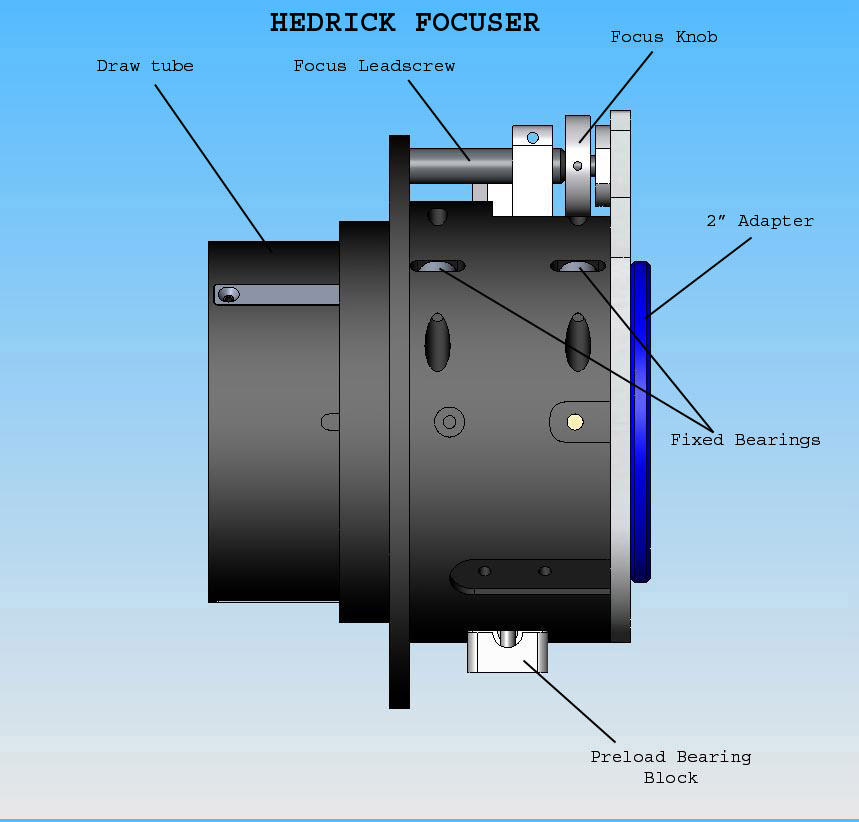
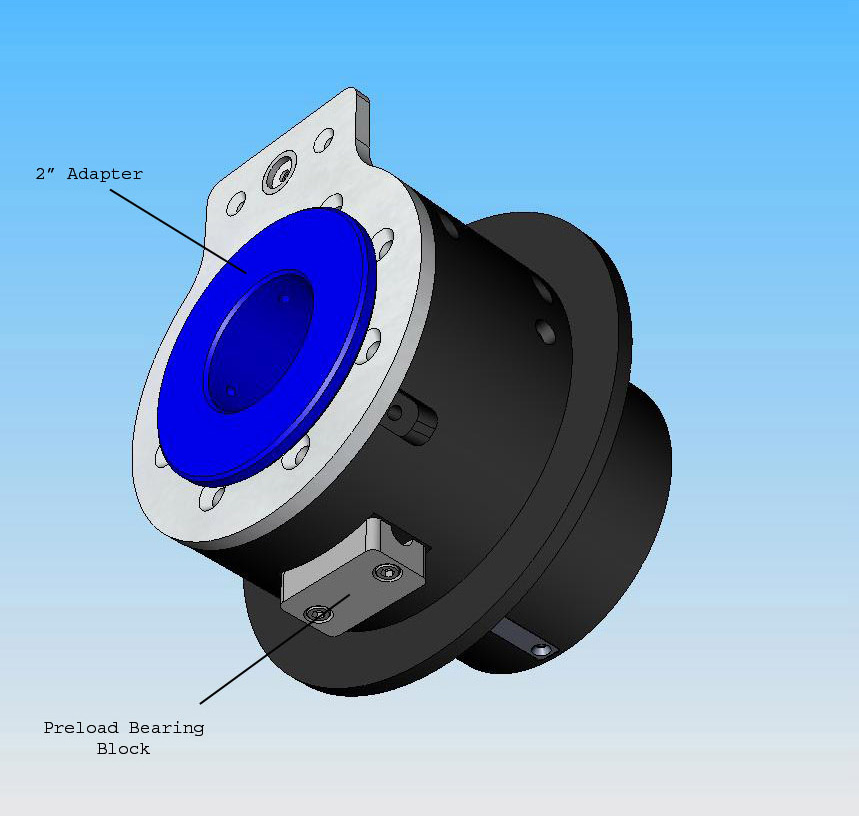

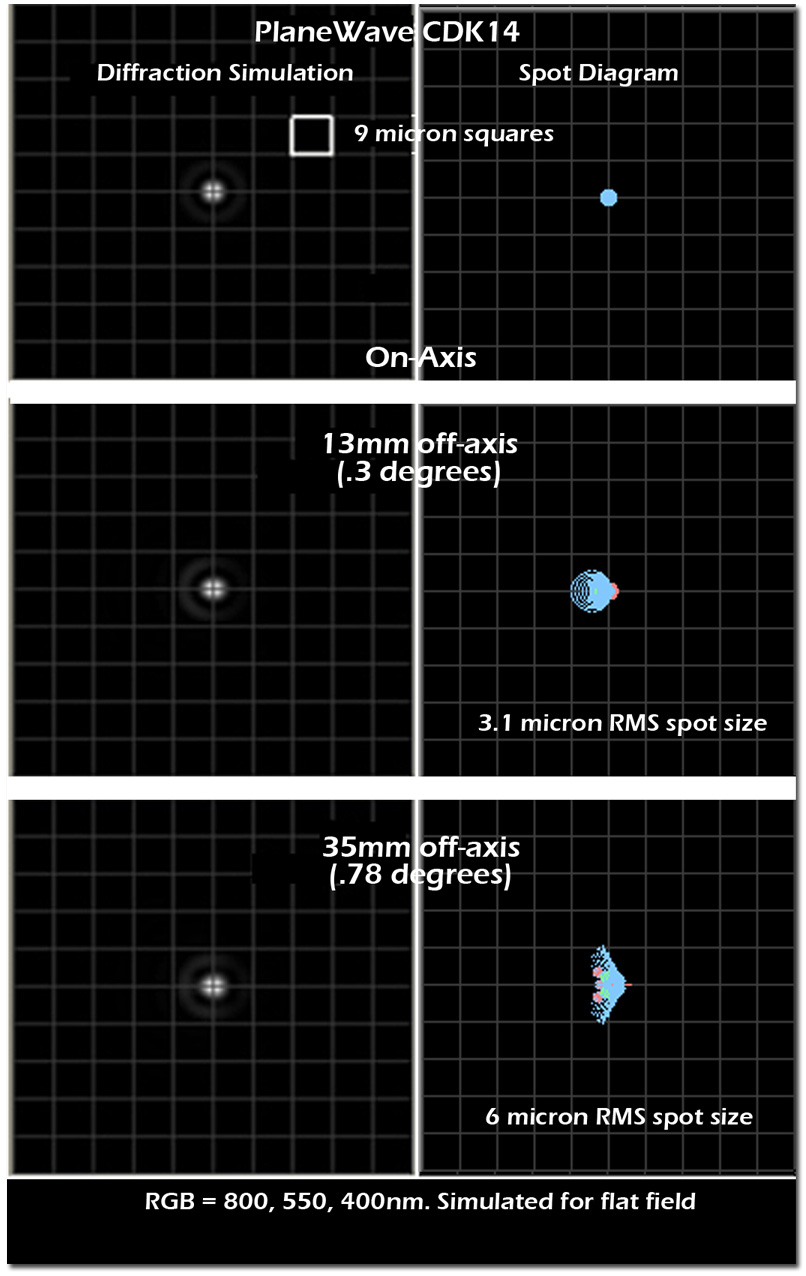
- Choosing a selection results in a full page refresh.
- Opens in a new window.