


Without a counterweight
8 kg
Reference load at up to 16 N·m of load torque.
Plus sky events, new gear and expert tips.
It comes off automatically at checkout.


ZWO
A strain wave mount for imaging in the field.
The 4.1 kg mount head works in equatorial mode for astrophotography and alt-azimuth mode for visual observing.
 Full-size field photo
A strain wave gear and synchronous belt drive the mount. ZWO specifies periodic error within ±15 arcseconds and supplies an individual test report with each unit.
Use ZWO’s reference loads to assess the complete rig. How far the load sits from the mount also affects how much the mount can carry.
8 kg
Reference load at up to 16 N·m of load torque.
13 kg
Reference load above 16 N·m and up to 26 N·m.
See the simulation and counterweight calculation
The base is 122 mm in diameter and has a central 3/8″-16 thread.
Connect compatible equipment near the saddle to keep loose cable runs shorter as the mount moves.
 Open ZWO original. Saddle ports and hex key storage
Polar-align for long-exposure imaging. Altitude adjusts in two ranges, 0°–60° and 30°–90°, with ±6° of azimuth adjustment.
Move the telescope up and down and side to side for visual observing.
 Open ZWO original. Equatorial and alt-azimuth mode indicators
 Open ZWO original. Altitude adjustment range
Connect over built-in Wi-Fi or Bluetooth. You can also use the supplied hand controller or run the mount with ASCOM, INDI or ZWO ASIAIR.
 Wireless connection
 On-screen controls
 ASIAIR control
For the mount on its own, use a centre-positive 5.5 × 2.1 mm plug. ZWO introduced the 12 V 3 A marking in July 2026. The hardware and performance stayed the same.
Operating range is −20 °C to 40 °C. Below 0 °C, enable low-temperature high-load mode in the software.
Heavy Load Mode caps the slew rate at 720×. The mount’s overall maximum is 1440× (6°/s).
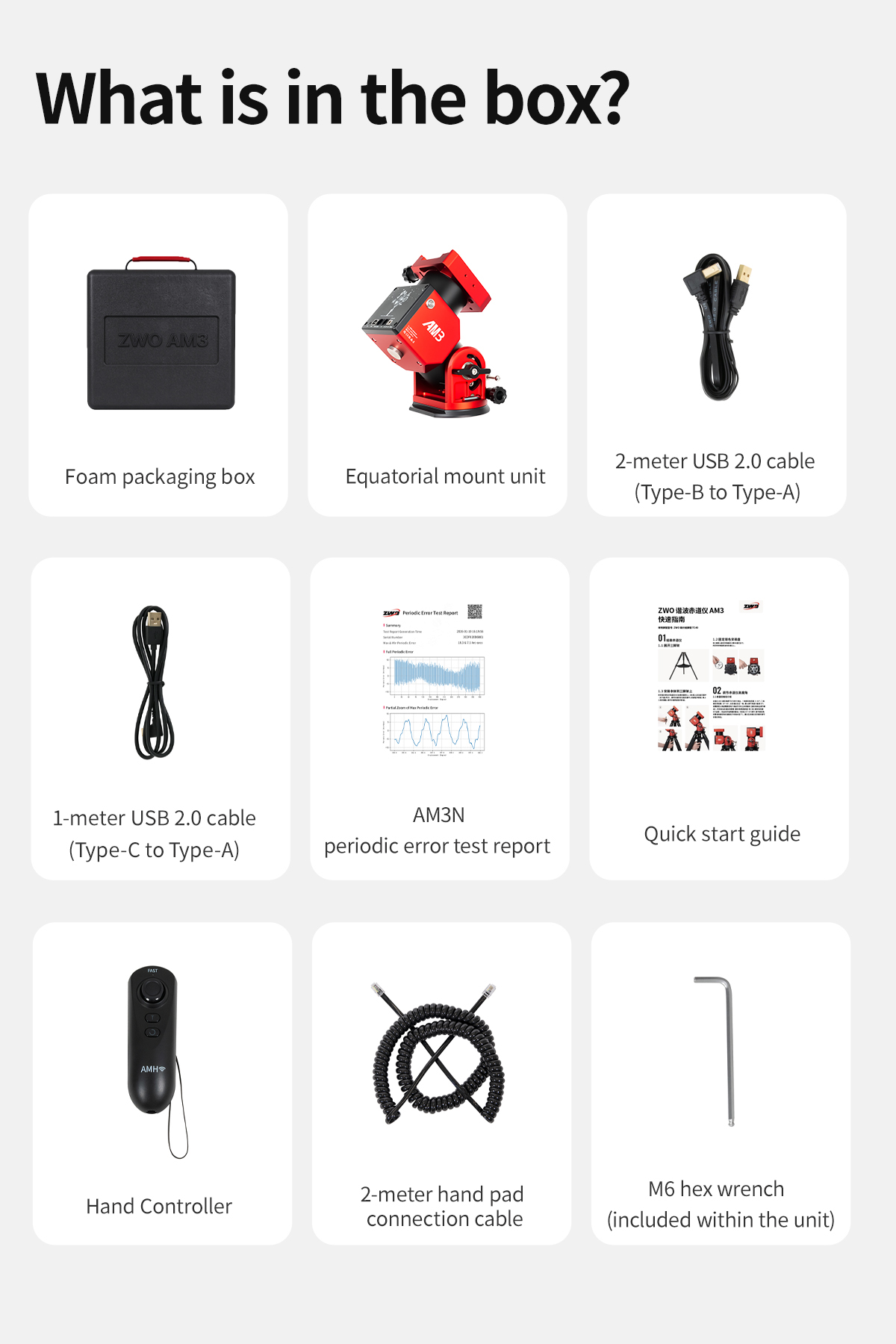 Open ZWO original. AM3N package contents
ZWO uses the arrangement below to estimate the AM3N’s reference loads. The drawing shows a 20 cm payload lever arm and marks the counterweight mass as m and its lever arm as L.
 Open ZWO original. Payload simulation geometry
These estimates use the 20 cm lever arm shown and ZWO’s approximation of 10 m/s² for gravity.
8 kg × 10 m/s² × 0.20 m = 16 N·m
ZWO’s reference load without a counterweight.
13 kg × 10 m/s² × 0.20 m = 26 N·m
ZWO’s reference load with a counterweight, for load torque above 16 N·m and up to 26 N·m.
In the higher torque range, ZWO recommends a counterweight of 5 kg or less. Use a 20–30 cm lever arm with a 5 kg weight. For other masses, use the torque range below to calculate the distance.
10 N·m ≤ m × g × L ≤ 15 N·m
m is the counterweight mass in kg, L is the lever arm in metres, and g is 9.8 m/s². ZWO uses 10 m/s² for the worked example.
10 N·m ÷ (2 kg × 10 m/s²) = 0.50 m
15 N·m ÷ (2 kg × 10 m/s²) = 0.75 m
The calculated lever arm is 0.50–0.75 m. Actual payload capacity depends on the total rig weight, lever arms and equipment layout.
 Open ZWO original. Dimensioned mechanical drawing
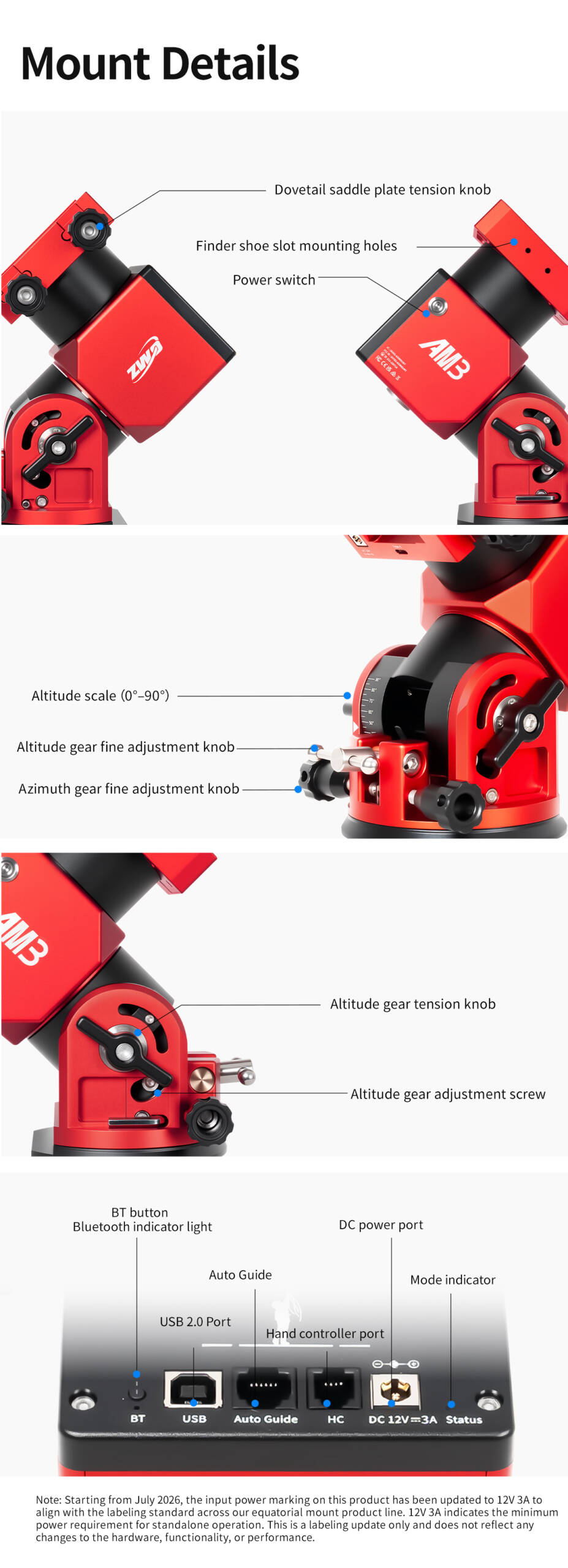 Open ZWO original. Mount controls and power panel


Let Gemini, ChatGPT or Claude help you. Click a button and ask away.
A strain wave mount for imaging in the field.
The 4.1 kg mount head works in equatorial mode for astrophotography and alt-azimuth mode for visual observing.
Full-size field photo
A strain wave gear and synchronous belt drive the mount. ZWO specifies periodic error within ±15 arcseconds and supplies an individual test report with each unit.
Use ZWO’s reference loads to assess the complete rig. How far the load sits from the mount also affects how much the mount can carry.
8 kg
Reference load at up to 16 N·m of load torque.
13 kg
Reference load above 16 N·m and up to 26 N·m.
See the simulation and counterweight calculation
The base is 122 mm in diameter and has a central 3/8″-16 thread.
Connect compatible equipment near the saddle to keep loose cable runs shorter as the mount moves.
Open ZWO original. Saddle ports and hex key storage
Polar-align for long-exposure imaging. Altitude adjusts in two ranges, 0°–60° and 30°–90°, with ±6° of azimuth adjustment.
Move the telescope up and down and side to side for visual observing.
Open ZWO original. Equatorial and alt-azimuth mode indicators
Open ZWO original. Altitude adjustment range
Connect over built-in Wi-Fi or Bluetooth. You can also use the supplied hand controller or run the mount with ASCOM, INDI or ZWO ASIAIR.
Wireless connection
On-screen controls
ASIAIR control
For the mount on its own, use a centre-positive 5.5 × 2.1 mm plug. ZWO introduced the 12 V 3 A marking in July 2026. The hardware and performance stayed the same.
Operating range is −20 °C to 40 °C. Below 0 °C, enable low-temperature high-load mode in the software.
Heavy Load Mode caps the slew rate at 720×. The mount’s overall maximum is 1440× (6°/s).
Open ZWO original. AM3N package contents
ZWO uses the arrangement below to estimate the AM3N’s reference loads. The drawing shows a 20 cm payload lever arm and marks the counterweight mass as m and its lever arm as L.
Open ZWO original. Payload simulation geometry
These estimates use the 20 cm lever arm shown and ZWO’s approximation of 10 m/s² for gravity.
8 kg × 10 m/s² × 0.20 m = 16 N·m
ZWO’s reference load without a counterweight.
13 kg × 10 m/s² × 0.20 m = 26 N·m
ZWO’s reference load with a counterweight, for load torque above 16 N·m and up to 26 N·m.
In the higher torque range, ZWO recommends a counterweight of 5 kg or less. Use a 20–30 cm lever arm with a 5 kg weight. For other masses, use the torque range below to calculate the distance.
10 N·m ≤ m × g × L ≤ 15 N·m
m is the counterweight mass in kg, L is the lever arm in metres, and g is 9.8 m/s². ZWO uses 10 m/s² for the worked example.
10 N·m ÷ (2 kg × 10 m/s²) = 0.50 m
15 N·m ÷ (2 kg × 10 m/s²) = 0.75 m
The calculated lever arm is 0.50–0.75 m. Actual payload capacity depends on the total rig weight, lever arms and equipment layout.
Open ZWO original. Dimensioned mechanical drawing
Open ZWO original. Mount controls and power panel