Welcome to The Binocular and Telescope Shop
Main menu
-
Telescopes
- Telescopes
-
Types of Telescopes
-
Celestron Telescope
-
Smart Telescopes
-
Saxon Telescopes
-
Skywatcher Telescopes
-
TeleVue Telescopes
-
Planewave Telescopes
-
Vixen Telescopes
-
TEC Telescopes
-
BORG Telescopes
-
Founder Optics
-
Solar Astronomy
-
Binoculars
- Binoculars
-
Types of Binoculars
-
Vortex Binoculars
-
Nikon Binoculars
-
Swarovski Binoculars
-
Leica Binoculars
-
ZEISS Binoculars
-
Fujinon Binoculars
-
Gerber Binoculars
-
Vixen Binoculars
-
Pentax Binoculars
-
Olympus Binoculars
-
Kite Optics
-
Kowa Binoculars
-
GPO Binoculars
-
Zerotech Binoculars
-
Binocular Accessories
-
Spotting Scopes
- Spotting Scopes
-
ZEISS Spotting Scopes
-
Swarovski Spotting Scopes
-
Leica Spotting Scopes
-
Nikon Spotting Scopes
-
Vortex Spotting Scopes
-
Kowa Spotting Scopes
-
Pentax Spotting Scopes
-
Celestron Spotting Scopes
-
Spotting Scope Accessories
-
Microscopes
- Microscopes
-
Beaver Labs Microscopes
-
Celestron Microscopes
-
Digital Microscopes
-
Microscopes for Children
-
Biological Microscopes
-
Mounts & Tripods
- Mounts & Tripods
-
ZWO Mounts
-
Celestron EQ Mounts
-
iOptron Mounts
-
Vixen Mounts
-
Paramount EQ Mount
-
Saxon Mounts
-
PlaneWave Mounts
-
Skywatcher EQ Mounts
-
Losmandy EQ Mounts
-
Camera Tripods
-
Astro Star Tracker Mounts
-
Mount Accessories
-
Imaging
- Imaging
-
ZWO Cameras
-
QHY Cameras
-
Starlight Xpress
-
FLI Cameras
-
Atik Cameras
-
Pegasus Astro
-
Camera Lenses
-
SBIG Cameras
-
Focusing
-
Imaging Accessories
-
Filters (Imaging)
-
Autoguiding
-
Accessories
- Accessories
-
Eyepieces, Diagonals and Barlows
-
Adapters & Extensions
-
Books & Sky Guides
-
Bags, Cases & Covers
-
Cleaning and Maintanence
-
Collimation
-
Dew Control
-
Dovetail Bars & Plates
-
Filters (Visual)
-
Finderscopes
-
Tube Rings
-
Tele Vue Eyepieces
-
Bintel Eyepieces
-
Celestron Eyepieces
-
Vixen Eyepieces
-
Barlows & Powermates
-
Saxon Eyepieces
-
Eyepiece Kits
-
Diagonals
-
Tools
Your cart
Choose your Location
-
Bintel Glebe
Usually ready for pickup in 24 hours
Bintel 84 Wentworth park road, Glebe, 2073, NSW
Phone:(02) 9518 7255
Hours:
Monday9:30 am–5:30 pm
Tuesday9:30 am–5:30 pm
Wednesday9:30 am–5:30 pm
Thursday9:30 am–5:30 pm
Friday9:30 am–5:30 pm
Saturday9:30 am–4 pm
SundayClosed
滤镜(成像)
62 products
62 products
Sort by:
- 特色
- 最相关
- 畅销
- 按字母顺序排序,A-Z
- 按字母顺序排序,Z-A
- 价格,从低到高
- 价格,从高到低
- 日期,从旧到新
- 日期,从新到旧
$135.00
New ZWO 2″ filter drawer featuring the anti-light-leaking design that can effectively solve the light leaking issue under long exposure.
NEW: Double strong magnets adopted for stronger adsorption, easier installation and filter removal.
Lock screw on the side for you to adjust the tension of the holder to eliminate gap. It's a way to make sure the filter is positioned correctly.
M54 filter drawer
- Diameter 70mm * Thickness 20mm
- M54 * 0.75 male (external) thread (camera side)
- M48 * 0.75 female (internal) thread (filter end)
- M54 * 0.75 female (internal) thread (telescope side)
- Suitable for 2-inch astronomical filters and full frame cameras, such as ASI2600MC Duo, ASI6200 and ASI2400 series.
From $395.00
The new Astronomik Deep-Sky RGB filters are the result of a long and detailed process of research and development. We have created the most advanced set of RGB filters for Deep-Sky imaging available today.
The transmission curves of the three filters are designed to give you strong and vivid colors with a strong reinforcement of the most important emission lines. Data taken with the new Astronomik Deep-Sky RGB filters is easier to process into a beautiful final masterpiece.
Feedback from our test-users and the first customers is really exciting. All of them reported smaller, sharper stars and this was one of our design goals, so these filters are designed to give you the best contrast and the smallest stars possible!
During the design of the Deep-Sky RGB filters we took a close look at the sensitivity curves of today’s popular CCD cameras. The result was we found a way to make one set of filters for all kind of sensors ranging from KAF- and KAI-sensors, to the chips made by Sony, meaning you can do 1:1:1 ratio RGB exposures with all sensors, with only minimal tweaking necessary during processing to achieve perfect colours in your image!
The transmission curve characteristics and coatings on the new Deep Sky RGB filters have been designed and engineered in such a way that no halos or reflections will be visible. Even with bright stars in the field of view you will be able to reveal the faintest structures in nebulas or galaxies
Additional to the Deep-Sky RGB filters Astronomik now offers you three different Luminance filters. The different spectral window of each new Luminance filters is designed to tune your setup to get the sharpest image from any optical design and any camera, even with instruments with less-than-perfect colour correction. (Link einfügen)
Like all Astronomik Filters, the new Deep-Sky RGB filters are made using an extremely durable and scratch resistant coating, deposited on the finest polished optical substrate, which is free of any striae or internal strains. All substrates are made to exactly the same thickness, so all of our filters are parfocal.
Astronomik Deep-Sky RGB Key features:
- Maximum transmission of up to 95%
- Ultra-Sharp, pinpoint star images
- High contrast
- Easy to process data for vivid colours in the final image
- Optimized spectral windows for max photon counts on the sensor
- Made on finest, opticaly polished glass
- Extremly durable, scratch resistant coating
- MFR Coating technique for a wide range of focal ratios
$599.00
窄带滤镜不会消除光污染的影响或增加物体的亮度。在许多情况下,它们会增加星云和夜空之间的对比度,而不是使星云变亮。
它可以减少某些波长的光的传输,特别是由人造光(包括汞蒸气)以及高压和低压钠蒸气灯产生的光以及由大气中的中性氧排放(即天辉)引起的不必要的自然光。
技术参数:
名称:ZWO新型窄带1.25英寸滤光片
尺寸:1.25英寸
厚度:5.5mm+2.5mm(螺纹)
玻璃厚度:1.85mm
螺纹:M28.5*0.6外螺纹
ZWO H-Alpha 滤镜的带通为 7nm,可使 656nm 波长的光通过,透光率高达 80%。窄带 H-alpha 天文摄影滤镜的最佳选择,可实现高对比度成像,即使在光污染较强的地区,就准备好体验它的无限乐趣吧!
ZWO 窄带 S-II 7nm 滤光片可透过 672nm 波长的光,带通为 7nm,专为星云观测而设计。它适用于大多数发射星云、行星状星云和超新星遗迹的目视观测,可与 H-alpha 和 OIII 一起使用用于三色 CCD 天文摄影的窄带滤光片(SHO 组)。
ZWO 窄带 O-III 7nm 滤光片专为星云观测而设计,允许以 500nm 波长为中心的 7nm 带宽的光通过,这对应于 OIII 发射线,阻挡所有其他光。将 ZWO O-III 窄带滤光片添加到您的成像系列中将帮助您超越 RGB 成像,并帮助您在全新光线下捕捉您最喜欢的星云,无论您的天空污染程度如何!
技术数据
- 半高宽:7±0.5nm
- 玻璃厚度 2.0+/-0.03 毫米(1.25 英寸/31 毫米/36 毫米)
- 精细光学抛光,确保两个表面均具有精确的 1/4 波前
- H-alpha 线 656nm 处透射率约为 90%(H-Alpha 滤光片)
- SII 线 672nm 处透射率约为 90%(SII 滤光片)
- 在主要 OIII 线 500nm 处透射率约为 90%(OIII 滤光片)
- 红外波长截止700-1100nm
- 带外透过率 <0.1%,OD3(光密度)
透射曲线
我们对 Ha 滤镜 (ASI1600 单色相机,单帧,300s,MaximDL 中的 DDP) 进行了测试:
$539.00
1. L-eXtreme F/2 简介
Optolong L-eXtreme F/2 是一款双波段(500.7 nm 和 656.28 nm,FWHM=7 nm)窄带通滤光片,满足连续变化角度的透射要求。以天文特征谱线(OIII、Ha)为主要透射波长,OIII 和 H-Alpha 星云发射线在 f2 - f3.3 焦比下准确通过。这是 Optolong 专门为快速光学系统或快速焦比成像系统开发的产品。它在 RASA、HyperStar 和其他快速焦比望远镜上表现良好。
主要特点:
♦与单次彩色天文相机、单色天文相机、数码单反相机配合使用,可以快速获得清晰细致的深空图像;
♦非常适合快速光学系统,如RASA、Hyperstar和其他快速焦比望远镜用户;
♦建议使用焦比为f2至f3.3的快速光学系统;
♦抗光污染、对比度更好、天体细节更多:此滤镜可滤除目标天体以外的背景光和噪音,以获得更佳的图像细节和对比度。L-eXtreme F/2 可有效阻挡光污染,使图像不会受到背景中不必要的灯光和天光的影响。您可以在快速光学系统中快速获得满意的图像。
2. 光谱及特性
L-eXtreme F/2 针对天体的发射线和光污染发射线特点,在遮挡大部分光污染的同时,保留了星云 OIII 和 Ha 的突出色彩。L-eXtreme F2 针对快速光学系统的特点进行了专门设计和优化计算,始终保持 OIII 和 Ha 两个波段的高透过率,帮助用户更准确、更快速地捕捉这些波段的星云发射线,获得更好的天文摄影图像。
如何读图表?
▲横轴为波长,单位为纳米(nm)。
▲纵轴表示透射率,单位为%。
3. 涂层技术
·多层增透膜
·非胶粘型光学基片镀膜
·Optolong滤镜采用基于离子辅助沉积镀膜技术的精密镀膜,经久耐用,耐刮擦,中心波长稳定,不受温度变化的影响。
·行星旋转系统提供涂层的精确性和均匀性,确保通带透射率和带外光密度的高值。
库存单位:14803
Ever tried look at the Full Moon through a telescope? You'll know just how bright it can be!
The saxon 1.25" Moon Filter helps reduce glare and increase the contrast of the Moon allowing you to see the fine details on craters, mountains and across the Lunar plains, called Mare.
From $115.00
Astronomik now offers you a range of three different UV+IR blockers as Luminance filters. The different spectral window of each new Luminance filters is designed to tune your setup to get the sharpest image from any optical design and any camera.
The Luminance channel is probably the most important for a great final image! You want as much signal as possible so the filter should have the highest transmission possible with a wide spectral bandpass. This combination provides the greatest sensitivity and gives you the highest photon counts on your pixels. While the high transmission level is a great aspect of the new Astronomik Luminance filters, not all optical instruments or additional optical elements like correctors, field-flatteners or reducers, have perfect colour correction so it can be the width of the spectral band pass of the Luminance filter that can cause problems. A band pass that is too wide will allow the transmission of incompletely focused light (Chromatic aberration), making stars appear soft or bloated. In such cases image processing can become difficult, so having a slightly narrowed spectral window in your Luminance filter can reduce or eliminate this damaging effect.
To give you all the tools to gather the best data possible we have expanded our line of Luminance filters: Now you can select a Luminance filter perfectly matched to the kind of telescope you use, to get the highest signal and sharpest image for the Luminance channel!
Depending on the color correction of your scope you may use a wider spectral window for the Luminance data. The L1 filter has the widest spectral window, the L2 is about the same as our current L-Filter and the L3 is much narrower.
If you use an optical system that is completely free of any chromatic aberration you should get an L1 filter for your setup. For general use the L2 filter is well suited to most optical systems with a corrector, flattener or reducer in the optical train while the L3 filter is designed for users of refractors with a less-than-perfect color correction and in combination with the new Deep-Sky RGB filters, the L3 filter will minimise the problem of bluish halos around stars.
The transmission curve characteristics and coatings on the new Luminance filters have been designed and engineered in such a way that no halos or reflections will be visible. Even with bright stars in the field of view you will be able to reveal the faintest structures in nebulas or galaxies.
Like all Astronomik Filters, the new Luminance filters are made using an extremely durable and scratch resistant coating, deposited on the finest polished optical substrate, which is free of any striae or internal strains. All substrates are made to exactly the same thickness, so all of our filters are parfocal.
Additional note for observers working under light polluted skies:
If your observing site suffers from light pollution you should try to use our CLS-CCD as a replacement for the Luminance filter. The transmission curve of the CLS-CCD will give you approximately the same amount of energy in all three colour channels while blocking nearly all unwanted artifical light pollution. Customers who replaced the Lx filter with the CLS-CCD are amazed by the increased quality of their data. This small change gives you the opportunity to take much deeper images from your current observing site.
$499.00
Optolong L-Synergy Dual Narrowband Filter
The Optolong L-Synergy filter is designed for astrophotographers using DSLR, color CMOS, or CCD cameras who want to achieve stunning narrowband results without switching to a monochrome system. By pairing traditional dual-narrowband (Ha & OIII) concepts with a unique “Ha & OIII + SII & OIII” approach, L-Synergy overcomes the usual limitations of colour cameras and makes Hubble-Palette–style imaging accessible to everyone.
With this filter, you can produce deep, high-contrast SHO-like images of emission nebulae using your existing colour camera—no additional SHO filters or monochrome upgrade required. It’s an affordable way to achieve professional-level results even under bright suburban skies.
Why Choose the L-Synergy Filter?
The L-Synergy is a dual 7 nm narrowband filter engineered for telescopes with an f/ratio of f/3.3 or slower. Years of optical refinement have produced a design that suppresses bright star halos while delivering extremely high transmission in the key emission bands.
-
Selective Narrowband Performance
Transmits only the OIII (500.7 nm) and SII (672.4 nm) nebula emission lines, rejecting unwanted wavelengths and light pollution. -
Exceptional Contrast and Signal-to-Noise
By isolating the oxygen and sulfur signals, the filter produces a darker background sky and dramatically improves contrast—especially valuable in heavily light-polluted environments. -
Light-Pollution Resistant
Filters out the vast majority of urban skyglow, allowing astrophotographers to capture clean, detailed nebula structure from almost any location.
Optical Design
L-Synergy is precision-engineered based on the spectral behaviour of emission nebulae and common light-pollution sources. Its carefully tuned passbands maintain consistently high transmission in both SII and OIII, ensuring accurate colour capture and high-quality data for processing.
The result: a powerful, easy-to-use narrowband solution that unlocks deep-sky imaging performance far beyond what typical colour cameras can achieve, giving more astrophotographers access to true SHO-style imaging.
From $165.00
The Astronomik CLS CCD is suitable under light-polluted skies for DSLR Cameras, which have been remodeled for astronomical use. The filter enhances the contrast between all deep-sky objects and the background.
The CLS-CCD Filter enhances the contrast between astronomical objects and the background. Due to the wider transmission curve compared to UHC filters, a greater amount of light will pass the filter. Stars will be less dimmed. This filter has been optimized to block as much spurious light as possible and simultaneously provide the best performance for 'useful' light. A good filter for DSLR-, CCD- and film b/w-photography as well as observation of deep-sky-objects with telescopes or photo lenses of all aperture f/2 and above.
Main use
The filter blocks completely emission lines of artificial light sources like streetlights (e.g. sodium- and mercury-vapor) as well as the airglow. All 'important' emission lines as well as the spectral range of the night-adapted eye are beeing passed. The supplementary IR-blocking layer allows the use for DSLR- and Webcams without an integrated IR-block filter.
Other uses
- Easier resolution of Double Stars.
- With the EOS-Clip model, photography with DSLR cameras is feasible even unter extreme light-polluting conditions without shifting the white balance.
- The 1,25" and 2" socket models can be used for observations from light-polluted areas.
- If you plan to create color images from emission line data, our CLS-CCD filter is a great choice for the Luminance channel
Alternatives
CLS: For cameras with an integrated IR-filter or for visual observation.
Suitability
- Visual observation (dark skies): Good, to reduce light pollution by mercury-vapour lamps (streetlight)
- Visual observation (urban skies): Reasonable, an UHC-E or UHC filter is more suitable
- Film photography: Very good, colour balance is near perfect
- CCD photography: Very good, optimized rejection of light pollution
- DSLR photography (original): Good, colour balance shifted but contrast enhanced
- DSLR photography (astro modified): Very good, colour balance is near perfect
- DSLR photography (MC modified): Very good, colour balance is near perfect
- Webcam / Video (Planets): Unsuitable
- Webcam / Video (Deep Sky): Very good, if light pollution is a big problem
Technical Data
- 95% transmission at 486nm (H-beta)
- 95% transmission at 496nm (OIII)
- 95% transmission at 501nm (OIII)
- 97% transmission at 656nm (H-alpha)
- pass from 450 to 520nm and from 640 to 690nm
- Parfocal with other Astronomik filters
- Glass thickness: 1mm
- Completely resistant against high humidity, scratches and aging effects
- Diffraction limited, the filter will not reduce the optical performance of your telescope!
- Astronomik filters are delivered in a high-quality, long lasting, filter box
- Since 2008 we do ship filters with a completely new design. Any kind of halo or strange reflection is a matter of past
$1,199.00
ZWO 新品
ZWO 窄带 7nm 滤光片组可帮助减少某些波长的光的传输,增加星云和夜空之间的对比度,特别是由人造光(包括汞蒸气)以及高压和低压钠蒸气灯以及由大气中的中性氧排放(即天辉)引起的不必要的自然光产生的光。
细节
名称:ZWO 窄带 7nm 滤光片套装 2in
尺寸:2英寸
厚度:5mm+2.5mm(螺纹)
螺纹:M48.5*0.75外螺纹
ZWO 窄带 H-Alpha滤镜的带通为 7nm,可让 656nm 波长的光通过,透光率高达 80%。窄带 H-alpha 天文摄影滤镜的最佳选择,即使在光污染严重的地区也能实现高对比度成像并展现星云的丰富细节,准备好体验无限乐趣吧!
ZWO 窄带 S-II 7nm 滤光片可使波长为 672nm 的光通过,带通为 7nm,专为星云观测而设计。它适用于对大多数发射星云、行星状星云和超新星遗迹进行目视观测,可与 H-alpha 和 OIII 窄带滤光片(SHO 套装)配合使用,用于三色 CCD 天文摄影。
ZWO 窄带 O-III 7nm 滤光片专为星云观测而设计,允许以 500nm 波长为中心的 7nm 带宽的光通过,这对应于 OIII 发射线,阻挡所有其他光。将 ZWO O-III 窄带滤光片添加到您的成像系列中将帮助您超越 RGB 成像,并帮助您在全新光线下捕捉您最喜欢的星云,无论您的天空污染程度如何!
技术数据
- 半高宽:7±0.5nm
- 精细光学抛光,确保两个表面均具有精确的 1/4 波前
- H-alpha 线 656nm 处透射率约为 90%(H-Alpha 滤光片)
- SII 线 672nm 处透射率约为 90%(SII 滤光片)
- 在主要 OIII 线 500nm 处透射率约为 90%(OIII 滤光片)
- 红外波长截止700-1100nm
- 带外透过率 <0.1%,OD3(光密度)
透射曲线
From $179.00
(Only Compatible with QHY MiniCAM8 Camera)
Deep Sky Filter Set
Includes LRGB and narrowband SHO filters sized at 19 mm × 12 mm × 1.1 mm. The LRGB filters have an optical density (OD) of 3, while the narrowband filters have an OD of 5, providing high contrast and minimal light leakage for deep sky imaging.
Planetary Filter Set
Ideal for planetary observation, this set includes LRGB filters along with a 20nm Methane filter, 40nm UV filter, and 10nm Sodium (Na) filter. Great for capturing fine atmospheric and spectral details.
Photometric Filter Set
A complete Sloan filter set: u’, g’, r’, i’, z’. Suitable for scientific imaging and precise photometric measurements.
Ar III Standalone Filter
The Ar III (Argon III) filter is a narrowband filter centered around 713nm, designed to capture the specific emission line of triply ionized argon. This emission line is commonly observed in planetary nebulae, H II regions, emission-line galaxies, and in the spectroscopy of ionized gases in laboratory plasmas.
From $140.00
The Astronomik CLS is a budget filter for visual observation, Black & White photography and CCD photographs of nebulae, galaxies and star clusters with astronomical instruments of any size.
The Astronomik CLS blocks the light of the spectral lines of mercury and sodium-vapor lamps and lets the largest part of the visible light and H-alpha emissions pass. All the important emission lines, as well as the spectral region that the very well dark adapted eye can see, can pass through the filter.
Main use
The filters are optimized for use with aperture ratios from 1:3 to 1:15. Transmission losses and chromatic distortions, which are problems with other filters, only appear with Astronomik filters when extremely bright aperture ratios of 1:2 and more are used. The CLS filter is suitable for use with telescopes of all aperture sizes.
Suitability
- Visual observation (dark skies): Good, to reduce light pollution by mercury-vapour lamps (streetlight)
- Visual observation (urban skies): Good, an UHC-E or UHC filter is more suitable
- Film photography: Very good, colour balance is near perfect
- CCD photography: Good, when used with an additional IR-block-filter
- DSLR photography (original): Good, colour balance shifted but contrast enhanced
- DSLR photography (astro modified): Very good, colour balance is near perfect
- DSLR photography (MC modified): Good, when used with an additional IR-block-filter
- Webcam / Video (Planets): Unsuitable
- Webcam / Video (Deep Sky): Very good, if light pollution is a big problem
Technical Data
- 92% transmission at 486nm (H-beta)
- 92% transmission at 496nm (OIII)
- 92% transmission at 501nm (OIII)
- 97% transmission at 656nm (H alpha)
- pass from 450 to 540nm and beyond 650nm
- Parfocal with other Astronomik filters
- Glass thickness: 1mm
- Completely resistant against high humidity, scratches and aging effects
- Diffraction limited, the filter will not reduce the optical performance of your telescope!
- Astronomik filters are delivered in a high-quality, long lasting, filter box
- Since 2008 we do ship filters with a completely new design. Any kind of halo or strange reflection is a matter of past
$399.00
ZWO Ha 7nm 滤光片 2in 可帮助减少某些波长的光的传输,增加星云和夜空之间的对比度,特别是由人造光(包括汞蒸气)以及高压和低压钠蒸气灯以及由大气中的中性氧排放(即天辉)引起的不必要的自然光产生的光。
ZWO Ha 7nm 滤镜的带通为 7nm,可使 656nm 波长的光通过,透光率高达 80%。窄带 H-alpha 天文摄影滤镜的最佳选择,即使在光污染严重的地区也能实现高对比度成像并揭示星云的丰富细节,只需准备好体验它的无限乐趣!
技术数据
- 半高宽:7±0.5nm
- 精细光学抛光,确保两个表面均具有精确的 1/4 波前
- H-alpha 线 656nm 处透射率约为 90%(H-Alpha 滤光片)
- 红外波长截止700-1100nm
- 带外透过率 <0.1%,OD3(光密度)
透射曲线
$49.00
- 高品质、全多层镀膜光学玻璃,具有二向色涂层,可阻挡红外 (IR) 光
- 提供最佳色彩平衡和清晰度
- 完全可拆卸,提供最大的灵活性——无需购买内置红外线阻挡的相机
- 兼容 Skyris 彩色相机和 The Imaging Source 天文相机
$919.00
Optolong L2 Dual-Combo Filter Set
The Optolong L2 Dual-Combo Set includes two premium dual-narrowband filters, L-eXtreme and L-Synergy, designed for colour-camera astrophotography. Compatible with telescopes f/3.3 and slower, this set allows users to capture Hubble Palette deep-sky images without switching to a monochrome camera or buying a full three-filter SHO set. It provides professional-level narrowband imaging with minimal investment.
The L-eXtreme transmits OIII (500.7 nm) and Hα (656.3 nm), blocking unwanted light-pollution wavelengths to deliver bright nebula details with high contrast. Years of refinement optimise performance and reduce bright star halos.
The L-Synergy transmits OIII (500.7 nm) and SII (672.4 nm) with high efficiency while rejecting other wavelengths. It minimises light pollution effects and preserves nebula detail, producing clean data for processing.
The combination of these filters allows colour-camera users to achieve Hubble Palette imaging efficiently. It enhances nebula structure, improves contrast, and enables richer colour separation in light-polluted skies.
The filters are engineered to preserve the distinctive colours of nebulae while filtering out most light pollution. Their tuned transmission profiles ensure strong signal in the target emission lines and high signal-to-noise performance for detailed deep-sky images.
This set is ideal for astrophotographers using colour cameras who want professional-quality narrowband imaging with existing equipment.
From $210.00
All Astronomik Filters are perfect for modern cameras, including both CMOS and CCD based cameras, allowing you to capture the very best images possible with your instruments. Sharpness, contrast and the absence of any reflections is guaranteed.
Each and every Astronomik filter has to pass a complex quality control process before being suitable for delivery to our customers. Each and every emission line filter is measured with a high-end Perkin-Elmer spectral-photometer to make sure that every single filter is up to the specifications published on our website.
On the back of each filter-box you will find a label that details the precise sensitivity and band pass measurements for that individual filter inside the box: You will see the max transmission and the recommended range of focal ratio were the filter will give you the best performance.
Thus Astronomik OIII CCD filter is a narrow band emission-line-filter for CCD photography. The filter lets the light of double ionized Oxygen of emission nebulae pass and blocks nearly the whole remainder of the spectrum where the CCD is sensitive.
The full width at half maximum (FWHM) of 12 nm is optimal suitable for common CCD cameras and allows the use of very fast optics The optimal aperture ratio for the use of the filter is 1:3 to 1:15 with apertures of more than 6" (150mm). It should be noted that the filter has a transmission of up to 99%, which cannot be attained by stacking more narrow-band filters. A further note, which led to selecting the half width (FWHM), is the dark current of common CCD imagers. Exposures with a CCD cooled to -15°C are limited by the dark current of the CCD, even in large cities with a bright background.
Another advantage of the 12 nm filter is the better availability of guiding stars for cameras with a built-in-autoguider (SBIG). If you use a very strong filter like our H-alpha 6nm filter you often won’t find a usable guidestar.
Together with our other three Astronomik emission-line filters you can do great color images even from very light polluted places!
Main use
The Astronomik OIII CCD increases the contrast between objects, in this case between the OIII emission line and the skyglow background. Our Astronomik OIII CCD completely suppresses the emission lines of artificial lighting (mercury (Hg) and sodium (Na)) and skyglow. Transmission losses and chromatic distortions, which arise with other filters, only occur with Astronomik filters when extremely bright aperture ratios of 1:2 and more come into play. The filter has a built-in IR-blocker up to 1150nm. You don’t need an additional IR-blocker with this filter.
Other uses
- When using the Astronomik OIII CCD filter togther with the H-alpha, OIII CCD and the SII CCD filters you can obtain three-color images of emission line objects (gas nebulae) from locations with very strong light pollution. To do so, you would take an image in three different wavelengths, select each one as a color-channel in Photoshop and paste them together as one single color image.
- If you plan to create color images from emission line data, our CLS CCD filter is a great choice for the Luminance channel
- The OIII CCD is also great for visual observation. If you plan to get filters for visual observation and for astrophotography get the CCD filter: You may use this filter visual as well as in front of you camera. The built-in IR-blocker doesn’t disturb visual observation but you need an additional IR-blocker if you want to use the visual filter with your camera.
Suitability
- Visual observation (dark skies): Very good, huge contrast enhancement at O III-emission nebulas
- Visual observation (urban skies): Very good, huge contrast enhancement at O III-emission nebulas
- Film photography: It depends, very long exposure time
- CCD photography: Very good, huge contrast enhancement at O III-emission nebulas
- DSLR photography (original): Very good, huge contrast enhancement at O III-emission nebulas
- DSLR photography (astro modified): Very good, huge contrast enhancement at O III-emission nebulas
- DSLR photography (MC modified): Very good, huge contrast enhancement at O III-emission nebulas
- Webcam / Video (Planets): Unsuitable
- Webcam / Video (Deep Sky): Reasonable, if light pollution is a big problem and OIII Objects are beeing observed
Technical Data
- typ. 95% transmission at 496nm (OIII)
- typ. 95% transmission at 501nm (OIII)
- full width at half maximum 12nm
- transmission from 494nm to 506nm
- Parfocal with other Astronomik filters
- Glass thickness: 1mm
- Completely resistant against high humidity, scratches and aging effects
- Diffraction limited, the filter will not reduce the optical performance of your telescope!
- Astronomik filters are delivered in a high-quality, long lasting, filter box
- Since 2008 we do ship filters with a completely new design. Any kind of halo or strange reflection is a matter of past
From $105.00
Ideal addition to the Astronomik ProPlanet IR 742 for imaging the moon and planets, with telescopes larger then 10" (250mm) when the seeing is poor.
This filter is an ideal complement to the ProPlanet IR 742 for use with converted DSLR cameras, CCD cameras and Webcams. The effects of seeing are distinctly reduced. It is your entry into previously unknown dimensions of photography of the moon and the planets.
The ProPlanet IR 807 only allows infrared light with wavelengths of more than 807 nm to pass. In this wavelength range the effects of seeing are significantly lower than in the visible spectrum of the human eye. This allows much sharper images than are usually obtained from your device and location. Another advantage is that the sky background of advanced dawn is dark and even allows photography of planets and moon at daylight.
Main use
The Astronomik ProPlanet IR 807 cuts off the visible part of the spectrum and allows the light of wavelengths longer then 807nm to pass. Due to this behavior the part of the spectrum that is most sensitive to bad seeing is rejected. This approach does a big improvement to the imaging of planets and the moon. The image is more steady than the image in the visible light.
Other uses
- The Astronomik ProPlanet IR 807 is designed to be an addition to the Astronomik ProPlanet IR 742, if the seeing is extremely bad and a larger telescope is used.
- For most cameras the exposure times doubles, compared to the Astronomik ProPlanet IR 742 or imaging in visible light, if the Astronomik ProPlanet IR 807 is used.
- Darkens the background during twilight.
- Imaging of bright planets, stars and comets by day.
- Imaging of young stars in dust clouds and stellar nurseries.
Alternatives
If the seeing is not so bad or if the telescope is smaller than 10" (250mm) we recommend the use of the Astronomik ProPlanet IR 742.
Suitability
- Visual observation (dark skies): Unsuitable, the eye is insensitive at this spectrum
- Visual observation (urban skies): Unsuitable, the eye is insensitive at this spectrum
- Film photography: Unsuitable
- CCD photography: Reasonable, for special IR photography (as chlorophyll)
- DSLR photography (original): Unsuitable
- DSLR photography (astro modified): Unsuitable
- DSLR photography (MC modified): Good, for IR daylight photography, longer exposure time
- Webcam / Video (Planets): Very good, rejects problems with seeing, particularly with telescopes larger 250 mm aperture
- Webcam / Video (Deep Sky): Very good, rejects problems with seeing, particularly with telescopes larger 250 mm aperture
Technical Data
- more then 97% transmission for wavelengths of 807nm to 1100nm
- blocking of wavelengths between 350nm and 790nm
- Parfocal with other Astronomik filters
- Glass thickness: 1mm
- Completely resistant against high humidity, scratches and aging effects
- Diffraction limited, the filter will not reduce the optical performance of your telescope!
- Astronomik filters are delivered in a high-quality, long lasting, filter box
- Since 2008 we do ship filters with a completely new design. Any kind of halo or strange reflection is a matter of past
$679.00
Antlia SII 3nm Pro 窄带滤光片将 FWHM(半峰全宽)优化至 3nm 带通。随着带宽变窄,3nm Pro 窄带滤光片通过降低不需要的背景信号来增强发射目标的对比度。Antlia SII 3nm Pro 滤光片旨在在 671.6nm 线上提供 88% 的透射率,为您提供最大信号和清晰的星云结构。
传统的较宽窄带滤光片由于强烈的中心波长 (CWL) 偏移而导致传输严重损失。我们保证在中心带宽 1nm 范围内 T>88%,这意味着 3nm Pro 窄带滤光片可以保证高透射率,适用于长焦比和快速光学系统。蓝移数据显示,Antlia SII 3nm Pro 滤光片几乎可以与所有速度高达 f/3 的系统一起使用,发射信号损失最小,并满足 Hyperstar 和 RASA 等快速光学器件的要求。
带外阻断规格为 OD5(0.001%),可提供出色的 SNR(信噪比)和有效截止率,以最大限度地减少来自其他波长的干扰。改进的锐利截止天文摄影 3nm Pro 滤镜旨在最大限度地减少明亮恒星周围的光晕。
用途与性能:
高透射率和最小带宽可最大程度地提高对比度
陡峭的光谱轮廓最大程度地减少了明亮恒星周围的光晕
单一基板可消除内部反射
窄带物体:SII 发射星云、行星、沃尔夫-拉叶星云和超新星遗迹
在光污染区域和黑暗场所使用
月亮升起时延长成像时间
所有 Antlia 窄带 Pro 滤镜均可在 F/3 下使用,但信号会略有损失
所有 Antlia 窄带滤光片的边缘均经过涂黑处理,以消除杂散光的内部反射
卓越的光学可靠性减少了后期图像处理
该滤镜不适用于不包含 SII 发射的深空物体。
技术规格:
基础基板:肖特光学基板
滤光片厚度: 2mm+/-0.05mm(2''安装)
FWHM(半峰全宽): 3nm
CWL(中心波长) :671.6nm
峰值透过率: >88%
阻断: > 5 OD(0.001% 带外阻断)@ 300-1000nm
表面质量: S/D(划痕/凹陷)= 60/40(参考 MIL-O-13830)
透射波前: Lambda/4 或更好。
平行度:小于 30 角秒
单面/无胶基材
保修:3 年防脱层
SKU: ANTLIASii3nm2
$749.00
ZWO 窄带 7nm 36mm 滤镜组
ZWO 窄带 7nm 36mm 滤镜组可帮助减少某些波长的光的传输,从而增加星云和夜空之间的对比度,具体来说,包括人造光(包括汞蒸气)以及高压和低压钠蒸气灯产生的光以及由大气中的中性氧排放(即天辉)引起的不必要的自然光。
细节
名称:ZWO 窄带 7nm 36mm 滤镜组
尺寸:36毫米
厚度:2mm
ZWO 窄带 H-Alpha滤镜的带通为 7nm,可让 656nm 波长的光通过,透光率高达 80%。窄带 H-alpha 天文摄影滤镜的最佳选择,即使在光污染严重的地区也能实现高对比度成像并展现星云的丰富细节,准备好体验无限乐趣吧!
ZWO 窄带 S-II 7nm 滤光片可使波长为 672nm 的光通过,带通为 7nm,专为星云观测而设计。它适用于对大多数发射星云、行星状星云和超新星遗迹进行目视观测,可与 H-alpha 和 OIII 窄带滤光片(SHO 套装)配合使用,用于三色 CCD 天文摄影。
ZWO 窄带 O-III 7nm 滤光片专为星云观测而设计,允许以 500nm 波长为中心的 7nm 带宽的光通过,这对应于 OIII 发射线,阻挡所有其他光。将 ZWO O-III 窄带滤光片添加到您的成像系列中将帮助您超越 RGB 成像,并帮助您在全新光线下捕捉您最喜欢的星云,无论您的天空污染程度如何!
技术数据
- 半高宽:7±0.5nm
- 精细光学抛光,确保两个表面均具有精确的 1/4 波前
- H-alpha 线 656nm 处透射率约为 90%(H-Alpha 滤光片)
- SII 线 672nm 处透射率约为 90%(SII 滤光片)
- 在主要 OIII 线 500nm 处透射率约为 90%(OIII 滤光片)
- 红外波长截止700-1100nm
- 带外透过率 <0.1%,OD3(光密度)
透射曲线
型号:ZWO-NB7nmD36
$450.00
L-RGB 滤镜组 1.25 英寸 2c 型滤镜的传输特性针对 CCD 天文摄影进行了优化。该滤镜组可拍摄所有类型物体的正确颜色图像。其他品牌做出奇怪的妥协,而我们尽可能做到最好的色彩再现。恒星以及仅以光谱线发射的物体都以真实颜色再现。您可以获得具有完美色彩的 CCD 图像,就好像物体足够明亮,可以用明视觉看到一样。此功能是 Astronomik 滤镜与其他制造商的滤镜之间的主要区别。
以下方面对于我们的过滤器的设计最为重要:
- 为用户提供简单的图像处理
- 短曝光时间下透射率最高(接近 100%)
- 调整各个滤镜的传输以实现最佳色彩再现
- 使用行业标准
Astronomik 不会在拍照的这一步就停止思考。更重要的是,应该为天文摄影师提供一个简单而优雅的编辑过程的工具。为了保持色彩,我们计算了 sRGB 色彩空间的滤镜集,该色彩空间是大多数显示器、打印机和成像软件制造商使用的行业标准。作为用户,您无需花时间学习比色法和色彩空间。我们已经为您解决了天文摄影的特殊问题。
由于载体基板的高精度加工,我们的滤光片具有共焦性,楔形误差低于所有常见范围。为了不成为高质量光学系统的瓶颈,Astronomik 滤光片当然具有衍射限制。焦距问题以及每幅彩色图像的精确位置根本不是问题!
主要用途
L-RGB 滤镜组将光谱分为红、绿、蓝和亮度。因此,可以使用纯黑白 CCD 传感器实现色彩分离。根据 DIN 5032,分离对应于人眼的色彩敏感度。通过使用 sRGB 颜色空间,可以在整个图像处理和输出过程中保持图像的颜色。使用 Astronomik L-RGB 滤镜组和相机,您可以创建在 sRGB 颜色空间中进行图像处理的理想原始材料。
库存编号:8h0039
$399.00
ZWO SII 7nm 2in 滤光片可使波长为 672nm 的光通过,带通为 7nm,专为星云观测而设计。它适用于对大多数发射星云、行星状星云和超新星遗迹进行目视观测,可与 H-alpha 和 OIII 窄带滤光片(SHO 套装)配合使用,用于三色 CCD 天文摄影。
技术数据
- 半高宽:7±0.5nm
- 精细光学抛光,确保两个表面均具有精确的 1/4 波前
- SII 线 672nm 处透射率约为 90%(SII 滤光片)
- 红外波长截止700-1100nm
- 带外透过率 <0.1%,OD3(光密度)
透射曲线
$399.00
ZWO OIII 7nm 2in 滤光片可帮助减少某些波长的光的传输,增加星云和夜空之间的对比度,特别是由人造光(包括汞蒸气)以及高压和低压钠蒸气灯以及由大气中的中性氧排放(即天辉)引起的不必要的自然光产生的光。
细节
名称:ZWO 窄带 7nm 滤光片套装 2in
尺寸:2英寸
厚度:5mm+2.5mm(螺纹)
螺纹:M48.5*0.75外螺纹
ZWO OIII 7nm 2in 滤光片专为星云观测而设计,可让波长为 500nm 的 7nm 带宽光通过,这对应于 OIII 发射线,从而阻挡所有其他光。将 ZWO O-III 窄带滤光片添加到您的成像系列中,将帮助您超越 RGB 成像,并帮助您在全新光线下捕捉您最喜欢的星云,无论您的天空污染程度如何!
技术数据
- 半高宽:7±0.5nm
- 精细光学抛光,确保两个表面均具有精确的 1/4 波前
- 在主要 OIII 线 500nm 处透射率约为 90%(OIII 滤光片)
- 红外波长截止700-1100nm
- 带外透过率 <0.1%,OD3(光密度)
透射曲线
From $350.00
The Astronomik H-alpha 12nm XT Clip-Filter is a premium narrowband emission-line filter engineered for imaging hydrogen nebulae from both light-polluted and dark observation sites. It isolates the H-alpha emission line at 656nm, dramatically enhancing contrast between hydrogen-alpha-emitting objects and the sky background — while blocking sodium (Na) and mercury (Hg) vapour lamp emissions, LED light maxima, natural airglow, and moonlight from UV through IR.
The XT (Extra Thin) version is coated on an ultra-thin 0.3–0.5mm substrate, specifically designed for wide-angle lens astrophotography. This significantly reduces optical aberrations that standard clip-filters can introduce at the edges of widefield images, delivering sharp, crisp stars all the way to the corners.
⚠ WARNING: This filter MUST NOT be used for solar observation.
Why 12nm FWHM?
The 12nm Full-Width-Half-Maximum bandpass is the ideal choice for DSLR and mirrorless cameras with CMOS sensors, CCD cameras with normal-to-high dark current, and imaging from suburban or dark-sky locations. It also passes more guide stars than narrower alternatives (6nm / 4nm), making it the preferred option for cameras with integrated or dual guiding sensors. In low light-pollution areas, the background signal is typically limited by sensor dark current rather than skyglow — so a narrower FWHM provides no additional benefit.
Choose Your Coating: MFR or MaxFR
Both coatings deliver exceptional out-of-band blocking from UV to IR, extremely high contrast, minimised stray light, zero halos, and needle-sharp stars.
| Coating | Optimal Aperture Range | Best For |
|---|---|---|
| MFR | f/3 to f/∞ | All-round use — telescopes and lenses at moderate to slow focal ratios |
| MaxFR | f/1.7 to f/8 (≈85% transmission at f/1.4) | Ultra-fast optical systems — fast camera lenses and fast astrographs |
MaxFR variants are available for Canon EOS R, Nikon Z, Nikon XL, and Sony Alpha 7 mounts.
Choose Your Camera Mount
Select the clip-filter variant that matches your camera body. Each clips directly into the camera's lens mount — no tools, no camera modifications, no adapters required. All lens functions (focus, aperture, image stabilisation) remain fully operational.
| Variant | Camera System | Available Coatings |
|---|---|---|
| EOS APS-C | Canon EOS APS-C DSLRs (7D, 20D–90D, 100D–4000D series, Rebel series) & EOS M via EF-M adapter | MFR |
| EOS M | Canon EOS M mirrorless (M, M2, M3, M5, M6, M6 II, M10, M50, M100, M200) | MFR |
| EOS R XL | Canon EOS R mirrorless full-frame (R, RP, R3, R5, R5 II, R6, R6 II, R8) & APS-C (R7, R10, R50, R100) | MFR · MaxFR |
| EOS XL | Canon EOS full-frame DSLRs (5D, 5D II, 5D III, 6D) | MFR · MaxFR |
| Nikon Z XL | Nikon Z full-frame mirrorless (Z5, Z6/II/III, Z7/II, Z8, Z9, Zf) | MFR · MaxFR |
| Nikon XL | Nikon full-frame DSLRs (D750, D800, D810; D780 & D850 limited*) | MFR · MaxFR |
| Sony Alpha 7 | Sony Alpha 7 & Alpha 9 series (all full-frame E-mount variants) | MFR · MaxFR |
* Nikon D780 & D850: after a firmware update, electronic-contact lenses require a workaround (tape over lens contacts) or use of manual-focus lenses / T-adapters only.
Advantages of the Clip-Filter Design
- Installs and removes in seconds — no tools or camera modifications needed, even in the dark
- All lens functions (focus, aperture, IS) remain fully operational
- Works with both camera lenses and telescopes
- Eliminates the cost of oversized front-mounted filters for large lenses
- No back-focus shift — unlike filter drawers or holders between body and lens
- Compatible with fast astrographs (e.g. Vixen R200SS, Takahashi Epsilon) where filter wheels can't be used
- Doubles as a sensor dust shield during long exposures
XT (Extra Thin) Technology
Standard clip-filters can introduce star elongation in the outermost corners when used with very short focal length lenses. The XT series solves this with an ultra-thin 0.3–0.5mm substrate — significantly reducing aberrations while maintaining the highest optical quality: finely polished, striae-free, stress-free, bubble-free glass suitable for the most demanding imaging applications.
XT filters use the same durable coating technology as all Astronomik filters — extremely scratch-resistant, humidity-proof, and backed by a 10-year warranty.
Technical Specifications
| Parameter | Value |
|---|---|
| Filter Type | Narrowband H-alpha Emission Line |
| Central Wavelength | 656nm (H-alpha) |
| Bandwidth (FWHM) | 12nm |
| Guaranteed Transmission | >90% at 656nm |
| Typical Transmission | 96% at 656nm |
| Substrate Thickness (XT) | 0.3–0.5mm (ultra-thin) |
| Out-of-Band Blocking | UV to IR |
| Optical Quality | Diffraction-limited, parfocal with all Astronomik filters |
| Coating Durability | Scratch-resistant, humidity-proof, no aging effects |
| Quality Control | Individually measured on PerkinElmer spectrophotometer; spectral data on each box |
| Warranty | 10 years |
Known Incompatibilities
- Canon EOS R mount: Not compatible with RF 35mm F1.8 IS Macro STM, RF 85mm F1.2L USM, Extender RF 1.4x, Extender RF 2x
- Canon EOS APS-C: Not compatible with Canon EF-S series lenses (third-party, M42, and T2 adapters are fine)
- Nikon Z: Not compatible with Nikon Z TC-2.0x teleconverter
- Canon EOS Ra: Compatible but not recommended — the Ra shows strong halos around bright stars even without a filter
- Canon EOS 5D Mark IV, 5DS, 5DS R, 6D Mark II: Not compatible with EOS XL clip-filter
What's in the Box
- 1× Astronomik H-alpha 12nm XT Clip-Filter (in selected mount variant and coating)
- High-quality protective filter box
- Individual spectral measurement data label
$679.00
Antlia OIII 3nm Pro 窄带滤光片将 FWHM(半峰全宽)优化至 3nm 带通。随着带宽变窄,3nm Pro 窄带滤光片通过降低不需要的背景信号来增强发射目标的对比度。Antlia OIII 3nm Pro 滤光片旨在在 500.7nm 线上提供 85% 的透射率,为您提供最大信号和清晰的星云结构。
传统的较宽窄带滤光片由于中心波长 (CWL) 偏移较大,会导致传输损失严重。我们保证在中心带宽 1nm 范围内 T>85%,这意味着 3nm Pro 窄带滤光片可以保证高透射率,适用于长焦比和快速光学系统。Blueshift 数据显示,Antlia 3nm Pro 滤光片可以与几乎所有速度高达 f/3 的系统一起使用,发射信号损失最小,并满足 Hyperstar 和 RASA 等快速光学器件的要求。
带外阻断规格为 OD5(0.001%),可提供出色的 SNR(信噪比)和有效截止率,以最大限度地减少来自其他波长的干扰。改进的锐利截止天文摄影 3nm Pro 滤镜旨在最大限度地减少明亮恒星周围的光晕。
用途与性能:
高透射率和最小带宽可最大程度地提高对比度
陡峭的光谱轮廓最大程度地减少了明亮恒星周围的光晕
单一基板可消除内部反射
窄带物体:OIII 发射星云、行星、沃尔夫-拉叶星云和超新星遗迹
在光污染区域和黑暗场所使用
月亮升起时延长成像时间
Antlia 窄带 Pro 滤波器可用于 F/3 系统,信号损失轻微
所有 Antlia 窄带滤光片的边缘均经过涂黑处理,以消除杂散光的内部反射
卓越的光学可靠性减少了后期图像处理
此滤镜不适用于不含 OIII 发射的深空物体。
技术规格:
基础基材:光学基材
滤光片厚度: 2mm+/-0.05mm(2'' 安装)
FWHM(半峰全宽): 3nm
CWL(中心波长) :500.7nm
峰值透过率: >85%
阻断: > 5 OD(0.001% 带外阻断)@ 300-1000nm
表面质量: S/D(划痕/凹陷)= 60/40(参考 MIL-O-13830)
透射波前: Lambda/4 或更好。
平行度:小于 30 角秒
单面/无胶基材
保修:3 年防脱层保修
请勿使用 ANTLIA 滤镜观察太阳。
当我们为天文成像系统设计滤光片时,我们会考虑它们如何与光学系统协同工作,精心设计阻塞和带通参数以实现最佳效果。带外阻塞率是一项非常重要的性能指标,因为它旨在急剧衰减带外波长。结果是 Antlia OIII 3nm Pro 滤光片在极暗的背景下提供出色的对比度,同时提供 OIII 信号的高传输率。这种滤光片更难以生产出始终如一的高标准。
每片滤镜都经过单独测试和扫描,以确保质量符合高性能参数。最终结果是滤镜实现了出色的对比度,但生产成本较高。我们认为性价比比市场上类似的优质滤镜更具优势。
SKU: ANTLIAOIII3nm2
$1,499.00
Atik 2 英寸窄带滤光片组的设计带通为 7 nm,有助于捕获星云的所有光子,同时阻止绝大多数宽带光污染。结果是信噪比更高,可以显示星云中的微弱细节。窄带滤光片组由氢-α (Ha)、硫 (SII) 和氧 (OIII) 组成。充分利用我们的特别优惠。购买任何 Atik 单色相机(Atik GP 除外),任何滤光片组(或两个滤光片组)均可享受 50% 的折扣。
ATIK 2 英寸窄带滤光片组与我们的滤光轮兼容,可让天文摄影师捕捉壮观窄带中的深空物体。该滤光片组通常用于对哈勃托盘中的物体进行成像。
带宽:
- 精工7nm
- 哈7nm
- OIII 7nm
峰值透射率:最低 80%
CWL(波长中心):
- 哈氏656.3纳米
- 星载光学 671.6nm
- 0III 500.7nm
尺寸:2” 安装
透射波前 RMS:λ/4
平行度(角秒):30秒
| 筛选 | 峰值传输 | 半宽 | 带内传输 | 带外传输 |
| 氢阿尔法 | 656.3纳米 | 7纳米 | >80% | 最大值<0.3% 平均值0.1% |
| 氧气 III | 500.7纳米 | 7纳米 | >80% | 最大值<0.3% 平均值0.1% |
| 硫磺 II | 671.6纳米 | 7纳米 | >80% | 最大值<0.3% 平均值0.1% |
库存编号:ATK0205
$25.00
ZWO 8x31mm 滤镜罩用于将未安装的滤镜安装到 ZWO 滤镜轮上。
请使用M2螺钉和遮罩固定滤镜:
⚫ 卸下固定后盖的螺丝,然后取下后盖
⚫ 将过滤器放到过滤器位置上。
⚫ 使用附带的带有面罩的 M2 螺丝将过滤器固定到位。
⚫ 将后盖放回原位,并拧紧螺丝。
31 毫米面罩图纸
From $310.00
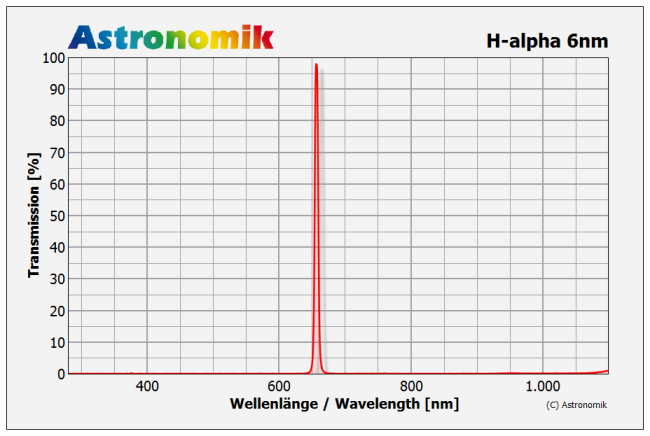
The Astronomik 6nm H-alpha filter is an extremely narrow emission-line filter for CCD photography. The filter lets the H-alpha light of emission nebulae pass and blocks nearly the whole remainder of the spectrum where the CCD is sensitive.
The full width at half-maximum (FWHM) of 6nm is optimized for a maximum contrast between the (H-alpha emitting) object and the background. The contrast gain is much higher than with our 12nm emission line filters but you won’t see as much stars in the resulting images.
The design of the transmission curve makes it possible to use the filters with instruments from 1:3.75 to 1:15. Selected filters for faster system are available upon special request.
All transmission curves of the 6nm filter are measured individually. Because of this procedure you can get the optimum filter for your telescope: If you place a direct order please specify the focal ratio of your instrument and we will select the best filter for your setup. So you may get the best filter without paying for an A+ filter.
Main use
The Astronomik H-alpha-CCD (6nm version) increases the contrast between objects, in this case between the H-alpha emission line and the skyglow background in the same way as the 12nm version. The gain in contrast is much higher due to the smaller FWHM. The 6nm H-Alpha filter is the right choice for extremely dim objects, even in the milkyway, and for observations from heavily light-polluted places. The Astronomik 6nm H-alpha-CCD completely suppresses the emission lines of artificial lighting (mercury (Hg) and sodium (Na)) and skyglow. Transmission losses and chromatic distortions, which arise with other filters, only occur with Astronomik filters when extremely bright aperture ratios come into play. Selected filters for faster systems are available upon special request.
Other uses
- Using the Astronomik 6nm H-Alpha together with the 12nm H-Alpha gives you the ability to have a maximum contrast in the HII objects and to keep the stars in the final image.
- The Astronomik 6nm H-Alpha filter may NOT be used for solar observation.
Suitability
- Visual observation (dark skies): Unsuitable
- Visual observation (urban skies): Unsuitable
- Film photography: Unsuitable
- CCD photography: Very good, huge contrast enhancement at H II-emission nebulas
- DSLR photography (original): Good, reduced sensitivity in the H-alpha band
- DSLR photography (astro modified): Very good, huge contrast enhancement at H II-emission nebulas
- DSLR photography (MC modified): Very good, huge contrast enhancement at H II-emission nebulas
- Webcam / Video (Planets): Unsuitable
- Webcam / Video (Deep Sky): Unsuitable
Technical Data
- typ. transmission von über 90% at H-Alpha (656nm)
- Parfocal with other Astronomik filters
- Glass thickness: 1mm
- Completely resistant against high humidity, scratches and aging effects
- Diffraction limited, the filter will not reduce the optical performance of your telescope!
- Astronomik filters are delivered in a high-quality, long lasting, filter box
- Since 2008 we do ship filters with a completely new design. Any kind of halo or strange reflection is a matter of past
From $210.00
The Astronomik SII-CCD filter is a narrow-band-filter for CCD photography.The filter lets the light of the ionized sulfur (SII) pass, and blocks nearly the whole remainder of the visual spectrum as well as IR, in which the CCD is sensitive.
The full width at half maximum (FWHM) of 12nm is optimal suitable for common CCD cameras and allows the use of very fast optics. The range of application extends from 1:2.8 to 1:15. Transmission losses and chromatic distortions, which arise with other filters, only occur with Astronomik filters when extremely bright aperture ratios of 1:2 and more come into play. It should be noted, that the filter has a transmission of up to 99%.
Another advantage of the 12nm filters is the good availability of guiding stars for cameras with a built-in-autoguider (SBIG). If you use a very strong filter like our 6nm filter you often won't find a usable guidestar.
The Astronomik SII CCD filter increases the contrast between objects, in this case between those with SII emission lines and the skyglow background. Also, our Astronomik SII-CCD filter completely suppresses the emission lines of artificial lighting (mercury (Hg) and sodium (Na)) and skyglow.
Main use
The Astronomik SII CCD increases the contrast between objects, in this case between the SII emission line and the skyglow background. Our Astronomik SII CCD completely suppresses the emission lines of artificial lighting (mercury (Hg) and sodium (Na)) and skyglow. Due to the high optical quality of the Astronomik H-alpha-CCD substrate you will see the same needle-sharp stars as you would from your regular telescope.
Other uses
- Using the new H-alpha-CCD and the new SII-CCD filters you can obtain three-color images of emission line objects (gas nebulae) from locations with very strong light pollution. To do so, you would take an image in three different wavelengths, select each one as a color-channel in Photoshop and paste them together as one single color image.
- If you plan to create color images from emission line data, our CLS-CCD filter is a great choice for the Luminance channel.
Suitability
- Visual observation (dark skies): Unsuitable
- Visual observation (urban skies): Unsuitable
- Film photography: It depends, but very long exposure times
- CCD photography: Very good, huge contrast enhancement at S II-emission nebulas
- DSLR photography (original): Unsuitable
- DSLR photography (astro modified): Very good, huge contrast enhancement at S II-emission nebulas
- DSLR photography (MC modified): Very good, huge contrast enhancement at S II-emission nebulas
- Webcam / Video (Planets): Unsuitable
- Webcam / Video (Deep Sky): Unsuitable
Technical Data
- typ. transmission of 95% at both SII lines (671,7nm und 673,0nm)
- Complete blocking of all disturbing wavelength ranges in the infrared
- Parfocal with other Astronomik filters
- Glass thickness: 1mm
- Completely resistant against high humidity, scratches and aging effects
- Diffraction limited, the filter will not reduce the optical performance of your telescope!
- Astronomik filters are delivered in a high-quality, long lasting, filter box
- Since 2008 we do ship filters with a completely new design. Any kind of halo or strange reflection is a matter of past
$1,160.00
ATIK 36mm 窄带滤光片组
Atik 36mm 窄带滤光片组的设计带通为 7 nm,有助于捕获星云的所有光子,同时阻止绝大多数宽带光污染。结果是信噪比更高,可以显示星云中的微弱细节。窄带滤光片组由氢-α (Ha)、硫 (SII) 和氧 (OIII) 组成。充分利用我们的特别优惠。购买任何 Atik 黑白相机(Atik GP 除外),任何滤光片组(或两个滤光片组)均可享受 50% 的折扣。
Atik 窄带 36 毫米滤光片组与我们的滤光轮兼容,可让天文摄影师捕捉壮观窄带中的深空物体。此滤光片组通常用于拍摄哈勃托盘中的物体。
Atik 窄带 36mm 滤光片组规格:
带宽:
- 精工7nm
- 哈7nm
- OIII 7nm
峰值透射率:最低 80%
CWL(波长中心):
- 哈氏656.3纳米
- 星载光学 671.6nm
- 0III 500.7nm
尺寸:36mm(未安装)
透射波前 RMS:λ/4
平行度(角秒):30秒
| 筛选 | 峰值传输 | 半宽 | 带内传输 | 带外传输 |
| 氢阿尔法 | 656.3纳米 | 7纳米 | >80% | 最大值<0.3% 平均值0.1% |
| 氧气 III | 500.7纳米 | 7纳米 | >80% | 最大值<0.3% 平均值0.1% |
| 硫磺 II | 671.6纳米 | 7纳米 | >80% | 最大值<0.3% 平均值0.1% |
库存编号:ATK0204
$719.00
ATIK LRGB 2 英寸滤镜组由亮度、红色、绿色和蓝色滤镜组成,专为 CCD 相机设计,可拍摄深空物体、星系和恒星的自然色彩。充分利用我们的特别优惠。享受 50% 折扣当您购买任何 Atik 单色相机(Atik GP 除外)时,均可获得任何滤镜组(或两套滤镜组) 。
如果您希望深空成像呈现自然色彩,LRGB 滤光片组应该是您的首选。OIII 发射重叠在蓝色和绿色滤光片上,可高效且自然地对所有深空物体进行成像。绿色和红色滤光片之间的间隙可阻挡 589nm 处的光污染线并改善图像的色彩。
ATIK LRGB 2" 规格
透光率:平均95%
尺寸:2”
镀膜波长:300-1050nm
透射波前 RMS:λ/4
平行度(角秒):30 秒
| 筛选 | 传输范围 | 带内传输 | 带外传输 |
| 亮度 | 410-680纳米 | 平均 >95%,最低 >90% | 最大值 <1% 平均值 <0.5% |
| 红色的 | 600-680纳米 | 平均 >95%,最低 >90% | 最大值 <1% 平均值 <0.5% |
| 绿色的 | 500-550纳米 | 平均 >95%,最低 >90% | 最大值 <1% 平均值 <0.5% |
| 蓝色的 | 410-500纳米 | 平均 >95%,最低 >90% | 最大值 <1% 平均值 <0.5% |
库存编号:ATK-0164
$1,069.00
ATIK 窄带 1.25 英寸滤光片的带通设计为 7 nm,有助于捕获星云的所有光子,同时阻止绝大多数宽带光污染。结果是信噪比更高,可以显示星云中的微弱细节。窄带滤光片组包括氢-α (Ha)、硫 (SII) 和氧 (OIII)。充分利用我们的特别优惠。购买任何 Atik 单色相机(Atik GP 除外),任何滤光片组(或两个滤光片组)均可享受 50% 的折扣。
ATIK 窄带 1.25 英寸滤光片组与我们的滤光轮兼容,可让天文摄影师在壮观的窄带中捕捉深空物体。该滤光片组通常用于对哈勃托盘中的物体进行成像。
ATIK 窄带 1.25 英寸规格
带宽:
- 精工7nm
- 哈7nm
- OIII 7nm
峰值透射率:最低 80%
CWL(波长中心):
- 哈氏656.3纳米
- 星载光学 671.6nm
- 0III 500.7nm
尺寸:1.25” 已安装,36mm 未安装或 2” 已安装
透射波前 RMS:λ/4
平行度(角秒):30秒
| 筛选 | 峰值传输 | 半宽 | 带内传输 | 带外传输 |
| 氢阿尔法 | 656.3纳米 | 7纳米 | >80% | 最大值<0.3% 平均值0.1% |
| 氧气 III | 500.7纳米 | 7纳米 | >80% | 最大值<0.3% 平均值0.1% |
| 硫磺 II | 671.6纳米 | 7纳米 | >80% | 最大值<0.3% 平均值0.1% |
库存编号:ATK0203
Showing 60/62
Explore Related Collections
- Choosing a selection results in a full page refresh.
- Opens in a new window.