Welcome to The Binocular and Telescope Shop
Main menu
-
Telescopes
- Telescopes
-
Types of Telescopes
-
Celestron Telescope
-
Smart Telescopes
-
Saxon Telescopes
-
Skywatcher Telescopes
-
TeleVue Telescopes
-
Planewave Telescopes
-
Vixen Telescopes
-
TEC Telescopes
-
BORG Telescopes
-
Founder Optics
-
Solar Astronomy
-
Binoculars
- Binoculars
-
Types of Binoculars
-
Vortex Binoculars
-
Nikon Binoculars
-
Swarovski Binoculars
-
Leica Binoculars
-
ZEISS Binoculars
-
Fujinon Binoculars
-
Gerber Binoculars
-
Vixen Binoculars
-
Pentax Binoculars
-
Olympus Binoculars
-
Kite Optics
-
Kowa Binoculars
-
GPO Binoculars
-
Zerotech Binoculars
-
Binocular Accessories
-
Spotting Scopes
- Spotting Scopes
-
ZEISS Spotting Scopes
-
Swarovski Spotting Scopes
-
Leica Spotting Scopes
-
Nikon Spotting Scopes
-
Vortex Spotting Scopes
-
Kowa Spotting Scopes
-
Pentax Spotting Scopes
-
Celestron Spotting Scopes
-
Spotting Scope Accessories
-
Microscopes
- Microscopes
-
Beaver Labs Microscopes
-
Celestron Microscopes
-
Digital Microscopes
-
Microscopes for Children
-
Biological Microscopes
-
Mounts & Tripods
- Mounts & Tripods
-
ZWO Mounts
-
Celestron EQ Mounts
-
iOptron Mounts
-
Vixen Mounts
-
Paramount EQ Mount
-
Saxon Mounts
-
PlaneWave Mounts
-
Skywatcher EQ Mounts
-
Losmandy EQ Mounts
-
Camera Tripods
-
Astro Star Tracker Mounts
-
Mount Accessories
-
Imaging
- Imaging
-
ZWO Cameras
-
QHY Cameras
-
Starlight Xpress
-
FLI Cameras
-
Atik Cameras
-
Pegasus Astro
-
Camera Lenses
-
SBIG Cameras
-
Focusing
-
Imaging Accessories
-
Filters (Imaging)
-
Autoguiding
-
Accessories
- Accessories
-
Eyepieces, Diagonals and Barlows
-
Adapters & Extensions
-
Books & Sky Guides
-
Bags, Cases & Covers
-
Cleaning and Maintanence
-
Collimation
-
Dew Control
-
Dovetail Bars & Plates
-
Filters (Visual)
-
Finderscopes
-
Tube Rings
-
Tele Vue Eyepieces
-
Bintel Eyepieces
-
Celestron Eyepieces
-
Vixen Eyepieces
-
Barlows & Powermates
-
Saxon Eyepieces
-
Eyepiece Kits
-
Diagonals
-
Tools
Your cart
Choose your Location
-
Bintel Glebe
Usually ready for pickup in 24 hours
Bintel 84 Wentworth park road, Glebe, 2073, NSW
Phone:(02) 9518 7255
Hours:
Monday9:30 am–5:30 pm
Tuesday9:30 am–5:30 pm
Wednesday9:30 am–5:30 pm
Thursday9:30 am–5:30 pm
Friday9:30 am–5:30 pm
Saturday9:30 am–4 pm
SundayClosed
Colour Deep Sky Cameras
23 products
23 products
Sort by:
- Featured
- Most relevant
- Best selling
- Alphabetically, A-Z
- Alphabetically, Z-A
- Price, low to high
- Price, high to low
- Date, old to new
- Date, new to old
Product Description
ASI294MC Pro
The ASI294 is the first camera in the world equipped with the latest Sony sensor IMX294CJK.
▶IMX294CJK
Sony 10.71M-Effective Pixel Color CMOS Image Sensor (official description from Sony site), with a diagonal of 21.63mm (4/3 format). ZWO has refined the sensor and remolded it to increase the diagonal to 23.2mm with approximately 11.71M-Effective pixels (4/3 format).
▶High-Sensitivity Type 4/3 CMOS Image Sensor that Supports 4K for Astronomic Cameras and Industrial Applications
The IMX294CJK sensor is the first in-house image sensor for astronomic cameras to adopt the 4/3 format and provides the necessary number of pixels for true 4k output at 120 frames per second (w/ ADC 10-bit output mode, the ASI294MC can run up to 25fps at 4k format when used with USB 3.0). In addition, the use of larger-sized pixels achieves SNR1s (link this to Sony’s page on SNR1s, so people know what it means) of 0.14 lx* which is very close to the value of the ASI224 (0.13 lx*).
▶Exceptional low-illumination performance
Exceptional low-illumination performance of SNR: 0.14 lx is realized by use of a large-size optical system and by expanding the area per pixel to 4.63 µm. This makes the IMX294CJK ideal for astronomic camera market applications that require low-illumination performance.
DDR Memory Buffer
The ASI294MC Pro camera includes a 256MB DDR3 memory buffer to help improve data transfer reliability. Additionally, the use of a memory buffer minimizes amp-glow, which is caused by the slow transfer speeds when the camera is used with a USB 2.0 port.
DDR memory buffer is the main difference between ASI “Cool” and “Pro” cameras.
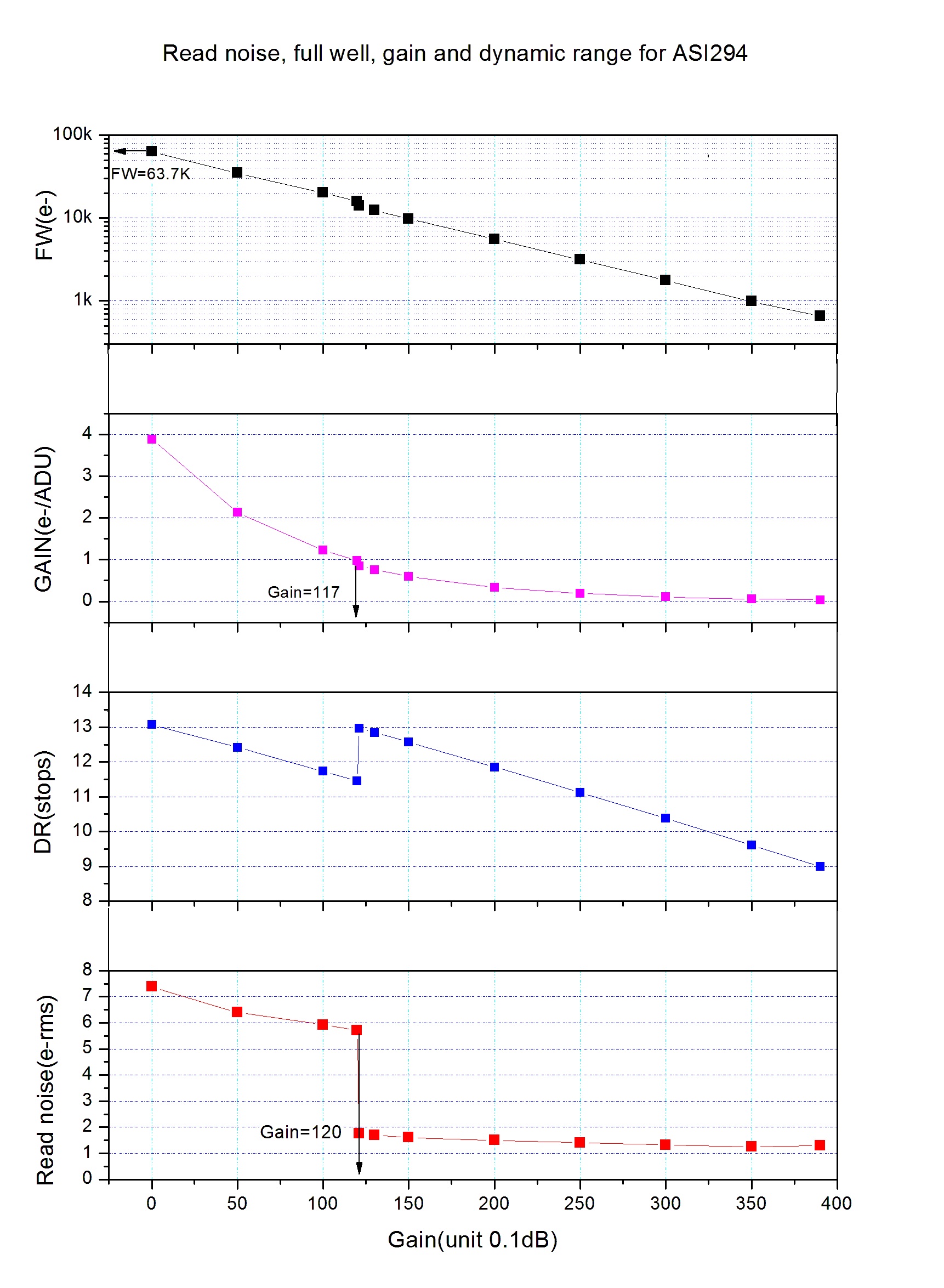
14bit ADC w/ 13 stops DR
The ASI294 has a 14bit ADC unit, allowing it to achieve 13 stops of dynamic range. This is an excellent characteristic for deep sky imaging, which is inherently high dynamic range. At 13 stops, the ASI294 has even more dynamic range than the ASI1600.
HCG Mode
HCG (high conversion gain) mode, which reduces read noise to even lower levels at higher gain without loss to dynamic range, is automatically enabled when the gain setting is 120 or higher. Read noise will drop under 2e-, while dynamic range will remain at 13 stops.
63700e full well, which is 3 times than ASI1600’s capacity. Even bright stars won’t saturate under long exposure.
This camera can achieve higher SNR(signal to noise ratio) with just one single exposure.
Reliable Mechanics
ASI294MC Pro has same mechanics as ASI1600 Pro. There are four screws that seal the sensor chamber. Our camera design has been extensively tested and is very stable.
Even when used in higher humidity environments, ASI294MC Pro will still work fine without dew problems.
High QE
The IMX294 sensor is a BSI (backside illuminated type) sensor, which has very high QE (quantum efficiency, which we estimate is over 75% peak).
Dark Current
The dark current of the ASI294 is slightly higher than the ASI1600, based on our test results.
Dark frame sample @ Highest dynamic range settings, 300s, -10°C, bin1. Please check the dark frame to make sure you fully know the performance.
USB 3.0 Port & USB2.0 HUB
USB 3.0 Port: Provide 5Gb bandwidth to make it possible for ASI294 Pro to run at 16 fps (14bit, normal mode) or 19 fps (10bit, high speed mode) at full resolution(11.7Mega).
Recommended cooler power supply: 12V @ 3-5A (or more) DC adapter (2.1×5.5mm, center pole positive). Also suitable: DC battery with 9-15V. Buy the power supply from Bintel too!
Using a battery 9-15V is also suitable for the cooler power supply.
USB 2.0 HUB: can connect with various accessories, such as filter wheel, guide camera and electronic focuser, so you can better manage your cables. The ASI294 Pro includes two short 0.5m USB 2.0 cables. The integrated USB 2.0 hub is powered by the external power source if you connect one.
Cooling System
The ASI294 Pro has a 2-stage TEC cooling system that enables deep cooling (35°C-40°C below ambient). The cooler requires an external power supply, which is not included with the camera. You may order a suitable power supply from Bintel here.
Connecting Drawing
1. M43-T2 adapter (optional)
2. EOS-T2 adapter (optional)
3. 2” Filter (optional)
4. 1.25” T-Mount
5. 1.25” Filter (optional)
6. M42-1.25” adapter
7. T2 extender 11mm
Mechanical Drawing
What is in the box?
ASI294 Pro box includes all necessary cables, adapters, and manuals.
Notice:Cooled cameras need a 12v power adapter, If you don’t have one, please click this link to buy a 12V power adapter. There are 4 different standards for the different country, please choose it carefully.
Drivers and Softwares:
The ZWO website is always updated with the most recent camera drivers as well as software for DSO and planetary imaging. Please make sure the most recent drivers and software from the ZWO website has been installed before you start shooting:
It is also recommended to read the manuals first before shooting.
Product review:
https://www.cloudynights.com/topic/591441-asi-new-camera-294-pro-beta-testing/page-11#entry8165708
Camera Technical Details
| Sensor | 4/3″ SONY IMX294 CMOS |
| Sensor Diagonal | 23.2 mm |
| Resolution | 11.7 MP (4144 × 2822) |
| Pixel Size | 4.63 μm |
| Bayer Pattern | RGGB |
| Shutter Type | Rolling shutter |
| Exposure Range | 32 μs – 2000 s |
| ROI | Supported |
| Read Noise | 1.2 e⁻ @ 39 dB gain |
| QE Peak | TBD |
| Full Well Capacity | 63.7 ke⁻ |
| ADC | 14-bit |
| DDRIII Buffer | 256 MB |
| Interface | USB 3.0 / USB 2.0 |
| Adaptor | M42 × 0.75 |
| Protect Window | AR window |
| Dimensions | 78 mm diameter |
| Weight | 410 g |
| Back Focus Distance | 6.5 mm |
Cooling & Power
| Cooling | Regulated two-stage TEC |
| Delta T | 35°C – 40°C below ambient |
| Camera Power Consumption | 650 mA @ 5 V |
| Cooler Power Consumption | 12 V @ 3 A (max) |
Environmental Conditions
| Working Temperature | −5°C to 45°C |
| Storage Temperature | −20°C to 60°C |
| Working Relative Humidity | 20% – 80% |
| Storage Relative Humidity | 20% – 95% |
Max FPS at Full Resolution
| ADC Mode | Resolution | Max FPS |
|---|---|---|
| 10-bit | 4144 × 2822 | 19 fps |
| 14-bit | 4144 × 2822 | 16 fps |
Additional resolutions are available in software and support custom resolution selection.
ZWO ASI533MC-Pro
ASI 533MC-P is the new One Shot Colour cameras from ZWO.
Sensor is the square back illuminated Sony ExMor IMX533 sensor.
Resolution is 3008 x 3008 with 3.76um pixels.
The sensor size is 11.31mm x 11.31mm for 9.07Mp.
Max FPS at Full Resolution is 20FPS.
Read Noise is very low at 1.0e to 3.83e
QE peak up to 80%
Full Well is 50Ke
Exposure Range is 32us – 2000s
ADC 14bit
Cooling to -40 ° ambient temperature.
256MB internal DDR3 memory
The ASI533MC PRO features SONY’s latest back illuminated IMX533 sensor, with a 1-inch square, 9.07MP sensor that is ideal for astronomical photography needs and can be considered as the latest iteration of the venerable ASI183MC Pro.
As you would expect this latest generation camera not only retains key features of the ASI183 series such as an attractive QE figure, high frame rate and along with other excellent characteristics of the ASI183 cameras, but also now includes new and improved features such as zero amp glow, extreme low read out noise (as low as 1.0e), 3.76 microns pixel size and an improved 2 stage TEC cooler giving enhanced cooling capabilities.
1” square sensor
The IMX533 is a 1-inch, 9MP CMOS image sensor in a square format with a 3.76 um pixel size, capable of producing frames at 20 frames/sec in 14bit mode.
Read out noise is as low as 1.0e which makes it comparable to SCMOS or EMCCD sensors and highly suitable for high definition, low noise imaging.
IMX533 backlit sensor
Sony’s back-illuminated CMOS image sensor improves sensitivity and noise reduction – the key factors to enhancing image quality, while radically realigning their fundamental pixel structure from front-illumination to back-illumination. It has retained the advantages of CMOS image sensors such as low power consumption and high-speed operation.
With a conventional front-illumination structure, the metal wiring and transistors on the surface of the silicon substrate that form the sensor’s light-sensitive area (photo-diode) impede photon gathering carried out by the on-chip lens. A back-illuminated structure minimizes the degradation of sensitivity to optical angle response, while also increasing the amount of light that enters each pixel due to the lack of obstacles such as metal wiring and transistors that have been moved to the reverse of the silicon substrate.
Sony has newly developed a unique photo-diode structure and on-chip lens optimized for back-illuminated structures, that achieves a higher sensitivity and a lower random noise without light by reducing noise, dark current and defect pixels compared to the conventional front-illuminated structure.
Camera Performance
Low read-out noise, high dynamic range.
ASI533MC Pro – ASI183MC Pro Comparision
ASI183MC Pro
Introducing the ASI183 camera series, the most sensitive cameras in ZWO history. Peak Q.E. of the mono sensor reaches 84%!
▶IMX183CLK-J/CQJ-J
Diagonal 15.86 mm Approx. 20.48M-Effective Pixel Monochrome/Color CMOS Image Sensor
▶High-Speed and High-Picture-Quality Rolling Shutter-Type Back-Illuminated CMOS Image Sensors
In the astronomic application field, Sony IMX183CLK-J (monochrome) and IMX183CQJ-J (color) sensors uses a very high sensitivity back-illuminated structure with high resolution 2.4 μm square unit pixel. The optical size is 1 inch.
DDR Memory Buffer
The ASI183 Pro camera includes a 256MB DDR3 memory buffer to help improve data transfer reliability. Additionally, the use of a memory buffer minimizes amp-glow, which is caused by the slow transfer speeds when the camera is used with a USB 2.0 port.
Astrophotography Performance
The ASI183 cameras has a very large full well capacity(15000e) for such small pixel size, 1.6e read noise @ 30DB, and 12stops dynamic range @ Gain=0. The ASI183 cameras also utilize firmware features to minimize amplifier glow for maximum performance in astrophotography.
Reliable Mechanics
ASI183 Pro has same mechanics as ASI1600 Pro. There are four screws that seal the sensor chamber. Our camera design has been extensively tested and is very stable.
Even when used in higher humidity environments, ASI183 Pro will still work fine without dew problems.
High Speed
Fast FPS can be used in solar and lunar imaging, as well as for live viewing/EAA.The high speed readout may also be used for real-time focusing, true lucky imaging of double stars and other small objects, planetary imaging of the major planets in the solar system, and much more.
10Bit ADC
5496×3672 19fps
3840×2160 41.04fps
1920×1080 80.10fps
1280×720 117.30fps
12bit ADC
5496×3672 19fps
3840×2160 36.12fps
1920×1080 70.48fps
1280×720 103.23fps
High QE
Sony’s back-illuminated Exmor R technology, giving it excellent Deep Sky performance. ASI183 QE peak reaches a remarkable 84%. In Ha channel, QE is still over 60%.
Having high QE means more of the light that enters your telescope and reaches the sensor is actually used. With 84% peak Q.E. and no less than ~50% within the visible spectrum, the ASI183 will utilize a high percentage of the light that reaches it, improving your signal quality.
Dark Current
The dark current of the ASI183 is extremely low, based on our test results.
USB 3.0 Port & USB2.0 HUB
USB 3.0 Port: Provide 5Gb bandwidth to make it possible for ASI183 Pro to run at 19 fps (12bit, normal mode) or 19 fps (10bit, high speed mode) at full resolution(20.18Mega).
Recommended cooler power supply: 12V @ 3-5A (or more) DC adapter (2.1×5.5mm, center pole positive). Also suitable: DC battery with 9-15V.
Using a battery with 9-15V is also suitable for the cooler power supply.
USB 2.0 HUB: can connect with various accessories, such as filter wheel, guide camera and electronic focuser, so you can better manage your cables. The ASI183 Pro includes two short 0.5m USB 2.0 cables. The integrated USB 2.0 hub is powered by the external power source if you connect one.
Cooling System
The ASI183 Pro has a 2-stage TEC cooling system that enables deep cooling (40°C-45°C below ambient). The cooler requires an external power supply, which is not included with the camera.
Connecting Drawing
1. M43-T2 adapter
2. EOS-T2 adapter
3. 2”Filter (optional)
4. 1.25” T-Mount
5. 1.25” Filter (optional)
6. M42-1.25” adapter (optional)
7. T2 extender 11mm
Mechanical Drawing
What is in the box?
ASI183 Pro box includes all necessary cables, adapters, and manuals.
Camera Specifications
| Sensor | 1″ CMOS IMX183CLK-J / CQJ-J |
| Sensor Diagonal | 15.9 mm |
| Resolution | 20.18 MP (5496 × 3672) |
| Pixel Size | 2.4 μm |
| Bayer Pattern | RGGB |
| Shutter Type | Rolling shutter |
| Exposure Range | 32 μs – 2000 s |
| ROI | Supported |
| Read Noise | 1.6 e⁻ @ 30 dB gain |
| QE Peak | 84% |
| Full Well | 15 ke⁻ |
| ADC | 12-bit |
| DDRIII Buffer | 256 MB |
| Interface | USB 3.0 / USB 2.0 |
| Adaptor | M42 × 0.75 |
| Protect Window | AR window |
| Dimensions | 78 mm diameter |
| Weight | 410 g |
| Back Focus Distance | 6.5 mm |
Cooling & Power
| Cooling | Regulated two-stage TEC |
| Delta T | 40°C – 45°C below ambient |
| Camera Power Consumption | 650 mA @ 5 V |
| Cooler Power Consumption | 12 V @ 3 A (max) |
Environmental Conditions
| Working Temperature | −5°C to 45°C |
| Storage Temperature | −20°C to 60°C |
| Working Relative Humidity | 20% – 80% |
| Storage Relative Humidity | 20% – 95% |
Max FPS at Full Resolution (10-bit ADC)
| Resolution | Max FPS |
|---|---|
| 5496 × 3672 | 19 fps |
| 3840 × 2160 | 41.04 fps |
| 1920 × 1080 | 80.10 fps |
| 1280 × 720 | 117.30 fps |
| 640 × 480 | 169.92 fps |
| 320 × 240 | 308.17 fps |
Max FPS at Full Resolution (12-bit ADC)
| Resolution | Max FPS |
|---|---|
| 5496 × 3672 | 19 fps |
| 3840 × 2160 | 36.12 fps |
| 1920 × 1080 | 70.48 fps |
| 1280 × 720 | 103.23 fps |
| 640 × 480 | 149.53 fps |
| 320 × 240 | 271.19 fps |
The ASI183MC, ZWO's most sensitive camera to date with a peak absolute Q.E. of 84% in mono made possible by a back illuminated sensor.
Introducing the ASI183 camera series, the most sensitivie cameras in ZWO history. Peak Q.E. of the mono sensor reaches 84%!
▶IMX183CLK-J/CQJ-J
Diagonal 15.86 mm Approx. 20.48M-Effective Pixel Monochrome/Color CMOS Image Sensor
▶High-Speed and High-Picture-Quality Rolling Shutter-Type Back-Illuminated CMOS Image Sensors
In the astronomic application field, Sony IMX183CLK-J (monochrome) and IMX183CQJ-J (color) sensors uses a very high sensitivity back-illuminated structure with high resolution 2.4 μm square unit pixel. The optical size is 1 inch.
Astrophotography Performance
The ASI183 cameras has a very large full well capacity(15000e) for such small pixel size, 1.6e read noise @ 30DB, and 12stops dynamic range @ Gain=0. The ASI183 cameras also utilize firmware features to minimize amplifier glow for maximum performance in astrophotography.
High Speed
Fast FPS can be used in solar and lunar imaging, as well as for live viewing/EAA.The high speed readout may also be used for real-time focusing, true lucky imaging of double stars and other small objects, planetary imaging of the major planets in the solar system, and much more.
10Bit ADC
5496×3672 19fps
3840×2160 41.04fps
1920×1080 80.10fps
1280×720 117.30fps
12bit ADC
5496×3672 19fps
3840×2160 36.12fps
1920×1080 70.48fps
1280×720 103.23fps
High QE
Sony’s back-illuminated Exmor R technology, giving it excellent Deep Sky performance. ASI183 QE peak reaches a remarkable 84%. In Ha channel, QE is still over 60%.
Having high QE means more of the light that enters your telescope and reaches the sensor is actually used. With 84% peak Q.E. and no less than ~50% within the visible spectrum, the ASI183 will utilize a high percentage of the light that reaches it, improving your signal quality.
USB 3.0 Port & ST4 Port
USB 3.0 Port: Provide 5Gb bandwidth to make it possible for ASI183 to run at 19 fps (12bit, normal mode) or 19 fps (10bit, high speed mode) at full resolution(20.18Mega).
ST4 Port: Can be used connect with auto guide port of mount, for guiding.
Mechanical Drawing
What is in the box?
ASI183 box includes all necessary cables, adapters, and manuals.
Camera Technical Details
| Sensor | 1″ CMOS IMX183CLK-J / CQJ-J |
| Sensor Diagonal | 15.9 mm |
| Resolution | 20.18 MP (5496 × 3672) |
| Pixel Size | 2.4 μm |
| Bayer Pattern | RGGB |
| Shutter Type | Rolling shutter |
| Exposure Range | 32 μs – 2000 s |
| ROI | Supported |
| ST4 Guider Port | Yes |
| Read Noise | 1.6 e⁻ @ 30 dB gain |
| QE Peak | 84% |
| Full Well Capacity | 15 ke⁻ |
| ADC | 12-bit |
| Interface | USB 3.0 / USB 2.0 |
| Adaptor | 2″ / 1.25″ / M42 × 0.75 |
| Dimensions | φ62 mm × 36 mm |
| Weight | 120 g (4.2 oz, without lens) |
Environmental Conditions
| Working Temperature | −5°C to 45°C |
| Storage Temperature | −20°C to 60°C |
| Working Relative Humidity | 20% – 80% |
| Storage Relative Humidity | 20% – 95% |
Max FPS at Full Resolution (10-bit ADC)
| Resolution | Max FPS |
|---|---|
| 5496 × 3672 | 19 fps |
| 3840 × 2160 | 41.04 fps |
| 1920 × 1080 | 80.10 fps |
| 1280 × 720 | 117.30 fps |
| 640 × 480 | 169.92 fps |
| 320 × 240 | 308.17 fps |
Max FPS at Full Resolution (12-bit ADC)
| Resolution | Max FPS |
|---|---|
| 5496 × 3672 | 19 fps |
| 3840 × 2160 | 36.12 fps |
| 1920 × 1080 | 70.48 fps |
| 1280 × 720 | 103.23 fps |
| 640 × 480 | 149.53 fps |
| 320 × 240 | 271.19 fps |
Note:
External power supplies are needed for all ASl-cooled cameras. We recommend you use a 12V@3A~5A DC adapter (D5.5×2.1mm, center pole positive) or a lithium battery with 11-14V to power the camera. You can also use ASIAlR to power the cameras. Be aware that using a power supply out of this voltage range will probably lead to irreparable damage to the camera.
One Camera for All
The STARVIS 2 technology brings ASI585MC Pro more advanced imaging performance compared to other cooled cameras. Its high frame rate makes it not only suitable for DSO photography but also solar/lunar/planetary photography.
Jupiter -Jim Rivera
Moon -Christopher Schementi
NGC3372 ( eta Carina) -Simon Lewis
M42, NGC 1976 (Great Orion Nebula) -Simon Lewis
STARVIS 2
STARVIS 2 was developed by SONY and evolved from STARVIS. It is the latest technology with a wider dynamic range and super-high sensitivity beyond the human eye. Benefiting from it, ASI585MC Pro’s sensitivity and signal-to-noise ratio is greatly improved.
Large Full Well Capacity
The back-illuminated structure improves the camera’s full well capacity. Even with unbinned 2.9μm pixels, ASI585MC Pro has a full well capacity of 40ke-, nearly 3 times that of the last-generation sensor IMX485. A larger full well capacity gets the camera higher efficiency in collecting light, can effectively restrain the highlight area from being overexposed, and also can improve the signal-to-noise ratio.
Zero Amp Glow
ASI585MC Pro exhibits extremely clean dark frames with zero amp glow! No matter how long the exposure and how high the gain value is, you can easily get clean and smooth astro images!
Note: This feature is implemented directly at the hardware level, it does not require software control.
512MB DDR3
ASI585MC Pro uses a USB 3.0 interface, along with the built-in 512MB DDR3 cache, ensuring high-speed, smooth, and stable data transmission.
USB 3.0 Port & USB 2.0 HUB
USB 3.0 Port: Provides 5Gb bandwidth to allow ASI585MC Pro to run at 47fps at 8.29MP full resolution (10bit, high-speed mode).
USB 2.0 HUB: Can be used to connect various kinds of USB devices such as EFW, guide camera, and EAF.
Two-stage TEC Cooling
Thanks to the two-stage TEC cooling, ASI585MC Pro can lower the CMOS sensor temperature to more than 35 degrees Celsius below ambient temperature, which can greatly reduce dark current generation and sensor noise even during extended exposure times.
*The Delta T 35℃ is tested at 30℃ ambient temperature. It might get down when the cooling system is working for a long time. Also, as the ambient temperature falls, the Delta T would decrease.
Below is the dark current curve of ASI585MC Pro at the temperature from -20℃ to 30℃.
Camera Performance
Low read noise, High dynamic range
The camera has a built-in HCG mode, which can effectively reduce read noise at high gain and allow the camera to maintain the same high dynamic range as it does at low gain. When the gain reaches 252, the HCG mode will be automatically turned on and the dynamic range reaches a level close to 11bit. The read noise in this case can be as low as 0.9e. QE (Quantum efficiency)
Based on our testing results, the QE peak value of ASI585MC Pro is 91%. Connection Methods (Back Focus Distance: 55mm)
Connection to External Devices
Structural Dimension Diagram
In the Box
ZWO ASI585MC Pro is a perfect match for either of these APO telescopes
NEW Smart Deep-sky imaging colour camera from ZWO with Guiding, Imaging and Smart Control of mounts and accessories.
The ASI585MC Air is ZWO’s newly released ultra-sensitive wireless smart deep-sky camera, it integrates a deep-space sensor, a guiding sensor and a smart astrophotography controller. With this all-in-one design, capturing stunning astrophotography has never been easier!
10 Key highlights
1.3 in 1 Camera: Imaging, Guiding, Control System
2.256G eMMC Storage
3.STARVIS 2 Technology
4.4K Resolution
5.Multiple Interface (Type-C x1 USB 2.0 x4 DC 12V 10A x2)
6.5G/2.4G Dual-band Wi-Fi / Bluetooth
7. Intelligent Live Stacking
8. High Signal-to-Noise Ratio, High Sensitivity
9. Voice Broadcast
10.Get Fully Control of Your Entire Rig at Your Fingertips
Featuring ZWO's self-developed "Dual Sensor + ASIAir" integration technology. Say goodbye to complex setups and enjoy a seamless, hassle-free astrophotography experience.
Smarts developed in-house by ZWO
Easily Connect to Multiple Devices
4x USB 2.0, 2x DC12V 3A, 1x USB Type-C
USB 2.0 ports for your focuser, filter wheel, and mount; DC 12V 3A input/output ports for reliable power; USB Type-C port for fast file transfers—you can focus on capturing stunning images without worrying about connectivity issues.
256G eMMC Storage: Ample Storage and Stability
With 256GB eMMC storage, the ASI585MC Air allows you to capture multiple targets with ease. Rigorously tested with over 300 benchmarks, it ensures system stability. Plus, the USB 2.0 ports support up to 1TB external storage, giving you plenty of room for all your astrophotography needs.
Starvis 2 4k Sensor
Image Sensor Technology Beyond the Human Eye's Sensitivity
Equipped with the upgraded STARVIS 2 image sensor, supporting a higher dynamic range.
With this technology, the sensitivity and signal-to-noise ratio of the ASI585MC Air are greatly enhanced, delivering exceptional image quality.
Complete Control of Your Entire Rig at Your Fingertips
The ASI585MC Air incorporates multiple ZWO patented technologies and allows you to shoot simply by connecting your phone. It supports App OTA updates, continuously improving the product features, making astrophotography easy and fun, while enriching the user experience
Instant Post-Processing and Sharing
Live stack is supported during your imaging session. You may also make adjustments to brightness, contrast and others on the final image. Instantly share your masterpieces on social media platforms and astronomy communities, making your work stand out.
Low Read Noise, High Dynamic Range
The camera has a built-in HCG mode, which can effectively reduce readout noise at high gain and allow the camera to maintain the same high dynamic range as it does at low gain. When the gain is 252, the HCG mode is automatically turned on and the Dynamic range reaches a level close to 12bit.The readout noise is as low as 0.7e.
QE
Based on ZWO Laboratory calculations, the peak quantum efficiency of ASI585MC Air is 91%
Data source: This data is from ZWO Laboratory. The actual quantum efficiency peak value is subject to real-world data.
Cooling System
Thanks to the two-stage TEC cooling, ASI585MC Air can lower the CMOS sensor temperature to 30-35 degrees Celsius below ambient temperature, which can greatly reduce dark current generation and sensor noise even during extended exposure times.
Power Consumption
IR-Cut coating for OSC camera
Frame Rate
Product Specifications
Camera Specifications
Camera Details
Telescope Connections
Mechanical Diagram
What's in the Box
- Camera body
- T2 extender(21mm)
- T2-M48 extender
- M42-M48 tilter
- USB2.0 cable
- DC 1m cable
- DC 1.5m male-female extension cable
- External antenna
- 2mm M2.5 hex wrench
- Quick guide
- 1m hook&loop tape
The ASI2600 Duo CMOS Camera combines imaging and guiding sensor in one compact body. The main sensor is the Sony IMX571 coming with a native 16bit ADC, 14stops dynamic range and 3.76um square pixel array. The readout noise is as low as 1.0e, and the full well capacity reaches an incredible level of 80ke. And it has no amp glow!
The guide sensor is the Type 1/1.8 SC2210 with excellent NIR sensitivity. The sensor size is 7.68mm x 4.32mm. It has 4umx4um pixels with an array of 1920x1080 and a full depth of 8780e.
The stars on the corner of the guide images affected by reducers back focus distance might not be very round. It is not due to the sensor tilt and will not affect normal use.
Please note that external power supplies are required for all ZWO ASI cooled cameras. Contact BINTEL for the correct power supply or advice to suit your ZWO camera.
Two-in-one design
Thanks to the compact design, the ASI2600MC Duo only needs one USB cable for control. It reduces potential cabling issues and improves setup speeds. You don’t need a separate OAG and guide camera.
Tilt Adjustment from Rear(Optional)
The 3 points from the rear make tilt adjustment much easier without the trouble of removing the tilt plate from the camera.
Performance improvement comparison
Guide sensor
The SC2210 sensor taken from the ASI220MM Mini camera features very high sensitivity. The QE peak value reaches 92% at 500nm. The readout noise is as low as 0.6e. As the new generation of guide sensor, it has achieved great results in guiding, proved by hundreds of astrophotographers.
Main sensor
The main sensor IMX571 features an APS-C format and 26MP total pixels. The size is 23.5mm in width x 15.7mm in height, and the diagonal is 28.3mm. The 3.76um x 3.76um small pixel size accommodates an impressive full depth of 50ke. With the new hardware technology, it is even extended to 80ke.
STARVIS technology
ASI2600 Duo CMOS Camera is based on Sony STARVIS technology. Sony’s back-illuminated CMOS image sensor improves sensitivity and noise reduction – the key factors to enhancing image quality.
Camera performance
Native 16bit ADC
This 16-bit ADC is not a CCD 16-bit ADC. It can really achieve a dynamic range output of 14stops, which will significantly improve the image sharpness and contrast, and also create smoother and more natural color transitions.
FPS
ASI2600 Duo CMOS Camera’s max FPS in RAW 8 mode at full resolution is 15FPS, which is even quicker compared to ASI2600MC Pro.
Extended full well mode
The full well capacity of ASI2600MC Duo is extended to 80ke, which is 1.6x larger than ASI2600MC Pro.
USB 3.0 & 512MB DDR3 buffer
With the match of USB 3.0 and 512MB DDR3 buffer, ASI2600MCDuo provides stable and secure data transmission that can effectively avoid frame-dropping issues during long exposures.
No amp-glow
Traditional CMOS sensors produce a weak infrared light source during operation quite often seen in the corner of uncalibrated images. It is the tell-tale sign of amp glow. As the ASI2600MM Duo uses zero-amp glow circuitry, you won’t have to worry about amp glow even when using high gain, long exposure imaging.
QE (Quantum efficiency)
Based on our testing results, the QE peak value of ASI2600MC Duo is over 91%.
Two-stage TEC cooling
Thanks to the two-stage TEC cooling, ASI2600MM Duo can lower the CMOS sensor temperature to more than 35 degrees Celsius below ambient temperature, which can greatly reduce dark current generation and sensor noise even during extended exposure times.
*The Delta T 35℃ is tested at 30℃ ambient temperature. It might get downto this when the cooling system is working for a long time. Also, as the ambient temperature falls, the Delta T would decrease.
What’s in the Box
Main Sensor
The main sensor IMX571 features an APS-C format and 26MP total pixels. The size is 23.5mm in width x 15.7mm in height, and the diagonal is 28.3mm. The 3.76um x 3.76um small pixel size accommodates an impressive full depth of 50ke. With the new hardware technology, it is even extended to 73ke.
Guide Sensor
The SC2210 sensor taken from the ASI220MM Mini camera features very high sensitivity. The QE peak value reaches 92% at 500nm. The read noise is as low as 0.6e. As the new generation of guide sensor, it has achieved great results in guiding, proved by hundreds of astrophotographers.
Start Your Astrophotography Journey with Great Convenience
The ASI2600MC Air combines guiding, imaging, and smart control into one compact, lightweight device. Say goodbye to complex setups and enjoy a seamless, hassle-free astrophotography experience.
Effortlessly Connect Multiple Devices
4x USB2.0, 3x DC12V 10A, 1x USB Type-C
USB 2.0 ports for your focuser, filter wheel, and mount; DC 12V 10A input/output ports for reliable power; and USB Type-C port for fast file transfers—you can focus on capturing stunning images without worrying about connectivity issues.
Shoot with Confidence: Ample Storage and Stability
With a massive 256GB eMMC storage, the ASI2600MC Air allows you to capture multiple targets with ease. Rigorously tested with over 300 benchmarks, it ensures system stability. Plus, the USB 2.0 ports support up to 1TB external storage, giving you plenty of room for all your astrophotography needs.
Cross-Platform Device Control
Except from ASIAIR App, ASI2600MC Air can also wirelessly connect to ZWO’s proprietary PC control software, ASIStudio, and also other 3rd-party PC software. 3rd-party software can be controlled through ASCOM extended protocol Alpaca (requires ASCOM Platform version V6.6 or higher).
Bluetooth Connection Supported
Nice and Neat Wiring with AM3/AM5
Frame Rate
Camera Specifications
The best solution of 55mm back focus length
Mechanical Diagram
Camera Details
What is in the box?
$5,199.00
The Atik 460EX offers the latest and greatest of Sony's CCDs, the ICX694. Featuring the latest generation EXview technology, this camera has outstanding Quantum Efficiency, very low noise, and excellent thermal management.
This model is an ideal match for telescopes commonly used by amateurs, up to bigger SCTs or RCs. Its excellent sensitivity makes it one of the best cameras for deep-sky astrophotography, offering a logical upgrade path for smaller CCD camera owners looking for uncompromising performance.
With more than twice the imaging area than the venerable ICX285, it will satisfy the need for larger sky coverage while maintaining excellent low-noise characteristics.
The Atik 460EX fully supports 1.25" filters down to f/2, so you won't need to replace any of your current investments in wheels or filters. This is an added advantage when looking to invest in a CCD camera that may go through multiple telescopes.
The Atik-4 Series cameras are a development of the renowned 3-Series cameras, featuring better cooling and a narrower body. They benefit from setpoint cooling to make taking matching dark frames a snap, and simple 12V power requirement to facilitate field operation. The impressive sensitivity, great cooling, and narrow profile make the Atik Series 4 outstanding CCD cameras to use on modern telescopes, including Hyperstar/Fastar systems.
Specifications
| Sensor Type: | CCD - Sony ICX694 |
| Horizontal Resolution: | 2750 pixels |
| Vertical Resolution: | 2200 pixels |
| Pixel Size: | 4.54 µM x 4.54 µM |
| ADC: | 16 bit |
| Readout Noise: | 5e- typical value |
| Interface: | Mini-USB 2.0 High Speed |
| Power: | 12v DC 1A |
| Maximum Exposure Length: | Unlimited |
| Minimum Exposure Length: | 1/1000 s |
| Cooling: | Thermoelectric set point with max ΔT=-25°C |
| Weight: | approx. 400 grams |
| Backfocus: | 13mm |
$3,299.00
Specifications for the Atik 414EX Colour
| Sensor Type | Sony ICX825AQ |
| Horizontal Resolution | 1392 pixels |
| Vertical Resolution | 1040 pixels |
| Pixel Size | 6.45 µM x 6.45 µM |
| ADC | 16 bit |
| Readout Noise | 5 e- typical value |
| Interface | USB 2 High Speed |
| Power | 12v DC 1.0A |
| Minimum Exposure | 1/1000th sec. |
| Maximum Exposure | unlimited |
| Cooling | Thermoelectric set point with max ΔT= >-30°C. |
| Weight | approx. 400 g |
Sony EXview HAD CCD II ICX825 sensor - Super Sensitive
The fact that you're reading this this shows you've made it past the most common trap in choosing a camera for astroimaging - how many megapixels is it?
There are 2 variables in your camera that are far more important to consider when imaging faint deep sky objects. Sensitivity and noise.
The sensitivity tells us how many precious photons will be converted to signal...this is were the Sony ICX825 shines! But how much more sensitive is it? Compared with Atik's previous 314L+ at 650nm, the 414EX is 60% more sensitive. In fact, the 414EX is even more sensitive than the already spectacular 460EX, making it the perfect camera for the enthusiast with a limited budget. The graph below shows the striking difference between the ICX285 and ICX825:
Low noise and effective cooling
Atik's 414EX has more than just great sensitivity.
Another feature of the 414EXmaking it a winner for astrophotography is it's exceptionally low noise. When capturing a stunning portrait of your favourite deep sky target you will understand how delicately faint it is. This means the data you wish to capture is sparse.
If the electronics of the camera add noise (unwanted signal) to your image the end result will be lacking in detail and contrast. To ensure the contribution from noise is minimised Atik's 414EX has thermoelectric cooling that can easily lower the CCD chip to 30ºC below ambient, and is regulated, so that your image calibration is consistent. This results in a noise level so low that for most applications dark frames are an option rather than a requirement. The upshot is that you can spend more time imaging!
With the advantage of low readout noise and high-speed readout, CMOS technology has revolutionized astronomical imaging. A monochrome, back-illuminated, high-sensitivity, astronomical imaging camera is the ideal choice for astro-imagers. The QHY600M-L uses the latest SONY back-illuminated sensor, the IMX455, a full frame (35mm format) sensor with 3.76um pixels and native 16-bit A/D. This sensor is available in both monochrome and color versions. The QHY600C-PH SBFL ends the days of non-16bit CMOS cameras and it ends the days non-full frame (and larger) monochrome CMOS cameras.
The QHY600C-PH SBFL has extremely low dark current (0.002e/p/s@-20C) using SONY’s Exmor BSI CMOS technology. QHY600C-PH SBFL is also a zero amplifer glow camera. The QHY600C-PH SBFL has only one electron of read noise at high gain and full resolution and 4FPS readout speed. One electron of read noise means the camera can achieve a SNR>3 at only 4 to 6 photons. This is perfect performance when conditions are photon limited, i.e., short exposures, narrow band imaging, etc., making this large area sensor ideal for sky surveys, time domain astronomy, fluorescence imaging, DNA sequencing and microscopy.
Models
QHY600 Series have mutiple models which covers both photographic and scientific using. Below list different types of QHY600 PH (photographic) series:
QHY600PH : Standard version for amateur astrographers;
2GB DDR3 image buffer
In order to provide smooth uninterrupted data transfer of the entire 60MP sensor at high speed, the QHY600 has 2GB DDR3 image buffer. The pixel count of the latest generation of CMOS sensors is very high resulting in greater memory requirements for temporary and permanent storage. For example, the QHY600 sensor produces about 120MB of data per frame. The data band-width is also increased from the original 16-bits to the current 32-bits. Transferring such a large file sizes necessarily requires the camera to have sufficient memory. The QHY600 has adopted a large-capacity memory of up to 2GB. Data throughput is doubled. This large image buffer meets the needs of high-speed image acquisition and transmission of the new generation of CMOS, making shooting of multiple frames smoother and less stuttered, further reducing the pressure on the computer CPU.
Another advantage is that when using some computers that do not have fast processors or have poor support for USB 3.0, the computer can’t transfer high-speed data well, and the data is often lost. The DDR can buffer a lot of image data and send it to the computer. Even if the USB 3.0 transmission frequently gets suspended, it will ensure that data is not lost. There are options in SharpCap to turn DDR buffering on or off. The current version of the ASCOM driver works in DDR mode.
Native 16 bit A/D: The new Sony sensor has native 16-bit A/D on-chip. The output is real 16-bits with 65536 levels. Compared to 12-bit and 14-bit A/D, a 16-bit A/D yields higher sample resolution and the system gain will be less than 1e-/ADU with no sample error noise and very low read noise.
BSI: One benefit of the back-illuminated CMOS structure is improved full well capacity. This is particularly helpful for sensors with small pixels. In a typical front-illuminated sensor, photons from the target entering the photosensitive layer of the sensor must first pass through the metal wiring that is embedded just above the photosensitive layer. The wiring structure reflects some of the photons and reduces the efficiency of the sensor. In the back- illuminated sensor the light is allowed to enter the photosensitive surface from the reverse side. In this case the sensor’s embedded wiring structure is below the photosensitive layer. As a result, more incoming photons strike the photosensitive layer and more electrons are generated and captured in the pixel well. This ratio of photon to electron production is called quantum efficiency. The higher the quantum efficiency the more efficient the sensor is at converting photons to electrons and hence the more sensitive the sensor is to capturing an image of something dim.
Zero Amplify Glow: This is also a zero amplifer glow camera.
TRUE RAW Data: In the DSLR implementation there is a RAW image output, but typically it is not completely RAW. Some evidence of noise reduction and hot pixel removal is still visible on close inspection. This can have a negative effect on the image for astronomy such as the “star eater” effect. However, QHY Cameras offer TRUE RAW IMAGE OUTPUT and produces an image comprised of the original signal only, thereby maintaining the maximum flexibility for post-acquisition astronomical image processing programs and other scientific imaging applications.
Anti-Dew Technology: Based on almost 20-year cooled camera design experience, The QHY cooled camera has implemented the fully dew control solutions. The optic window has built-in dew heater and the chamber is protected from internal humidity condensation. An electric heating board for the chamber window can prevent the formation of dew and the sensor itself is kept dry with our silicon gel tube socket design for control of humidity within the sensor chamber.
Cooling: In addition to dual stage TE cooling, QHYCCD implements proprietary technology in hardware to control the dark current noise.
Multiple Readout Modes are special for QHY 16-bit Cameras (QHY600/268/461/411). Different readout modes have different driver timing, etc., and result in different performance. See details at “Multiple Readout Modes and Curves” Part.
You may find some types of thermal noise can change with time in some back-illuminated CMOS cameras. This thermal noises has the characteristic of the fixed position of typical thermal noise, but the value is not related to the exposure time. Instead, each frame appears to have its own characteristics. The QHY600/268/461/411 use an innovative suppression technology that can significantly reduce the apparent level of such noise.
UVLO(Under Voltage Locking) is to protect the electronic device from damage caused by abnormally low voltages.
Our daily life experience tells us that the actual operational voltage of an electrical device must not significantly exceed the rated voltage, otherwise it will be damaged. For such precision equipment as cameras, long-term work at too low input voltage can also be detrimental to the working life of the camera, and may even make some devices, such as power manager, burn up due to long-term overload. In the all-in-one driver and SDK after 2021.10.23 stable version, the camera will give a warning when the input voltage of the camera is below 11V.
It is common behavior for a CMOS sensor to contain some horizontal banding. Normally, random horizontal banding can be removed with multiple frame stacking so it does not affect the final image. However, periodic horizontal banding is not removed with stacking so it may appear in the final image. By adjust the USB traffic in Single Frame mode or Live Frame mode, you can adjust the frequency of the CMOS sensor driver and it can optimize the horizontal banding appeared on the image. This optimized is very effective to remove the periodic banding in some conditions.
A typical Periodic Horizontal Noise under certain USB_TRAFFIC values.
The camera is designed to use the +12V to reboot the camera without disconnecting and reconnecting the USB interface. This means that you can reboot the camera simply by shutting down the +12V and then powering it back on. This feature is very handy for remote controlling the camera in an observatory. You can use a remotely controlled power supply to reboot the camera. There is no need to consider how to reconnect the USB in the case of remote control.
Specifications
| Model |
QHY600PH (Photographic Version)
QHY600PH SBFL (Short Back Focal Length Version) QHY600PH L (Lite Version) |
| CMOS Sensor | SONY IMX455 |
| Mono/Color | Both Available (while Mono only with QHY600PH-L) |
| FSI/BSI | BSI |
| Pixel Size | 3.76um x 3.76um |
| Effective Pixel Area | 9576*6388
(9600*6422 with overscan and optically black area) |
| Effective Pixels | 61.17 Megapixels (effective area. |
| Sensor Size | Full Frame 36mm x 24mm |
| A/D Sample Depth
|
16-bit (0-65535 levels) at 1X1 binning
18-bit at 2X2, 19-bit at 3X3, 20-bit at 4X4 software binning *QHY600 uses the software digital binning for 2*2binning. With digital sum, 2*2binning will be four 16-bit summed then it is 18-bit. |
| Full Well Capacity (1×1, 2×2, 3×3) | Standard Mode >51ke- / >204ke- / >408ke- Super Full Well Mode >80ke- / >320ke- / >720ke- |
| Full Frame Rate | USB3.0 Port Image Transfer Speed
Full Frame Size: 4.0FPS (8-bit output) Full Frame Size: 2.5FPS (16-bit output) 7.2FPS at 9600×3194, 22.5FPS at 9600×1080, 28FPS at 9600×768, 47FPS at 9600×480, 160FPS at 9600×100, Fiber Port Image Transfer Speed (QHY600Pro only) Full Frame Size: 4.0FPS (16-bit output) |
| Readout Noise | 1.0e- to 3.7e- (Standard Mode) |
| Dark Current | 0.0022e-/p/s @ -20C 0.0046e-/p/s @ -10C |
| Exposure Time Range | 40us – 3600sec |
| Unity Gain* | 25 (Extended Full Well Mode) *
*With the improvement of the CMOS technology, the 16bit CMOS camera has been released, like QHY600/268/411/461. For these cameras, even in lowest gain it has beyond the requirement of unit gain (less than 1e/ADU due to sufficient samples) So you can directly set gain 0 as start. Please note QHY600/268C/411/461 has extend full well mode. In this mode you still need to find out the unit gain position. |
| Amp Control | Zero Amplifer Glow |
| Firmware/FPGA remote Upgrade | Supported. Via Camera USB Port |
| Shutter Type | Electric Rolling Shutter |
| Computer Interface | USB3.0 |
| Built-in Image Buffer | DDR3 memory
PH & PH SBFL ver.: 2GBytes |
| Hardware Frame Sequence Number | Supported |
| Cooling System | Dual Stage TEC cooler: – Long exposures (> 1 second) typically -35C below ambient – Short exposure (< 1second) high FPS, typically -30C below ambient(Test temperature +20°) |
| Optic Window Type | AR+AR High Quality Multi-Layer Anti-Reflection Coating |
| Anti-Dew Heater | Yes |
| Telescope Interface | M54/0.75 |
| Back Focal Length | QHY600PH&QHYPH-L: 17.5mm+6mm (±0.2)
QHY600SBFL: 14.5mm* *The BFL Consumed equals 12.5mm when connecting QHYCFW. About the defination of “BFL Comsumed” and our adapter system please view: https://www.qhyccd.com/adapters/ |
| Weigth | PH Version: 850g Lite Version: 790g |
| Power | 40W/100% 20W/50% 13.8W/0% |
Camera Curves
The curve shows absolute QE
$1,549.00
Specifications
- CCD: Sony ICX825AQ ExView2 monochrome CCD
- Pixel count: 1392(H) x 1040(V)
- Pixel size: 6.45 x 6.45uM
- Optical size: 8.98 x 6.71 mm
- Read noise: Typically 5.0 electrons
- QE: Peak QE 75% (yellow light)
- Gain: 0.3 e/ADU
- Barrel size: 31.75mm dia. x 85mm long (1.25 inch eyepiece push fit size)
- Barrel thread: 25.4mm x 0.75mm ‘CS’ mount lens thread
- Input connection: ‘Mini B’ USB socket for USB2.0
- Output connection: Standard RJ12 autoguider socket
- Output type: Opto-isolated 4 lines (N,S,E & W) pull down with common return line
- Download rate: Approx. 2 frames per second in binned 1×1 mode
$2,049.00
There's lots of advantages of using a CCD chip for deep-sky imaging compared to CMOS cameras.
Please note this camera uses a "Grade 1" CCD chip.
Specifications
- CCD type: Sony ICX825AQ EXview II HAD CCD with ultra low dark current, extended IR response and vertical anti-blooming.
- CCD quality: Grade 1 or better – No bad columns, no dead pixels, no more than 6 ‘hot’ pixels (saturated in <10 seconds).
- CCD Full resolution Pixel data: Pixel size: 6.45uM x 6.45uM, Image format: 1392 x 1040 pixels
- CCD Image area: 8.98mm (Horizontal) x 6.7mm (Vertical).
- Spectral Response: QE max at 540nM (~65%), 50% roll-off at 400nM and 750nM.
- Readout Noise: Typically ONLY 3.5 electrons.
- Full-well capacity: Greater than 23,000 e- (unbinned)
- Anti-blooming: Overload margin greater than 800x.
- Dark current: Dark frame saturation time greater than 100 hours. Less than 0.002 electrons/second @ -10C.
- Data format: 16 bits.
- System gain: 0.3 electrons per ADU
- Computer Interface: Built-in USB 2.0 compatible interface with 3 port USB 2 hub for peripheral devices.
- Image download time: Typically 0.6 seconds full resolution using USB 2.0, approximately 2 seconds with USB 1.1.
- Power requirements: 115VAC / 240VAC @ 12VA, or 12VDC @ 1.5 A max.
- Cooling system: Regulated set-point cooling supply with two stage thermoelectric cooler to give a CCD temperature of better than -40C below ambient. Dry Argon fill.
- Size: 75 x 70mm black anodised aluminium barrel with 42mm ‘T2’ thread at the CCD window end & input/output plugs at rear.
- Weight: approx. 450g
PRODUCT MANUAL Trius-PRO-825C-handbook
PRODUCT DATASHEET 2022-SX-TRIUS-PRO-Blue-Camera-Specification
$3,799.00
Specifications:
- CCD type: ICX814AQ (colour) Exview CCD with ultra low dark current and vertical anti-blooming.
- CCD Full resolution pixel data: Pixel size: 3.69uM x 3.69uM, Image format: 3388 x 2712 pixels
- CCD Image area: 12.49mm (Horizontal) x 9.99mm (Vertical).
- CCD quality: Grade 1 or better – No bad columns, no dead pixels, no more than 50 ‘hot’ pixels (saturated in <10 seconds).
- Spectral Response: QE max at 580nM (~77%), 50% roll-off at 360nM and 770nM.
- Readout Noise: Typically only 3 electrons RMS.
- Well depth – 15,000e
- System gain – 0.25e / ADU
- Image download time – 5 seconds in 1 x 1 binning mode
- Anti-blooming: Overload margin greater than 800x.
- Dark current: Less than 0.002 electrons/second @ – 10C CCD temperature.
- Data format: 16 bits.
- System gain: 0.25 electrons per ADU
- Computer Interface: Built-in USB 2.0 compatible interface.
- Power requirements: 115VAC / 240VAC @ 12VA, or 12VDC @ 900mA max.
- Cooling system: Regulated set-point cooling supply with thermoelectric cooler to give a minimum CCD temperature of approximately -40C below ambient.
- Size: 75 x 70mm black anodised aluminium barrel with 42mm ‘T2’ thread at the CCD window end & input/output plugs at rear. CCD alignment screws are provided for setting the chip parallel to the focal plane.
- Weight: approx. 450g
$3,499.00
There's lots of advantages of using a CCD chip for deep-sky imaging compared to CMOS cameras.
Please note this camera uses a "Grade 1" CCD chip.
Specifications
- CCD type: ICX694AQ (colour) Exview CCD with ultra low dark current and vertical anti-blooming.
- CCD Full resolution pixel data: Pixel size: 4.54uM x 4.54uM, Image format: 2750 x 2200 pixels
- CCD Image area: 12.49mm (Horizontal) x 9.99mm (Vertical).
- CCD quality: Grade 1 or better – No bad columns, no dead pixels, no more than 50 ‘hot’ pixels (saturated in <10 seconds).
- Spectral Response: QE max at 580nM (~77%), 50% roll-off at 360nM and 770nM.
- Readout Noise: Typically only 3. 5 electrons RMS
- Full-well capacity: Greater than 17,000 e- (unbinned)
- Anti-blooming: Overload margin greater than 800x.
- Dark current: Less than 0.002 electrons/second @ – 10C CCD temperature.
- Data format: 16 bits.
- System gain: 0.3 electrons per ADU
- Computer Interface: Built-in USB 2.0 compatible interface.
- Image download time: Typically 5 seconds at full resolution.
- Power requirements: 115VAC / 240VAC @ 12VA, or 12VDC @ 900mA max.
- Cooling system: Regulated set-point cooling supply with thermoelectric cooler to give a minimum CCD temperature of approximately -40C below ambient.
- Size: 75 x 70mm black anodised aluminium barrel with 42mm ‘T2’ thread at the CCD window end & input/output plugs at rear. CCD alignment screws are provided for setting the chip parallel to the focal plane.
- Weight: approx. 450g
- High speed USB 2.0 interface for approx. 5 second downloads.
- Built-in triple powered USB hub for guider and filter wheel control.
- Single USB cable control for all features – get rid of that dangerous cable tangle!
- Very low power consumption. Less than 1.5 amps at 12v DC.
- Compact and lightweight – only 75mm in diameter x 70mm long – less than 500 grams load on the telescope.
PRODUCT MANUAL Trius-PRO-694C-handbook
PRODUCT DATASHEET 2022-SX-TRIUS-PRO-Blue-Camera-Specification
$2,799.00
There's lots of advantages of using a CCD chip for deep-sky imaging compared to CMOS cameras.
Please note this camera uses a "Grade 1" CCD chip.
Specifications
- Built-in autoguider output – compatible with most mounts.
- Built-in triple USB hub ports for accessory control – directly drive filter wheels, GOTO ‘scopes etc.
- Single USB cable control for all features – get rid of that dangerous cable tangle!
- Two stage cooler with dry Argon filled CCD chamber.
- Very low power consumption. Less than 1.5 amps at 12v DC.
- Compact and lightweight – only 75mm in diameter x 70mm long – less than 500 grams load on the telescope.
- CCD type: Sony ICX674ALQ (colour) EXview CCD with ultra low dark current and vertical anti-blooming.
- CCD Full resolution pixel data: Pixel size: 4.54uM x 4.54uM, Image format: 1940 x 1460 pixels
- CCD Image area: 8.81mm (Horizontal) x 6.63mm (Vertical).
- CCD quality: Grade 1 or better – No bad columns, no dead pixels, no more than 50 ‘hot’ pixels (saturated in <10 seconds).
- Spectral Response: QE max at 580nM (~77%), 50% roll-off at 360nM and 770nM.
- Readout Noise: Typically only 3.5 electrons RMS
- Full-well capacity: Greater than 17,000 e- (unbinned)
- Anti-blooming: Overload margin greater than 800x.
- Dark current: Less than 0.003 electrons/second @ – 10C CCD temperature.
- Data format: 16 bits.
- System gain: 0.3 electrons per ADU
- Computer Interface: Built-in USB 2.0 compatible interface.
- Image download time: Typically 2 seconds at full resolution.
- Power requirements: 240VAC @ 12VA, or 12VDC @ 900mA max.
- Cooling system: Regulated set-point cooling supply with thermoelectric cooler to give a minimum CCD temperature of approximately -40C below ambient.
- Size: 75 x 70mm black anodised aluminium barrel with 42mm ‘T2’ thread at the CCD window end & input/output plugs at rear. CCD alignment screws are provided for setting the chip parallel to the focal plane.
- Weight: approx. 450g.
PRODUCT MANUAL Trius-PRO-674C-handbook
PRODUCT DATASHEET 2022-SX-TRIUS-PRO-Blue-Camera-Specification
$4,899.00
Overview
- Very large, high resolution ‘SuperHAD’ CCD chip, with 6,000,000 x 7.8uM square pixels in a 23.4 x 15.6mm array. Size equivalent to APS film.
- Single-shot colour, using a Bayer matrix of R, G and B on-chip filters. No filter wheel required.
- Triple USB hub for accessories, built-in.
- High performance two stage cooler for better than -35 C chip temperature reduction.
- Dry Argon chamber fill for improved cooling performance.
- Exceptionally low dark signal – No dark frames necessary for most deep sky objects.
- Exceptionally effective anti-blooming with minimal effect on linearity and no lost active area.
- High sensitivity, equivalent to 60% QE at peak of green filters.
- Back focal length 17mm +/-1mm.
- NEW! Built-in super high speed USB 2.0 interface (USB 1.1 compatible) for approx. 3.5 second downloads.
- Built-in autoguider output.
- Single USB cable control for all features – get rid of that dangerous cable tangle!
- Only ONE computer needed to control all of the devices and functions.
- Very low power consumption. Less than 1.5 amps at 12v DC.
- Compact and lightweight – only 75mm in diameter x 100mm long – less than 500 grams load on the ‘scope.
Specifications:
- CCD type: Sony ICX453AQ SuperHAD CCD with ultra low dark current, Bayer RGB matrix and vertical anti-blooming.
- CCD Full resolution Pixel data: Pixel size: 7.8uM x 7.8uM, Image format: 3024 x 2016 pixels
- CCD Image area: 23.4mm (Horizontal) x 15.6mm (Vertical).
- CCD quality: Grade 1 or better – No bad columns, no dead pixels, no more than 50 ‘hot’ pixels (saturated in <10 seconds).
- Spectral Response: QE max at 540nM (~60%), 50% roll-off at 400nM and 650nM.
- Readout Noise: Less than 12 electrons RMS – typically ONLY 7 electrons!
- Full-well capacity: Greater than 25,000 e- (unbinned)
- Anti-blooming: Overload margin greater than 800x.
- Dark current: Dark frame saturation time greater than 100 hours. Less than 0.02 electrons/second @ + 10C ambient.
- Data format: 16 bits.
- System gain: 0.4 electrons per ADU
- Computer Interface: Built-in USB 2.0 compatible interface. Also works with USB 1.1.
- Image download time: Typically 3.5 seconds full resolution using USB 2.0, approximately 8 seconds with USB 1.1.
- Power requirements: 115VAC / 240VAC @ 12VA, or 12VDC @ 1.5 A max.
- Cooling system: Regulated constant current cooling supply with two stage thermoelectric cooler to give a CCD temperature of approximately -35C below ambient.
- Size: 75 x 70mm black anodised aluminium barrel with 42mm ‘T2’ thread at the CCD window end & input/output plugs at rear. CCD alignment screws are provided for setting the chip parallel to the focal plane.
- Weight: approx. 400g
With the advantage of low readout noise and high-speed readout, CMOS technology has revolutionized astronomical imaging. A monochrome, back-illuminated, high-sensitivity, astronomical imaging camera is the ideal choice for astro-imagers. The QHY600M-L uses the latest SONY back-illuminated sensor, the IMX455, a full frame (35mm format) sensor with 3.76um pixels and native 16-bit A/D. This sensor is available in both monochrome and color versions. The QHY600C-PH ends the days of non-16bit CMOS cameras and it ends the days non-full frame (and larger) monochrome CMOS cameras.
The QHY600C-PH has extremely low dark current (0.002e/p/s@-20C) using SONY’s Exmor BSI CMOS technology. QHY600C-PH is also a zero amplifer glow camera. The QHY600C-PH has only one electron of read noise at high gain and full resolution and 4FPS readout speed. One electron of read noise means the camera can achieve a SNR>3 at only 4 to 6 photons. This is perfect performance when conditions are photon limited, i.e., short exposures, narrow band imaging, etc., making this large area sensor ideal for sky surveys, time domain astronomy, fluorescence imaging, DNA sequencing and microscopy.
Models
QHY600 Series have mutiple models which covers both photographic and scientific using. Below list different types of QHY600 PH (photographic) series:
QHY600PH : Standard version for amateur astrographers;
2GB DDR3 image buffer
In order to provide smooth uninterrupted data transfer of the entire 60MP sensor at high speed, the QHY600 has 2GB DDR3 image buffer. The pixel count of the latest generation of CMOS sensors is very high resulting in greater memory requirements for temporary and permanent storage. For example, the QHY600 sensor produces about 120MB of data per frame. The data band-width is also increased from the original 16-bits to the current 32-bits. Transferring such a large file sizes necessarily requires the camera to have sufficient memory. The QHY600 has adopted a large-capacity memory of up to 2GB. Data throughput is doubled. This large image buffer meets the needs of high-speed image acquisition and transmission of the new generation of CMOS, making shooting of multiple frames smoother and less stuttered, further reducing the pressure on the computer CPU.
Another advantage is that when using some computers that do not have fast processors or have poor support for USB 3.0, the computer can’t transfer high-speed data well, and the data is often lost. The DDR can buffer a lot of image data and send it to the computer. Even if the USB 3.0 transmission frequently gets suspended, it will ensure that data is not lost. There are options in SharpCap to turn DDR buffering on or off. The current version of the ASCOM driver works in DDR mode.
Native 16 bit A/D: The new Sony sensor has native 16-bit A/D on-chip. The output is real 16-bits with 65536 levels. Compared to 12-bit and 14-bit A/D, a 16-bit A/D yields higher sample resolution and the system gain will be less than 1e-/ADU with no sample error noise and very low read noise.
BSI: One benefit of the back-illuminated CMOS structure is improved full well capacity. This is particularly helpful for sensors with small pixels. In a typical front-illuminated sensor, photons from the target entering the photosensitive layer of the sensor must first pass through the metal wiring that is embedded just above the photosensitive layer. The wiring structure reflects some of the photons and reduces the efficiency of the sensor. In the back- illuminated sensor the light is allowed to enter the photosensitive surface from the reverse side. In this case the sensor’s embedded wiring structure is below the photosensitive layer. As a result, more incoming photons strike the photosensitive layer and more electrons are generated and captured in the pixel well. This ratio of photon to electron production is called quantum efficiency. The higher the quantum efficiency the more efficient the sensor is at converting photons to electrons and hence the more sensitive the sensor is to capturing an image of something dim.
Zero Amplify Glow: This is also a zero amplifer glow camera.
TRUE RAW Data: In the DSLR implementation there is a RAW image output, but typically it is not completely RAW. Some evidence of noise reduction and hot pixel removal is still visible on close inspection. This can have a negative effect on the image for astronomy such as the “star eater” effect. However, QHY Cameras offer TRUE RAW IMAGE OUTPUT and produces an image comprised of the original signal only, thereby maintaining the maximum flexibility for post-acquisition astronomical image processing programs and other scientific imaging applications.
Anti-Dew Technology: Based on almost 20-year cooled camera design experience, The QHY cooled camera has implemented the fully dew control solutions. The optic window has built-in dew heater and the chamber is protected from internal humidity condensation. An electric heating board for the chamber window can prevent the formation of dew and the sensor itself is kept dry with our silicon gel tube socket design for control of humidity within the sensor chamber.
Cooling: In addition to dual stage TE cooling, QHYCCD implements proprietary technology in hardware to control the dark current noise.
Multiple Readout Modes are special for QHY 16-bit Cameras (QHY600/268/461/411). Different readout modes have different driver timing, etc., and result in different performance. See details at “Multiple Readout Modes and Curves” Part.
You may find some types of thermal noise can change with time in some back-illuminated CMOS cameras. This thermal noises has the characteristic of the fixed position of typical thermal noise, but the value is not related to the exposure time. Instead, each frame appears to have its own characteristics. The QHY600/268/461/411 use an innovative suppression technology that can significantly reduce the apparent level of such noise.
UVLO(Under Voltage Locking) is to protect the electronic device from damage caused by abnormally low voltages.
Our daily life experience tells us that the actual operational voltage of an electrical device must not significantly exceed the rated voltage, otherwise it will be damaged. For such precision equipment as cameras, long-term work at too low input voltage can also be detrimental to the working life of the camera, and may even make some devices, such as power manager, burn up due to long-term overload. In the all-in-one driver and SDK after 2021.10.23 stable version, the camera will give a warning when the input voltage of the camera is below 11V.
It is common behavior for a CMOS sensor to contain some horizontal banding. Normally, random horizontal banding can be removed with multiple frame stacking so it does not affect the final image. However, periodic horizontal banding is not removed with stacking so it may appear in the final image. By adjust the USB traffic in Single Frame mode or Live Frame mode, you can adjust the frequency of the CMOS sensor driver and it can optimize the horizontal banding appeared on the image. This optimized is very effective to remove the periodic banding in some conditions.
A typical Periodic Horizontal Noise under certain USB_TRAFFIC values.
The camera is designed to use the +12V to reboot the camera without disconnecting and reconnecting the USB interface. This means that you can reboot the camera simply by shutting down the +12V and then powering it back on. This feature is very handy for remote controlling the camera in an observatory. You can use a remotely controlled power supply to reboot the camera. There is no need to consider how to reconnect the USB in the case of remote control.
Specifications
| Model |
QHY600PH (Photographic Version)
QHY600PH SBFL (Short Back Focal Length Version) QHY600PH L (Lite Version) |
| CMOS Sensor | SONY IMX455 |
| Mono/Color | Both Available (while Mono only with QHY600PH-L) |
| FSI/BSI | BSI |
| Pixel Size | 3.76um x 3.76um |
| Effective Pixel Area | 9576*6388
(9600*6422 with overscan and optically black area) |
| Effective Pixels | 61.17 Megapixels (effective area. |
| Sensor Size | Full Frame 36mm x 24mm |
| A/D Sample Depth
|
16-bit (0-65535 levels) at 1X1 binning
18-bit at 2X2, 19-bit at 3X3, 20-bit at 4X4 software binning *QHY600 uses the software digital binning for 2*2binning. With digital sum, 2*2binning will be four 16-bit summed then it is 18-bit. |
| Full Well Capacity (1×1, 2×2, 3×3) | Standard Mode >51ke- / >204ke- / >408ke- Super Full Well Mode >80ke- / >320ke- / >720ke- |
| Full Frame Rate | USB3.0 Port Image Transfer Speed
Full Frame Size: 4.0FPS (8-bit output) Full Frame Size: 2.5FPS (16-bit output) 7.2FPS at 9600×3194, 22.5FPS at 9600×1080, 28FPS at 9600×768, 47FPS at 9600×480, 160FPS at 9600×100, Fiber Port Image Transfer Speed (QHY600Pro only) Full Frame Size: 4.0FPS (16-bit output) |
| Readout Noise | 1.0e- to 3.7e- (Standard Mode) |
| Dark Current | 0.0022e-/p/s @ -20C 0.0046e-/p/s @ -10C |
| Exposure Time Range | 40us – 3600sec |
| Unity Gain* | 25 (Extended Full Well Mode) *
*With the improvement of the CMOS technology, the 16bit CMOS camera has been released, like QHY600/268/411/461. For these cameras, even in lowest gain it has beyond the requirement of unit gain (less than 1e/ADU due to sufficient samples) So you can directly set gain 0 as start. Please note QHY600/268C/411/461 has extend full well mode. In this mode you still need to find out the unit gain position. |
| Amp Control | Zero Amplifer Glow |
| Firmware/FPGA remote Upgrade | Supported. Via Camera USB Port |
| Shutter Type | Electric Rolling Shutter |
| Computer Interface | USB3.0 |
| Built-in Image Buffer | DDR3 memory
PH & PH SBFL ver.: 2GBytes |
| Hardware Frame Sequence Number | Supported |
| Cooling System | Dual Stage TEC cooler: – Long exposures (> 1 second) typically -35C below ambient – Short exposure (< 1second) high FPS, typically -30C below ambient(Test temperature +20°) |
| Optic Window Type | AR+AR High Quality Multi-Layer Anti-Reflection Coating |
| Anti-Dew Heater | Yes |
| Telescope Interface | M54/0.75 |
| Back Focal Length | QHY600PH&QHYPH-L: 17.5mm+6mm (±0.2)
QHY600SBFL: 14.5mm* *The BFL Consumed equals 12.5mm when connecting QHYCFW. About the defination of “BFL Comsumed” and our adapter system please view: https://www.qhyccd.com/adapters/ |
| Weigth | PH Version: 850g Lite Version: 790g |
| Power | 40W/100% 20W/50% 13.8W/0% |
Camera Curves
The curve shows absolute QE
BSI
One benefit of the back-illuminated CMOS structure is improved full well capacity. This is particularly helpful for sensors with small pixels like the QHY533 Colour. In a typical front-illuminated sensor, photons from the target entering the photosensitive layer of the sensor must first pass through the metal wiring that is embedded just above the photosensitive layer. The wiring structure reflects some of the photons and reduces the efficiency of the sensor.
In the back- illuminated sensor the light is allowed to enter the photosensitive surface from the reverse side. In this case the sensor’s embedded wiring structure is below the photosensitive layer. As a result, more incoming photons strike the photosensitive layer and more electrons are generated and captured in the pixel well. This ratio of photon to electron production is called quantum efficiency. The higher the quantum efficiency the more efficient the sensor is at converting photons to electrons and hence the more sensitive the sensor is to capturing an image of something dim.
TRUE RAW Data
In the DSLR implementation there is a RAW image output, but typically it is not completely RAW. Some evidence of noise reduction and hot pixel removal is still visible on close inspection. This can have a negative effect on the image for astronomy such as the “star eater” effect. However, QHY Cameras offer TRUE RAW IMAGE OUTPUT and produces an image comprised of the original signal only, thereby maintaining the maximum flexibility for post-acquisition astronomical image processing programs and other scientific imaging applications.
Based on almost 20-year cooled camera design experience, The QHY cooled camera has implemented the fully dew control solutions. The optic window has built-in dew heater and the chamber is protected from internal humidity condensation. An electric heating board for the chamber window can prevent the formation of dew and the sensor itself is kept dry with our silicon gel tube socket design for control of humidity within the sensor chamber.
In addition to dual stage TE cooling, QHYCCD implements proprietary technology in hardware to control the dark current noise.
Amplify Control
Compare last generation’s astrocam for beginners, like QHY183 or QHY 163, QHY533M has much better amplify control.
QHY533M Dark Frame, 300s
QHY183M Dark Frame, 300s
QHY533M Dark frame
600s, with highest gain (170) and strech–only very slight amplify can be detected at the corner.
| Model | QHY533M | QHY533C |
| COMS Sensor | SONY IMX533 M | SONY IMX533 C |
| Mono/Color | Mono | Color |
| FSI/BSI | BSI | |
| Pixel Size | 3.76um x 3.76um | |
| Effective Pixel Area | 3008*3028 (includes the optically black area and overscan area) | |
| Effective Pixels | 9MP | |
| Sensor Size | 1 inch | |
| A/D Sample Depth
|
Native 14-bit A/D | |
| Full Well Capacity (1×1, 2×2, 3×3) | 58ke- | |
| Full Frame Rate | USB3.0 Port: Full Resolution 26.5FPS @8BIT 20FPS @16BIT2160Lines 37FPS @8BIT 28.5FPS@16BIT1080Lines 71.5FPS @8BIT 55FPS @16BIT768Lines 97FPS @8BIT 76FPS @16BIT480Lines 152FPS @8BIT 117FPS @16BIT240Lines 280FPS @8BIT 215FPS@16BIT |
|
| Readout Noise | 1.3 to 3.4e- | |
| Dark Current | -20C,0.0005e- /pixel/sec | |
| Exposure Time Range | 30us-3600sec | |
| Unity Gain | 68 | |
| Shutter Type | Electronic Shutter | |
| Computer Interface | USB3.0 | |
| Built-in Image Buffer | 1Gbyte DDR3 Memory | |
| Cooling System | Two-stage TEC cooler
Less than 1S lower than ambient temperature -30C in continuous mode More than 1S continuous mode or lower than ambient temperature -35C in single frame mode (Test temperature +20°) |
|
| Optic Window Type | AR+AR High Quality Multi-Layer Anti-Reflection Coating | |
| Anti-Dew Heater | Yes | |
| Telescope Interface | – | Support M48 (with adapter) |
| Back Focal Length | Actual Back Focal Consumed: 14 mm (Combined with CFW)
Standard BFL: 17.5mm(±0.5) |
17mm |
| Weight | 845g | 845g |
$3,190.00
The QHY268M/C is a new generation of back-illuminated CMOS cameras with true 16-bit A/D and 3.76um pixels. This new Sony sensor is an ideal CMOS sensor exhibiting no amplifer glow. 16-bit A/D gives high resolution sampling of the whole full well range. Digitizing 0-65535 levels yields a smooth image with continuous gradation of greyscale levels. The QHY268M/C is a cooled, back-illuminated, CMOS camera based on the Sony IMX571 sensor with native 16-bit A/D and 3.76um pixels.
1GB DDR3 image buffer
In order to provide smooth uninterrupted data transfer of the entire 26MP sensor at high speed, the QHY268 has 1GB DDR3 image buffer. The pixel count of the latest generation of CMOS sensors is very high resulting in greater memory requirements for temporary and permanent storage. The QHY268 has adopted a large-capacity memory of up to 1GB. Data throughput is doubled. This large image buffer meets the needs of high-speed image acquisition and transmission of the new generation of CMOS, making shooting of multiple frames smoother and less stuttered, further reducing the pressure on the computer CPU.
QHY268M has a unique internal humidity sensor (while QHY268C doesn’t). The Blue curve shown below represents humidity.
Multiple Readout Modes are special for QHY 16-bit Cameras (QHY600/268/461/411). Different readout modes have different driver timing, etc., and result in different performance. See details at “Multiple Readout Modes and Curves” Part.
You may find some types of thermal noise can change with time in some back-illuminated CMOS cameras. This thermal noises has the characteristic of the fixed position of typical thermal noise, but the value is not related to the exposure time. Instead, each frame appears to have its own characteristics. The QHY600/268/461/411 use an innovative suppression technology that can significantly reduce the apparent level of such noise.
UVLO(Under Voltage Locking) is to protect the electronic device from damage caused by abnormally low voltages.
Our daily life experience tells us that the actual operational voltage of an electrical device must not significantly exceed the rated voltage, otherwise it will be damaged. For such precision equipment as cameras, long-term work at too low input voltage can also be detrimental to the working life of the camera, and may even make some devices, such as power manager, burn up due to long-term overload. In the all-in-one driver and SDK after 2021.10.23 stable version, the camera will give a warning when the input voltage of the camera is below 11V.
It is common behavior for a CMOS sensor to contain some horizontal banding. Normally, random horizontal banding can be removed with multiple frame stacking so it does not affect the final image. However, periodic horizontal banding is not removed with stacking so it may appear in the final image. By adjust the USB traffic in Single Frame mode or Live Frame mode, you can adjust the frequency of the CMOS sensor driver and it can optimize the horizontal banding appeared on the image. This optimized is very effective to remove the periodic banding in some conditions.
A typical Periodic Horizontal Noise under certain USB_TRAFFIC values.
Reboot the camera by power off and on
The camera is designed to use the +12V to reboot the camera without disconnecting and reconnecting the USB interface. This means that you can reboot the camera simply by shutting down the +12V and then powering it back on. This feature is very handy for remote controlling the camera in an observatory. You can use a remotely controlled power supply to reboot the camera. There is no need to consider how to reconnect the USB in the case of remote control.
| Model | QHY268M | QHY268C |
| CMOS Sensor | SONY IMX571 M | SONY IMX571 C |
| Mono/Color | Mono | Color |
| FSI/BSI | BSI | |
| Pixel Size | 3.76um x 3.76um | |
| Effective Pixel Area | 6280*4210 (includes the optically black area and overscan area) | |
| Effective Pixels | 26MP | |
| Sensor Size | APS-C | |
| A/D Sample Depth
|
Native 16-bit (0-65535 greyscale) A/D | |
| Full Well Capacity (1×1, 2×2, 3×3) | 51ke- 75ke- or above in extended full well mode |
|
| Full Frame Rate | USB3.0 Port: Full Resolution 6.8FPS @8BIT 6FPS @16BIT 2048lines 13.6FPS @8BIT 11.5FPS@16BIT 1080lines 25.4FPS @8BIT 19.5FPS@16BIT 768lines 35FPS @8BIT 25FPS@16BIT 480lines 50FPS @8BIT 34FPS@16BIT |
|
| Readout Noise | 1.1e- High Gain,
3.5e- Low Gain (5.3e- to 7.4e- in extended full well mode) |
|
| Dark Current | -20C,0.0005e /pixel/sec
-10C,0.001e /pixel/sec |
|
| Exposure Time Range | 30us-3600sec | |
| Recommend Gain* | 30 (PH Mode,or Extended Full Well Mode)
56 (High Gain Mode) *With the improvement of the CMOS technology, For these 16bit CMOS cameras, even in lowest gain it has beyond the requirement of unit gain (less than 1e/ADU due to sufficient samples). Learn more at the “Readout Modes” part of this page. |
|
| Amp Control | Zero Amplifer Glow | |
| Firmware/FPGA remote Upgrade | Fully support via Camera USB port | |
| Shutter Type | Electronic Shutter | |
| Computer Interface | USB3.0 | |
| Built-in Image Buffer | 1GByte DDR3 Memory | |
| Cooling System | Two-stage TEC cooler
Less than 1S lower than ambient temperature -30C in continuous mode More than 1S continuous mode or lower than ambient temperature -35C in single frame mode (Test temperature +20°) |
|
| Optic Window Type | AR+AR High Quality Multi-Layer Anti-Reflection Coating | |
| Anti-Dew Heater | Yes | |
| Humidity Sensor* | Yes | No |
| Telescope Interface | Support M54 or M48 (Combined with adapters ) | Support M54 or M48 (Combined with adapters ) |
| Back Focal Length | QHY268M: 12.5mm* *If companied with the QHY filter wheel, the BFL consumed is counted as 12.5mm. The actual BFL (the intercept from the CMOS chip to the top of the camera) is 14.3mm (±0.3). Since most users will match CFW with monochrome cams, please take 12.5mm as major reference. |
QHY268C: 14.3mm(±0.3)*
*Since 2023, the top part of QHY268C is the same as 268M. |
| Weigth | About 810g | About 810g |
Camera Curves
$1,249.00
At just over 4 inches in diameter and a few inches thick (IMX585), the new miniCAM8 is a compact, high-resolution, high-performance, cooled imaging system capable of exceptional, high-quality deep space images as well as high-quality, high-resolution planetary images.
So often, compactness in astroimaging is achieved at the expense of some other critical feature found in multi-component cooled systems, such as sensor quality or thermoelectric cooling, etc. Such is not the case with the new miniCAM8. Based on Sony’s IMX585 8 MP sensor, the miniCAM8 includes full TE cooling capable of reaching a delta of -45℃ from ambient along with a built-in 8-position filter wheel for complete LRGB and narrowband imaging.
High Near-Infrared Sensitivity
The IMX585 is a Sony Starvis II processor that enables high sensitivity and high dynamic range (HDR). It also improves sensitivity in the near-infrared range by approximately 1.7 times* compared to the IMX485. The new camera miniCAM8 has a maximum quantum efficiency of 60% in the near-infrared band and 92% in the visible wavelength band.
*This data is officially provided by Sony: https://www.sony-semicon.com/cn/news/2021/2021062901.html
BSI
One benefit of the back-illuminated CMOS structure is improved full-well capacity. This is particularly helpful for sensors with small pixels. In a typical front-illuminated sensor, photons from the target entering the photosensitive layer of the sensor must first pass through the metal wiring that is embedded just above the photosensitive layer. The wiring structure reflects some of the photons and reduces the efficiency of the sensor.
In the back-illuminated sensor, the light is allowed to enter the photosensitive surface from the reverse side. In this case, the sensor’s embedded wiring structure is below the photosensitive layer. As a result, more incoming photons strike the photosensitive layer, and more electrons are generated and captured in the pixel well. This ratio of photon to electron production is called quantum efficiency. The higher the quantum efficiency, the more efficient the sensor is at converting photons to electrons, and hence the more sensitive the sensor is to capturing an image of something dim.
Zero Amplify Glow
miniCAM8 is also a zero amplifier glow camera.
Anti-Dew Technology
Based on almost 20-year cooled camera design experience, the QHY cooled camera has implemented the fully dew control solutions. The optic window has a built-in dew heater, and the chamber is protected from internal humidity condensation. An electric heating board for the chamber window can prevent the formation of dew, and the sensor itself is kept dry with our silicon gel tube socket design for control of humidity within the sensor chamber.
Cooling
In addition to dual-stage TE cooling, QHYCCD implements proprietary technology in hardware to control the dark current noise.
Filters
The astronomical filters included with the miniCAM8 deepsky combos are custom-designed to match the specific characteristics of the cameras. The size is 19 mm * 12 mm * 1.1 mm. The LRGB and SHO narrowband filters for the miniCAM8M deepsky combo are customized by XiMei Filters. The LRGB filters have an optical density (OD) value of 3, while the narrowband filters have an OD value of 5.
| Model | miniCAM8 |
| CMOS Sensor | Sony IMX585 |
| Mono/Color | Both Available |
| BSI/FSI | BSI |
| Sensor Size | 1/1.2inch |
| Pixel Size | 2.9μm*2.9μm |
| Total Pixel Area | 3856*2180 |
| Effective Pixels | 8 MP |
| Full Well Capacity | 54ke-
Linearity HDR Mode: 46ke- |
| Readout Noise | 0.76 – 7.8 e-
Linearity HDR Mode: 1.0e- |
| Peak QE | M: 92%
C: R: 82%; G: 87%; B: 75% |
| Dynamic Range | Linearity HDR mode: The dynamic range reaches up to 46,300:1, equivalent to 93 dB or 15.5 stops. |
| A/D | Dual 12-bit (output as 16-bit) |
| Full Frame Rates | Full Resolution: 41.5FPS@8bit,23.5FPS @16bit |
| ROI Frame Rates | Full Resolution 1080Lines, 82FPS@8bit, 47FPS@16bit;640Lines, 177FPS@8bit, 105FPS@16bit |
| Exposure Time Range | 11μs-900sec |
| Shutter Type | Electronic Rolling Shutter |
| Built-in Image Buffer | 512MB DDR3 |
| Computer Interface | USB3.0 |
| Telescope Interface | 1.25 inch |
| Optic Window Type | AR+AR |
| Filter Wheel | Built-in 8-Position Carousel |
| Back Focal Length | 17.5mm |
| Cooling System | Dual Stage TEC cooler:
Long exposures (> 1 second) typically -45℃ below ambient |
| Weight | 480g |
$5,599.00
The Atik 490EX is the highest resolution Atik to date and one of the most flexible ones. Featuring the latest generation Sony™ EXview HAD CCD II™ technology in an area over twice as large as before, this camera has outstanding Quantum Efficiency, very low noise, and excellent thermal management.
This model is an ideal match not only for Hyperstar systems but also for most small to midsize telescopes used by astrophotographers.
The Atik 490EX fully supports 1.25" filters down to f/2, so you won't need to replace any of your current investments in wheels or filters. This is an added advantage when looking to invest in a CCD camera that may go through multiple telescopes.
The Atik-4 Series cameras are a development of the renowned 3-Series cameras, featuring better cooling and a narrower body. They benefit from setpoint cooling to make taking matching dark frames a snap, and simple 12V power requirement to facilitate field operation. The impressive sensitivity, great cooling, and narrow profile make the Atik Series 4 outstanding CCD cameras to use on modern telescopes, including Hyperstar/Fastar systems.
Specifications
| Sensor Type: | CCD - Sony ICX814 |
| Horizontal Resolution: | 3380 pixels |
| Vertical Resolution: | 2704 pixels |
| Pixel Size: | 3.69 µM x 3.69 µM |
| ADC: | 16 bit |
| Readout Noise: | 5e- typical value |
| Interface: | Mini-USB 2.0 High Speed |
| Power: | 12v DC 1A |
| Maximum Exposure Length: | Unlimited |
| Minimum Exposure Length: | 1/1000 s |
| Cooling: | Thermoelectric set point with max ΔT=-25°C |
| Weight: | approx. 400 grams |
| Backfocus: | 13mm |
$4,999.00
The 12 megapixel sensor of the Atik 4120EX is the ideal solution for capturing stunning high resolution images. Exclusively available as one-shot colour (OSC), this is an ideal match for Hyperstar systems and short focal length telescopes. The small 3,1 µm pixels are able to faithfully record the colour of stars and nebulae, even in the fastest imaging systems. The high resolution means you can print your images to A3 and beyond, while the famed sensitivity of the Sony EXview sensor ensures those images are brimming with detail.
Features of the 4-Series
Our 4-Series is designed in such way as to combine power and control with flexibility and ease of use. The narrow body makes them ideal for use on Hyperstar and Fastar systems whilst maintaining suitability with a huge range of other telescopes. They feature fully regulated set-point cooling which makes for easy and consistent image calibration, though they feature such low noise that dark frames are no longer even a requirement, meaning you can spend more time imaging the things that matter.
The slim, ergonomic design of these cameras naturally comes in at a low weight to help minimize stress on the corrector plate. The desiccant port is readily accessible from outside the camera for easy maintenance , and a simple 12V power requirement is complimented by low power use to help you get the most out of your imaging sessions, whether in the observatory or out in the field.
EXview
All of our 4-EX series cameras use sensors embedded with Sony EXview HAD CCD II™ technology which results in outstanding Quantum Efficiency, incredibly low read noise and excellent thermal management. These high Quantum Efficiencies make for impressive sensitivity across a vast range of wavelengths, but become particularly outstanding when imaging in narrowband, capturing stunning levels of detail in even the faintest of objects.
What's in the box?
- Camera body with 1.25'' adapter
- 3-metre USB cable
- 1.8-metre battery power connector
- CD-ROM with drivers, software and user's manual (PDF)
- Quickstart guide (paper)
Our highly-acclaimed Capture software is included for camera control and data acquisition, and plug-ins are included to allow use with Astroart and Maxim DL.
A universal (110-230V) power adapter is optional.
Explore Related Collections
- Choosing a selection results in a full page refresh.
- Opens in a new window.